





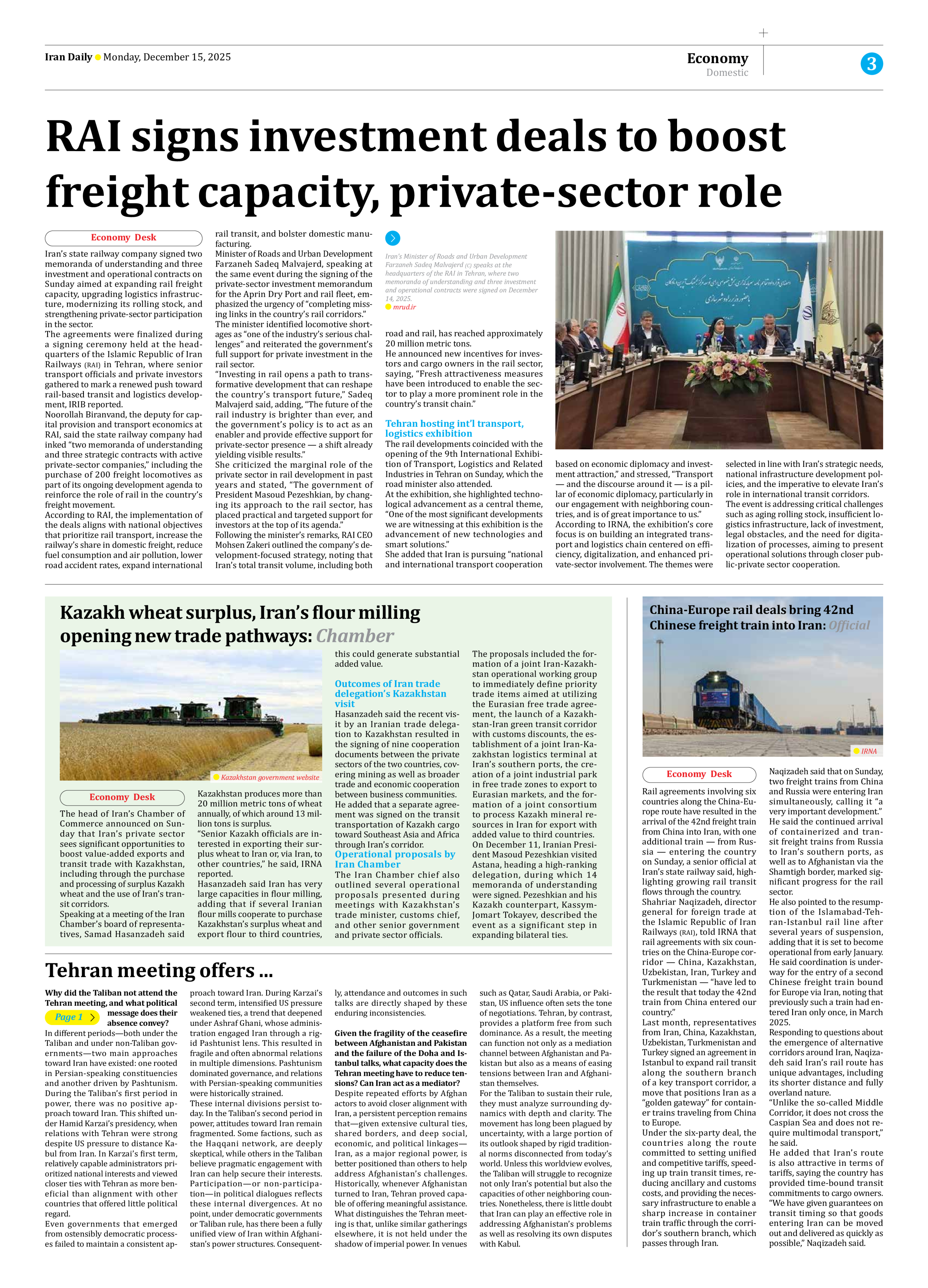


China-Europe rail deals bring 42nd Chinese freight train into Iran: Official
Rail agreements involving six countries along the China-Europe route have resulted in the arrival of the 42nd freight train from China into Iran, with one additional train — from Russia — entering the country on Sunday, a senior official at Iran’s state railway said, highlighting growing rail transit flows through the country.
Shahriar Naqizadeh, director general for foreign trade at the Islamic Republic of Iran Railways (RAI), told IRNA that rail agreements with six countries on the China-Europe corridor — China, Kazakhstan, Uzbekistan, Iran, Turkey and Turkmenistan — “have led to the result that today the 42nd train from China entered our country.”
Last month, representatives from Iran, China, Kazakhstan, Uzbekistan, Turkmenistan and Turkey signed an agreement in Istanbul to expand rail transit along the southern branch of a key transport corridor, a move that positions Iran as a “golden gateway” for container trains traveling from China to Europe.
Under the six-party deal, the countries along the route committed to setting unified and competitive tariffs, speeding up train transit times, reducing ancillary and customs costs, and providing the necessary infrastructure to enable a sharp increase in container train traffic through the corridor’s southern branch, which passes through Iran.
Naqizadeh said that on Sunday, two freight trains from China and Russia were entering Iran simultaneously, calling it “a very important development.”
He said the continued arrival of containerized and transit freight trains from Russia to Iran’s southern ports, as well as to Afghanistan via the Shamtigh border, marked significant progress for the rail sector.
He also pointed to the resumption of the Islamabad-Tehran-Istanbul rail line after several years of suspension, adding that it is set to become operational from early January.
He said coordination is underway for the entry of a second Chinese freight train bound for Europe via Iran, noting that previously such a train had entered Iran only once, in March 2025.
Responding to questions about the emergence of alternative corridors around Iran, Naqizadeh said Iran’s rail route has unique advantages, including its shorter distance and fully overland nature.
“Unlike the so-called Middle Corridor, it does not cross the Caspian Sea and does not require multimodal transport,” he said.
He added that Iran’s route is also attractive in terms of tariffs, saying the country has provided time-bound transit commitments to cargo owners. “We have given guarantees on transit timing so that goods entering Iran can be moved out and delivered as quickly as possible,” Naqizadeh said.