





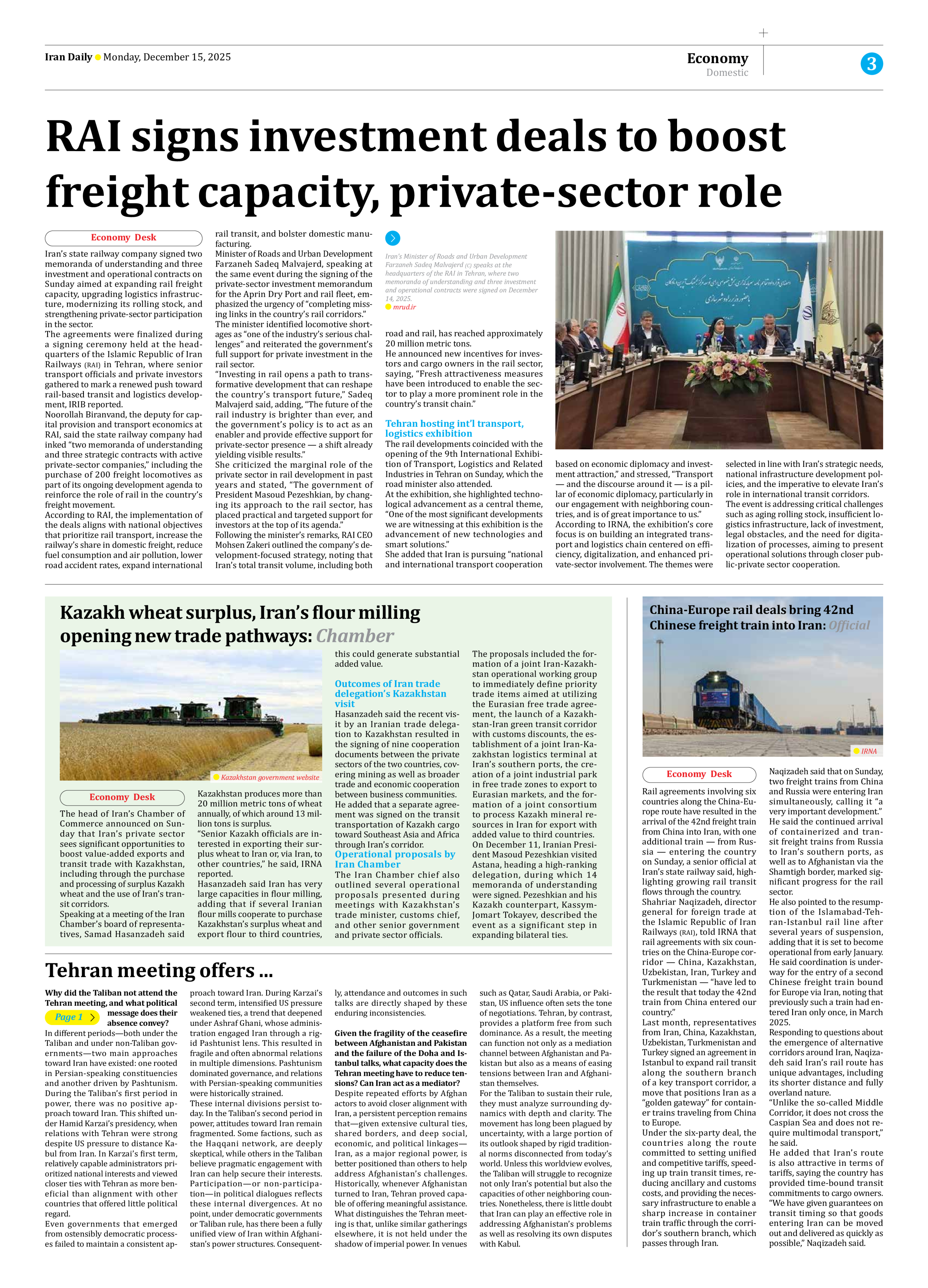


Kazakh wheat surplus, Iran’s flour milling opening new trade pathways: Chamber
The head of Iran’s Chamber of Commerce announced on Sunday that Iran’s private sector sees significant opportunities to boost value-added exports and transit trade with Kazakhstan, including through the purchase and processing of surplus Kazakh wheat and the use of Iran’s transit corridors.
Speaking at a meeting of the Iran Chamber’s board of representatives, Samad Hasanzadeh said Kazakhstan produces more than 20 million metric tons of wheat annually, of which around 13 million tons is surplus.
“Senior Kazakh officials are interested in exporting their surplus wheat to Iran or, via Iran, to other countries,” he said, IRNA reported.
Hasanzadeh said Iran has very large capacities in flour milling, adding that if several Iranian flour mills cooperate to purchase Kazakhstan’s surplus wheat and export flour to third countries, this could generate substantial added value.
Outcomes of Iran trade delegation’s Kazakhstan visit
Hasanzadeh said the recent visit by an Iranian trade delegation to Kazakhstan resulted in the signing of nine cooperation documents between the private sectors of the two countries, covering mining as well as broader trade and economic cooperation between business communities.
He added that a separate agreement was signed on the transit transportation of Kazakh cargo toward Southeast Asia and Africa through Iran’s corridor.
Operational proposals by Iran Chamber
The Iran Chamber chief also outlined several operational proposals presented during meetings with Kazakhstan’s trade minister, customs chief, and other senior government and private sector officials.
The proposals included the formation of a joint Iran-Kazakhstan operational working group to immediately define priority trade items aimed at utilizing the Eurasian free trade agreement, the launch of a Kazakhstan-Iran green transit corridor with customs discounts, the establishment of a joint Iran-Kazakhstan logistics terminal at Iran’s southern ports, the creation of a joint industrial park in free trade zones to export to Eurasian markets, and the formation of a joint consortium to process Kazakh mineral resources in Iran for export with added value to third countries.
On December 11, Iranian President Masoud Pezeshkian visited Astana, heading a high-ranking delegation, during which 14 memoranda of understanding were signed. Pezeshkian and his Kazakh counterpart, Kassym-Jomart Tokayev, described the event as a significant step in expanding bilateral ties.