







RAI signs investment deals to boost freight capacity, private-sector role
Iran’s state railway company signed two memoranda of understanding and three investment and operational contracts on Sunday aimed at expanding rail freight capacity, upgrading logistics infrastructure, modernizing its rolling stock, and strengthening private-sector participation in the sector.
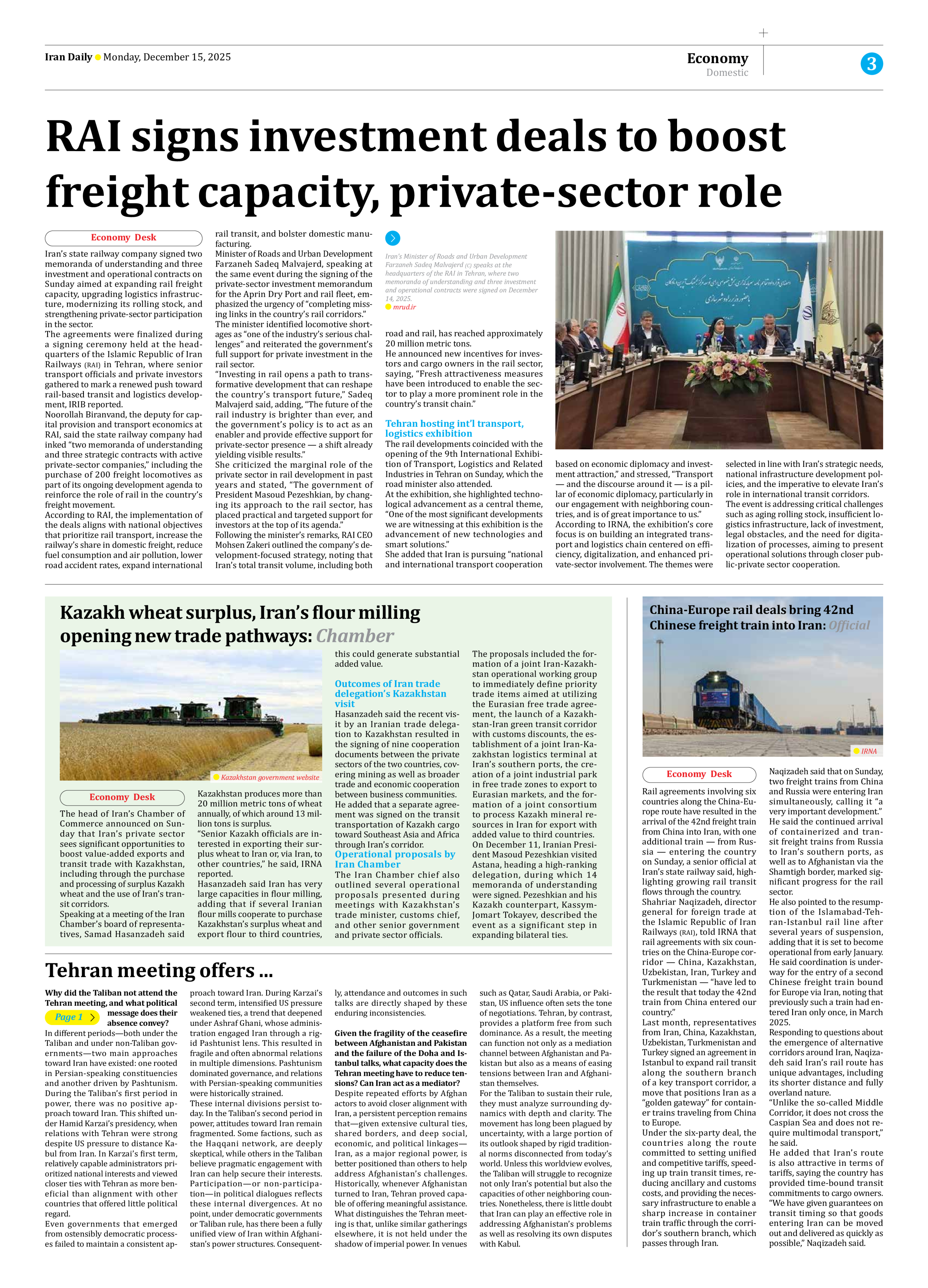
The agreements were finalized during a signing ceremony held at the headquarters of the Islamic Republic of Iran Railways (RAI) in Tehran, where senior transport officials and private investors gathered to mark a renewed push toward rail-based transit and logistics development, IRIB reported.
Noorollah Biranvand, the deputy for capital provision and transport economics at RAI, said the state railway company had inked “two memoranda of understanding and three strategic contracts with active private-sector companies,” including the purchase of 200 freight locomotives as part of its ongoing development agenda to reinforce the role of rail in the country’s freight movement.
According to RAI, the implementation of the deals aligns with national objectives that prioritize rail transport, increase the railway’s share in domestic freight, reduce fuel consumption and air pollution, lower road accident rates, expand international rail transit, and bolster domestic manufacturing.
Minister of Roads and Urban Development Farzaneh Sadeq Malvajerd, speaking at the same event during the signing of the private-sector investment memorandum for the Aprin Dry Port and rail fleet, emphasized the urgency of “completing missing links in the country’s rail corridors.”
The minister identified locomotive shortages as “one of the industry’s serious challenges” and reiterated the government’s full support for private investment in the rail sector.
“Investing in rail opens a path to transformative development that can reshape the country’s transport future,” Sadeq Malvajerd said, adding, “The future of the rail industry is brighter than ever, and the government’s policy is to act as an enabler and provide effective support for private-sector presence — a shift already yielding visible results.”
She criticized the marginal role of the private sector in rail development in past years and stated, “The government of President Masoud Pezeshkian, by changing its approach to the rail sector, has placed practical and targeted support for investors at the top of its agenda.”
Following the minister’s remarks, RAI CEO Mohsen Zakeri outlined the company’s development-focused strategy, noting that Iran’s total transit volume, including both road and rail, has reached approximately 20 million metric tons.
He announced new incentives for investors and cargo owners in the rail sector, saying, “Fresh attractiveness measures have been introduced to enable the sector to play a more prominent role in the country’s transit chain.”
Tehran hosting int’l transport, logistics exhibition
The rail developments coincided with the opening of the 9th International Exhibition of Transport, Logistics and Related Industries in Tehran on Sunday, which the road minister also attended.
At the exhibition, she highlighted technological advancement as a central theme, “One of the most significant developments we are witnessing at this exhibition is the advancement of new technologies and smart solutions.”
She added that Iran is pursuing “national and international transport cooperation based on economic diplomacy and investment attraction,” and stressed, “Transport — and the discourse around it — is a pillar of economic diplomacy, particularly in our engagement with neighboring countries, and is of great importance to us.”
According to IRNA, the exhibition’s core focus is on building an integrated transport and logistics chain centered on efficiency, digitalization, and enhanced private-sector involvement. The themes were selected in line with Iran’s strategic needs, national infrastructure development policies, and the imperative to elevate Iran’s role in international transit corridors.
The event is addressing critical challenges such as aging rolling stock, insufficient logistics infrastructure, lack of investment, legal obstacles, and the need for digitalization of processes, aiming to present operational solutions through closer public-private sector cooperation.