





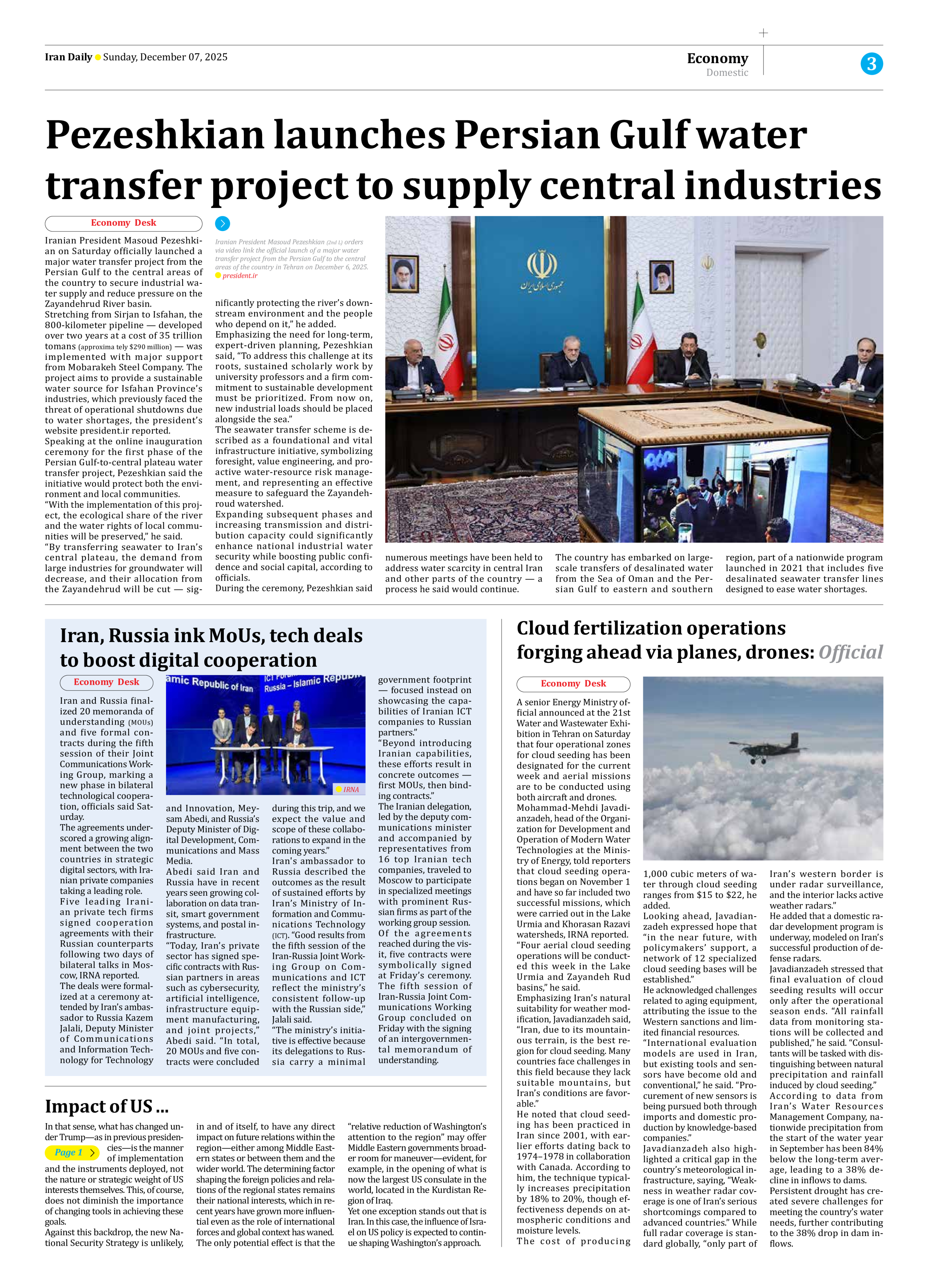


Cloud fertilization operations forging ahead via planes, drones: Official
A senior Energy Ministry official announced at the 21st Water and Wastewater Exhibition in Tehran on Saturday that four operational zones for cloud seeding has been designated for the current week and aerial missions are to be conducted using both aircraft and drones.
Mohammad-Mehdi Javadianzadeh, head of the Organization for Development and Operation of Modern Water Technologies at the Ministry of Energy, told reporters that cloud seeding operations began on November 1 and have so far included two successful missions, which were carried out in the Lake Urmia and Khorasan Razavi watersheds, IRNA reported.
“Four aerial cloud seeding operations will be conducted this week in the Lake Urmia and Zayandeh Rud basins,” he said.
Emphasizing Iran’s natural suitability for weather modification, Javadianzadeh said, “Iran, due to its mountainous terrain, is the best region for cloud seeding. Many countries face challenges in this field because they lack suitable mountains, but Iran’s conditions are favorable.”
He noted that cloud seeding has been practiced in Iran since 2001, with earlier efforts dating back to 1974–1978 in collaboration with Canada. According to him, the technique typically increases precipitation by 18% to 20%, though effectiveness depends on atmospheric conditions and moisture levels.
The cost of producing 1,000 cubic meters of water through cloud seeding ranges from $15 to $22, he added.
Looking ahead, Javadianzadeh expressed hope that “in the near future, with policymakers’ support, a network of 12 specialized cloud seeding bases will be established.”
He acknowledged challenges related to aging equipment, attributing the issue to the Western sanctions and limited financial resources.
“International evaluation models are used in Iran, but existing tools and sensors have become old and conventional,” he said. “Procurement of new sensors is being pursued both through imports and domestic production by knowledge-based companies.”
Javadianzadeh also highlighted a critical gap in the country’s meteorological infrastructure, saying, “Weakness in weather radar coverage is one of Iran’s serious shortcomings compared to advanced countries.” While full radar coverage is standard globally, “only part of Iran’s western border is under radar surveillance, and the interior lacks active weather radars.”
He added that a domestic radar development program is underway, modeled on Iran’s successful production of defense radars.
Javadianzadeh stressed that final evaluation of cloud seeding results will occur only after the operational season ends. “All rainfall data from monitoring stations will be collected and published,” he said. “Consultants will be tasked with distinguishing between natural precipitation and rainfall induced by cloud seeding.”
According to data from Iran’s Water Resources Management Company, nationwide precipitation from the start of the water year in September has been 84% below the long-term average, leading to a 38% decline in inflows to dams.
Persistent drought has created severe challenges for meeting the country’s water needs, further contributing to the 38% drop in dam inflows.