







Pezeshkian launches Persian Gulf water transfer project to supply central industries
Iranian President Masoud Pezeshkian on Saturday officially launched a major water transfer project from the Persian Gulf to the central areas of the country to secure industrial water supply and reduce pressure on the Zayandehrud River basin.
Stretching from Sirjan to Isfahan, the 800-kilometer pipeline — developed over two years at a cost of 35 trillion tomans (approxima tely $290 million) — was implemented with major support from Mobarakeh Steel Company. The project aims to provide a sustainable water source for Isfahan Province’s industries, which previously faced the threat of operational shutdowns due to water shortages, the president’s website president.ir reported.
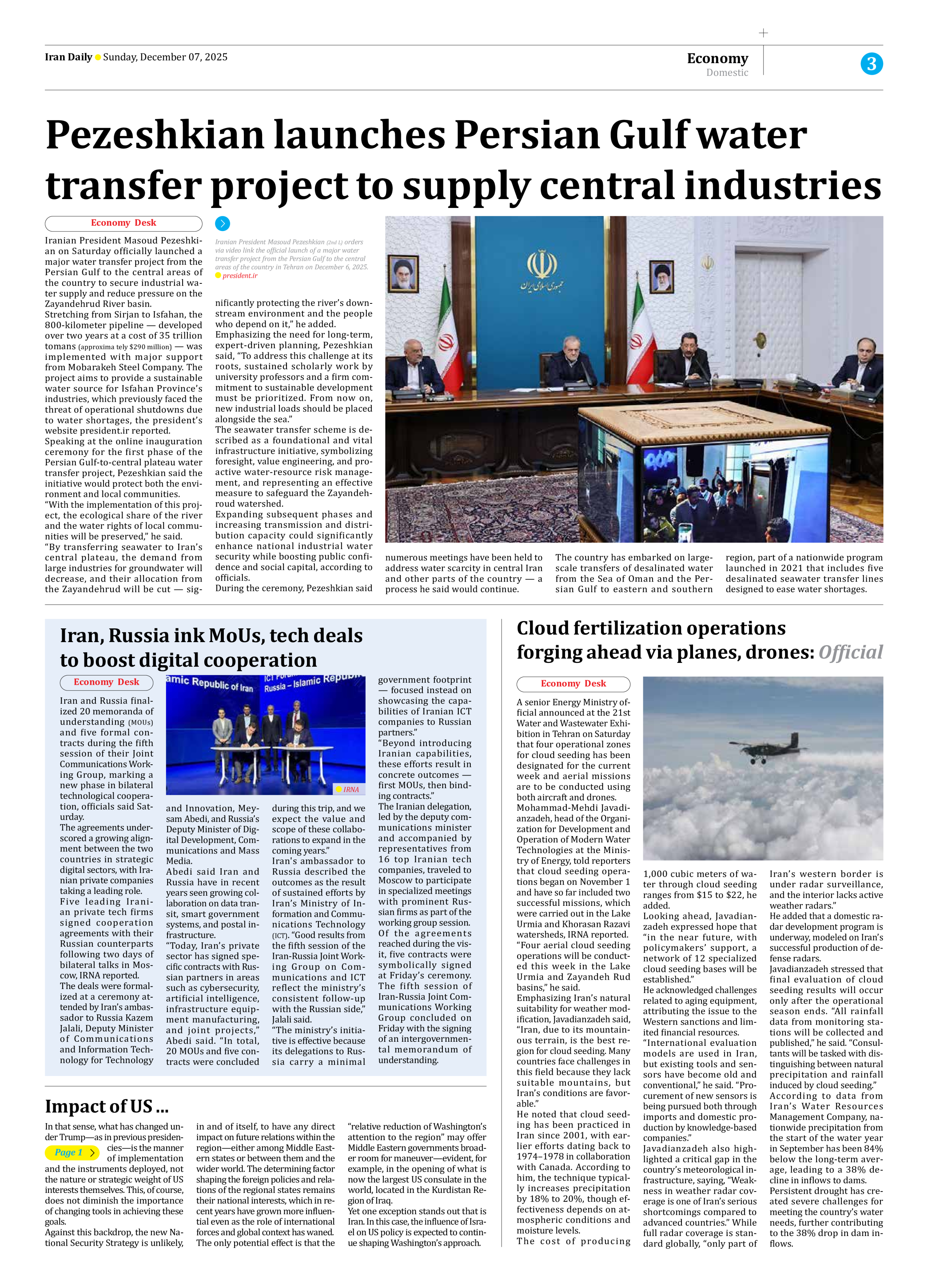
Speaking at the online inauguration ceremony for the first phase of the Persian Gulf-to-central plateau water transfer project, Pezeshkian said the initiative would protect both the environment and local communities.
“With the implementation of this project, the ecological share of the river and the water rights of local communities will be preserved,” he said.
“By transferring seawater to Iran’s central plateau, the demand from large industries for groundwater will decrease, and their allocation from the Zayandehrud will be cut — significantly protecting the river’s downstream environment and the people who depend on it,” he added.
Emphasizing the need for long-term, expert-driven planning, Pezeshkian said, “To address this challenge at its roots, sustained scholarly work by university professors and a firm commitment to sustainable development must be prioritized. From now on, new industrial loads should be placed alongside the sea.”
The seawater transfer scheme is described as a foundational and vital infrastructure initiative, symbolizing foresight, value engineering, and proactive water-resource risk management, and representing an effective measure to safeguard the Zayandehroud watershed.
Expanding subsequent phases and increasing transmission and distribution capacity could significantly enhance national industrial water security while boosting public confidence and social capital, according to officials.
During the ceremony, Pezeshkian said numerous meetings have been held to address water scarcity in central Iran and other parts of the country — a process he said would continue.
The country has embarked on large-scale transfers of desalinated water from the Sea of Oman and the Persian Gulf to eastern and southern region, part of a nationwide program launched in 2021 that includes five desalinated seawater transfer lines designed to ease water shortages.