




Iranian handicrafts gain international recognition at Hanoi festival
Iran’s participation in the Global Festival for the Conservation and Development of Craft Villages in Hanoi, Vietnam, held from November 13 to 16, 2026, resulted in several notable achievements, including an international artist residency award for an Iranian artisan, representation on the jury of a global handicrafts competition, and the presentation of proposals aimed at strengthening the country’s handicrafts education and development programs.
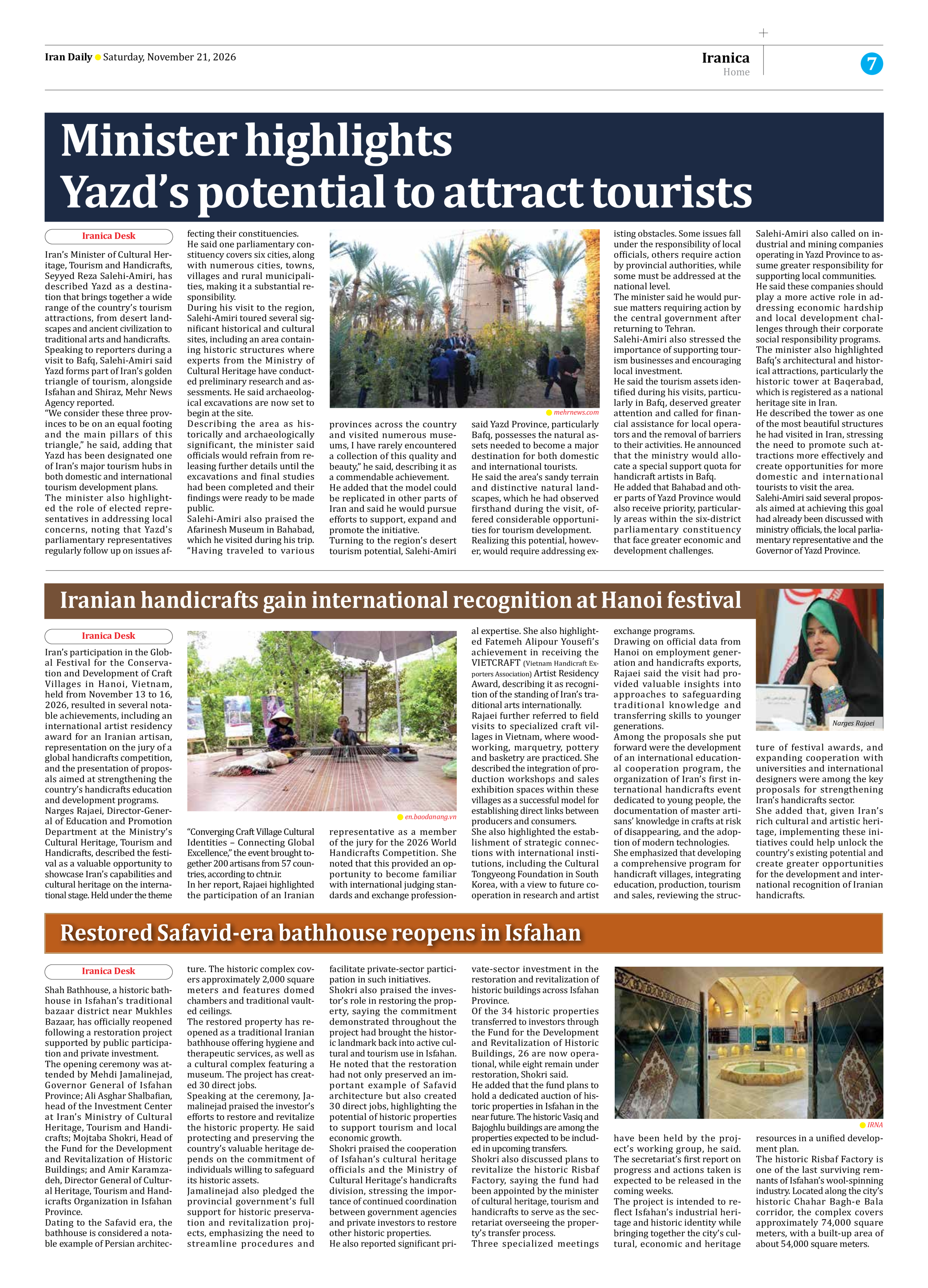
Narges Rajaei, Director-General of Education and Promotion Department at the Ministry’s Cultural Heritage, Tourism and Handicrafts, described the festival as a valuable opportunity to showcase Iran’s capabilities and cultural heritage on the international stage. Held under the theme “Converging Craft Village Cultural Identities – Connecting Global Excellence,” the event brought together 200 artisans from 57 countries, according to chtn.ir.
In her report, Rajaei highlighted the participation of an Iranian representative as a member of the jury for the 2026 World Handicrafts Competition. She noted that this provided an opportunity to become familiar with international judging standards and exchange professional expertise. She also highlighted Fatemeh Alipour Yousefi’s achievement in receiving the VIETCRAFT (Vietnam Handicraft Exporters Association) Artist Residency Award, describing it as recognition of the standing of Iran’s traditional arts internationally.
Rajaei further referred to field visits to specialized craft villages in Vietnam, where woodworking, marquetry, pottery and basketry are practiced. She described the integration of production workshops and sales exhibition spaces within these villages as a successful model for establishing direct links between producers and consumers.
She also highlighted the establishment of strategic connections with international institutions, including the Cultural Tongyeong Foundation in South Korea, with a view to future cooperation in research and artist exchange programs.
Drawing on official data from Hanoi on employment generation and handicrafts exports, Rajaei said the visit had provided valuable insights into approaches to safeguarding traditional knowledge and transferring skills to younger generations.
Among the proposals she put forward were the development of an international educational cooperation program, the organization of Iran’s first international handicrafts event dedicated to young people, the documentation of master artisans’ knowledge in crafts at risk of disappearing, and the adoption of modern technologies.
She emphasized that developing a comprehensive program for handicraft villages, integrating education, production, tourism and sales, reviewing the structure of festival awards, and expanding cooperation with universities and international designers were among the key proposals for strengthening Iran’s handicrafts sector.
She added that, given Iran’s rich cultural and artistic heritage, implementing these initiatives could help unlock the country’s existing potential and create greater opportunities for the development and international recognition of Iranian handicrafts.