




Minister highlights Yazd’s potential to attract tourists
Iran’s Minister of Cultural Heritage, Tourism and Handicrafts, Seyyed Reza Salehi-Amiri, has described Yazd as a destination that brings together a wide range of the country’s tourism attractions, from desert landscapes and ancient civilization to traditional arts and handicrafts.
Speaking to reporters during a visit to Bafq, Salehi-Amiri said Yazd forms part of Iran’s golden triangle of tourism, alongside Isfahan and Shiraz, Mehr News Agency reported.
“We consider these three provinces to be on an equal footing and the main pillars of this triangle,” he said, adding that Yazd has been designated one of Iran’s major tourism hubs in both domestic and international tourism development plans.
The minister also highlighted the role of elected representatives in addressing local concerns, noting that Yazd’s parliamentary representatives regularly follow up on issues affecting their constituencies.
He said one parliamentary constituency covers six cities, along with numerous cities, towns, villages and rural municipalities, making it a substantial responsibility.
During his visit to the region, Salehi-Amiri toured several significant historical and cultural sites, including an area containing historic structures where experts from the Ministry of Cultural Heritage have conducted preliminary research and assessments. He said archaeological excavations are now set to begin at the site.
Describing the area as historically and archaeologically significant, the minister said officials would refrain from releasing further details until the excavations and final studies had been completed and their findings were ready to be made public.
Salehi-Amiri also praised the Afarinesh Museum in Bahabad, which he visited during his trip.
“Having traveled to various provinces across the country and visited numerous museums, I have rarely encountered a collection of this quality and beauty,” he said, describing it as a commendable achievement.
He added that the model could be replicated in other parts of Iran and said he would pursue efforts to support, expand and promote the initiative.
Turning to the region’s desert tourism potential, Salehi-Amiri said Yazd Province, particularly Bafq, possesses the natural assets needed to become a major destination for both domestic and international tourists.
He said the area’s sandy terrain and distinctive natural landscapes, which he had observed firsthand during the visit, offered considerable opportunities for tourism development.
Realizing this potential, however, would require addressing existing obstacles. Some issues fall under the responsibility of local officials, others require action by provincial authorities, while some must be addressed at the national level.
The minister said he would pursue matters requiring action by the central government after returning to Tehran.
Salehi-Amiri also stressed the importance of supporting tourism businesses and encouraging local investment.
He said the tourism assets identified during his visits, particularly in Bafq, deserved greater attention and called for financial assistance for local operators and the removal of barriers to their activities. He announced that the ministry would allocate a special support quota for handicraft artists in Bafq.
He added that Bahabad and other parts of Yazd Province would also receive priority, particularly areas within the six-district parliamentary constituency that face greater economic and development challenges.
Salehi-Amiri also called on industrial and mining companies operating in Yazd Province to assume greater responsibility for supporting local communities.
He said these companies should play a more active role in addressing economic hardship and local development challenges through their corporate social responsibility programs.
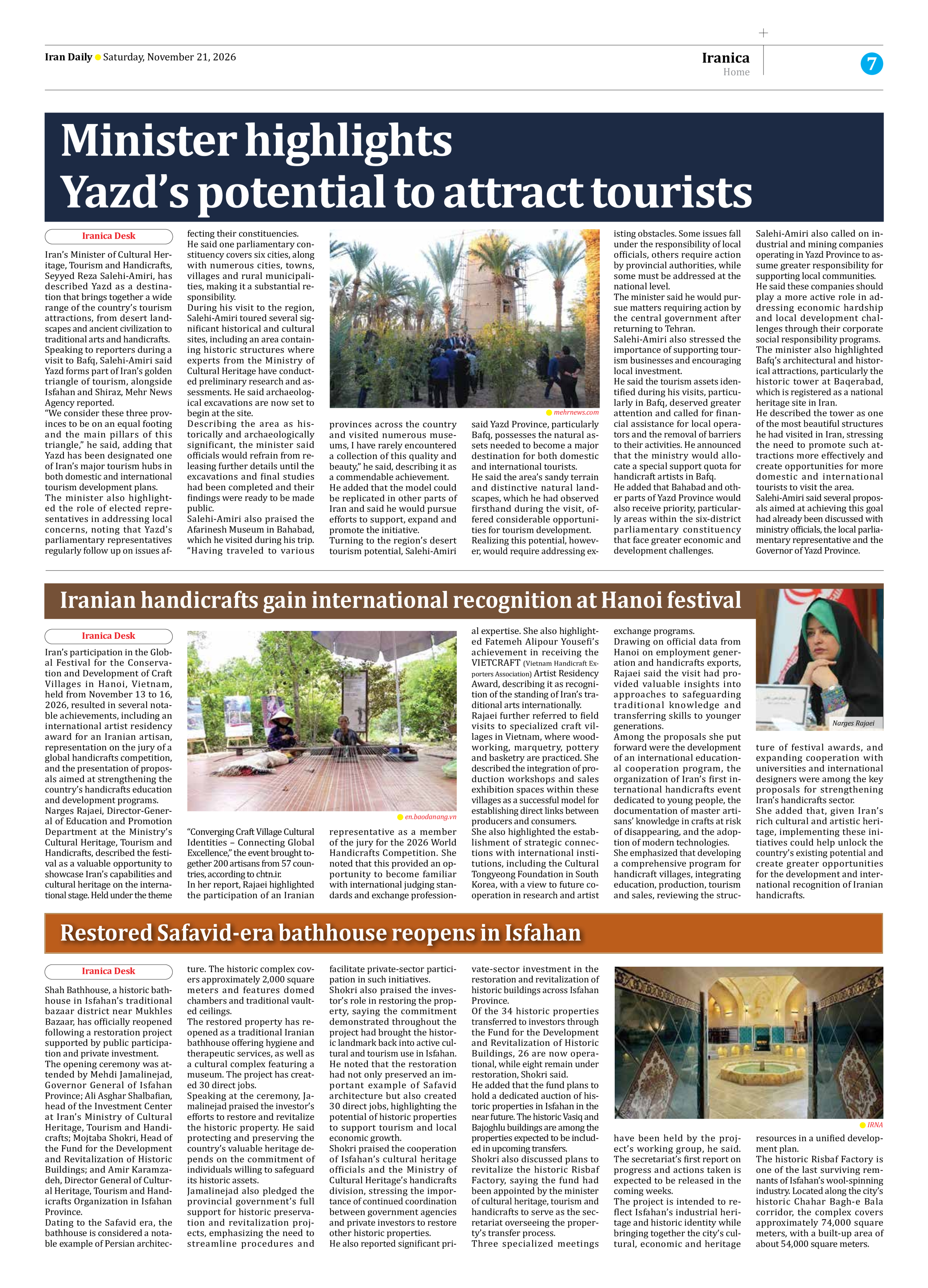
The minister also highlighted Bafq’s architectural and historical attractions, particularly the historic tower at Baqerabad, which is registered as a national heritage site in Iran.
He described the tower as one of the most beautiful structures he had visited in Iran, stressing the need to promote such attractions more effectively and create opportunities for more domestic and international tourists to visit the area.
Salehi-Amiri said several proposals aimed at achieving this goal had already been discussed with ministry officials, the local parliamentary representative and the Governor of Yazd Province.