


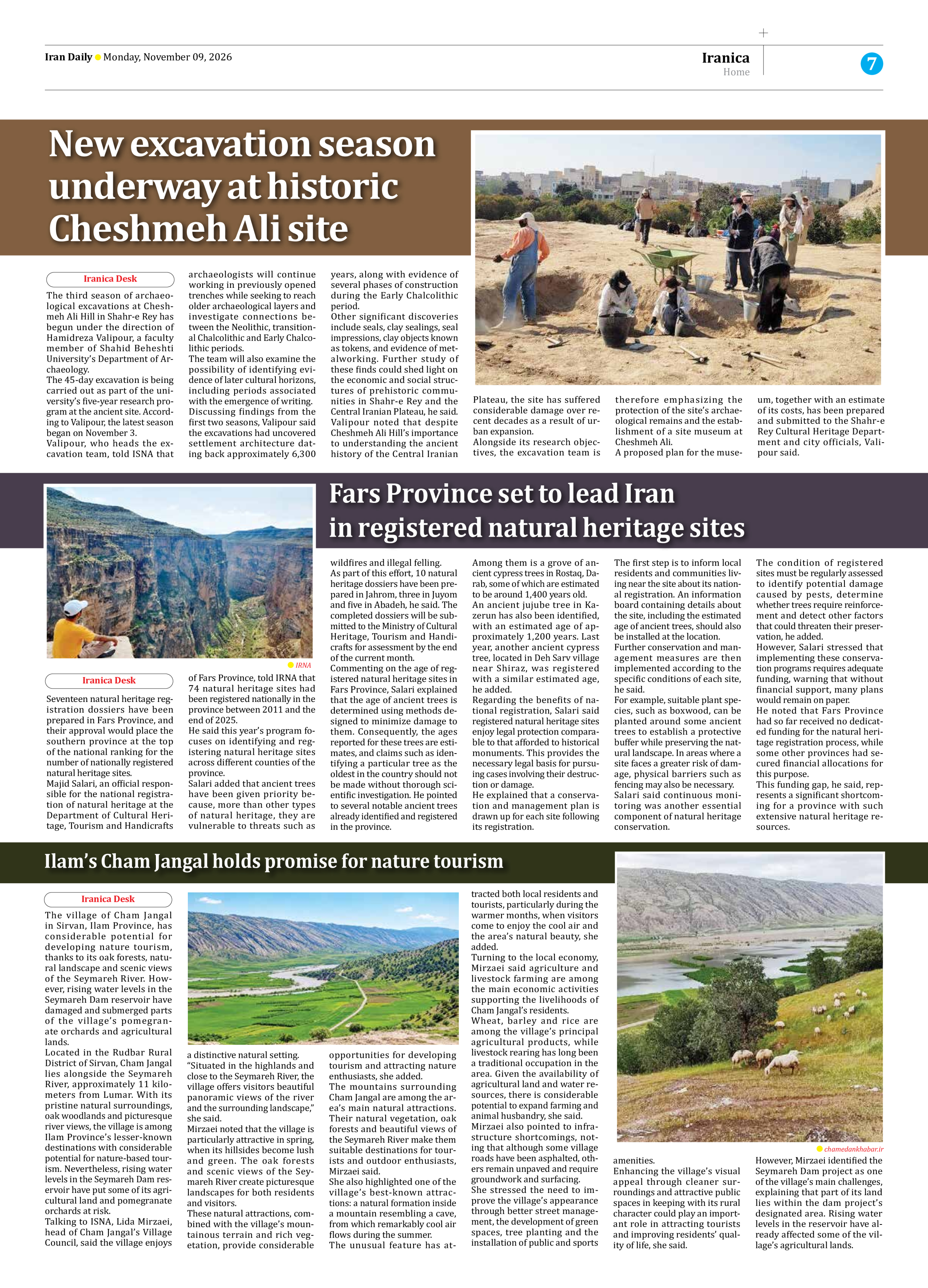


New excavation season underway at historic Cheshmeh Ali site
The third season of archaeological excavations at Cheshmeh Ali Hill in Shahr-e Rey has begun under the direction of Hamidreza Valipour, a faculty member of Shahid Beheshti University’s Department of Archaeology.
The 45-day excavation is being carried out as part of the university’s five-year research program at the ancient site. According to Valipour, the latest season began on November 3.
Valipour, who heads the excavation team, told ISNA that archaeologists will continue working in previously opened trenches while seeking to reach older archaeological layers and investigate connections between the Neolithic, transitional Chalcolithic and Early Chalcolithic periods.
The team will also examine the possibility of identifying evidence of later cultural horizons, including periods associated with the emergence of writing.
Discussing findings from the first two seasons, Valipour said the excavations had uncovered settlement architecture dating back approximately 6,300 years, along with evidence of several phases of construction during the Early Chalcolithic period.
Other significant discoveries include seals, clay sealings, seal impressions, clay objects known as tokens, and evidence of metalworking. Further study of these finds could shed light on the economic and social structures of prehistoric communities in Shahr-e Rey and the Central Iranian Plateau, he said.
Valipour noted that despite Cheshmeh Ali Hill’s importance to understanding the ancient history of the Central Iranian Plateau, the site has suffered considerable damage over recent decades as a result of urban expansion.
Alongside its research objectives, the excavation team is therefore emphasizing the protection of the site’s archaeological remains and the establishment of a site museum at Cheshmeh Ali.
A proposed plan for the museum, together with an estimate of its costs, has been prepared and submitted to the Shahr-e Rey Cultural Heritage Department and city officials, Valipour said.