




Iran pushes for smoother trade, transit with Turkey, Pakistan
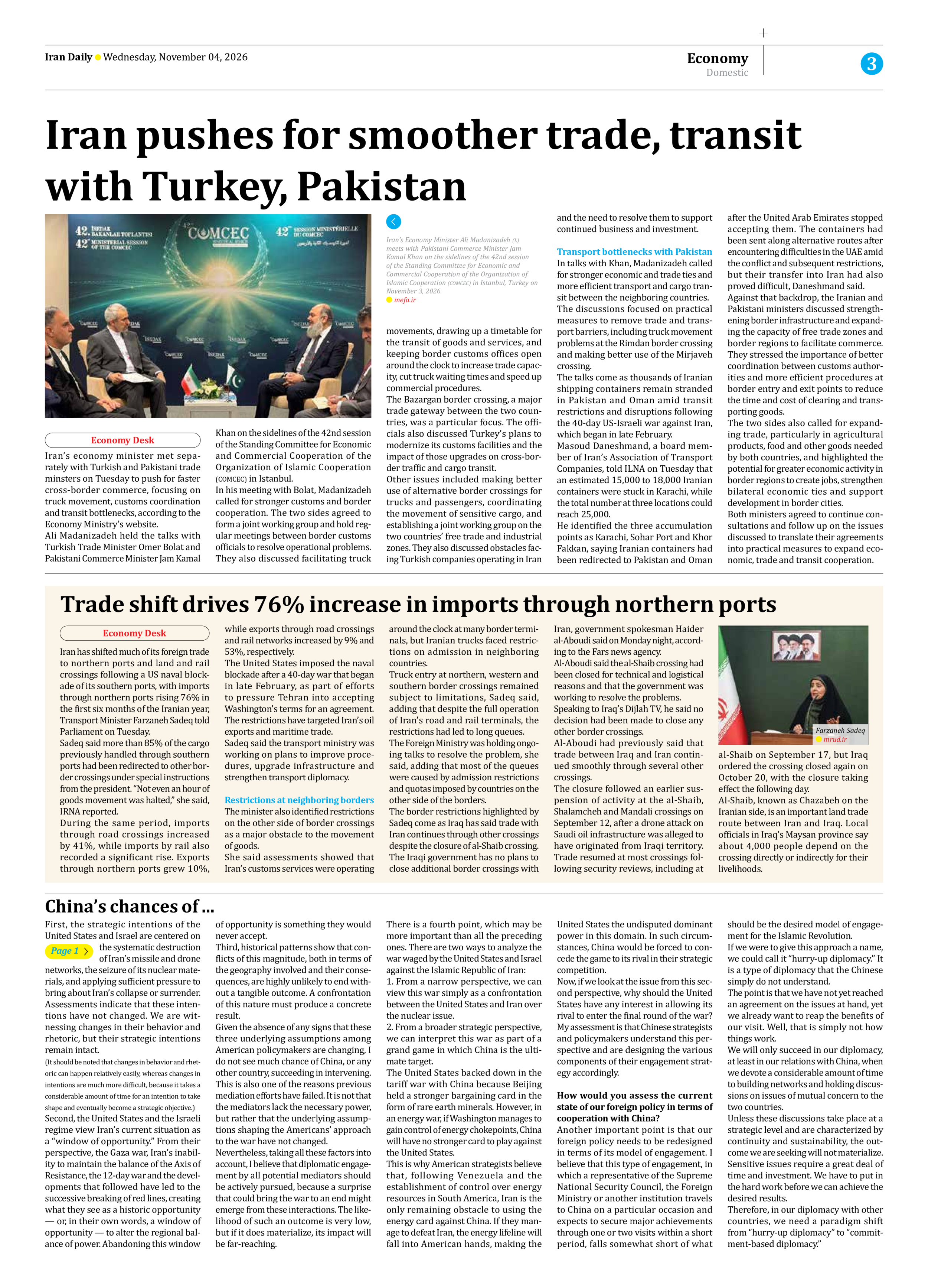
Iran’s economy minister met separately with Turkish and Pakistani trade minsters on Tuesday to push for faster cross-border commerce, focusing on truck movement, customs coordination and transit bottlenecks, according to the Economy Ministry’s website.
Ali Madanizadeh held the talks with Turkish Trade Minister Omer Bolat and Pakistani Commerce Minister Jam Kamal Khan on the sidelines of the 42nd session of the Standing Committee for Economic and Commercial Cooperation of the Organization of Islamic Cooperation (COMCEC) in Istanbul.
In his meeting with Bolat, Madanizadeh called for stronger customs and border cooperation. The two sides agreed to form a joint working group and hold regular meetings between border customs officials to resolve operational problems.
They also discussed facilitating truck movements, drawing up a timetable for the transit of goods and services, and keeping border customs offices open around the clock to increase trade capacity, cut truck waiting times and speed up commercial procedures.
The Bazargan border crossing, a major trade gateway between the two countries, was a particular focus. The officials also discussed Turkey’s plans to modernize its customs facilities and the impact of those upgrades on cross-border traffic and cargo transit.
Other issues included making better use of alternative border crossings for trucks and passengers, coordinating the movement of sensitive cargo, and establishing a joint working group on the two countries’ free trade and industrial zones. They also discussed obstacles facing Turkish companies operating in Iran and the need to resolve them to support continued business and investment.
Transport bottlenecks with Pakistan
In talks with Khan, Madanizadeh called for stronger economic and trade ties and more efficient transport and cargo transit between the neighboring countries.
The discussions focused on practical measures to remove trade and transport barriers, including truck movement problems at the Rimdan border crossing and making better use of the Mirjaveh crossing.
The talks come as thousands of Iranian shipping containers remain stranded in Pakistan and Oman amid transit restrictions and disruptions following the 40-day US-Israeli war against Iran, which began in late February.
Masoud Daneshmand, a board member of Iran’s Association of Transport Companies, told ILNA on Tuesday that an estimated 15,000 to 18,000 Iranian containers were stuck in Karachi, while the total number at three locations could reach 25,000.
He identified the three accumulation points as Karachi, Sohar Port and Khor Fakkan, saying Iranian containers had been redirected to Pakistan and Oman after the United Arab Emirates stopped accepting them. The containers had been sent along alternative routes after encountering difficulties in the UAE amid the conflict and subsequent restrictions, but their transfer into Iran had also proved difficult, Daneshmand said.
Against that backdrop, the Iranian and Pakistani ministers discussed strengthening border infrastructure and expanding the capacity of free trade zones and border regions to facilitate commerce. They stressed the importance of better coordination between customs authorities and more efficient procedures at border entry and exit points to reduce the time and cost of clearing and transporting goods.
The two sides also called for expanding trade, particularly in agricultural products, food and other goods needed by both countries, and highlighted the potential for greater economic activity in border regions to create jobs, strengthen bilateral economic ties and support development in border cities.
Both ministers agreed to continue consultations and follow up on the issues discussed to translate their agreements into practical measures to expand economic, trade and transit cooperation.