




UNESCO inscription decision on Masouleh to follow expert evaluations
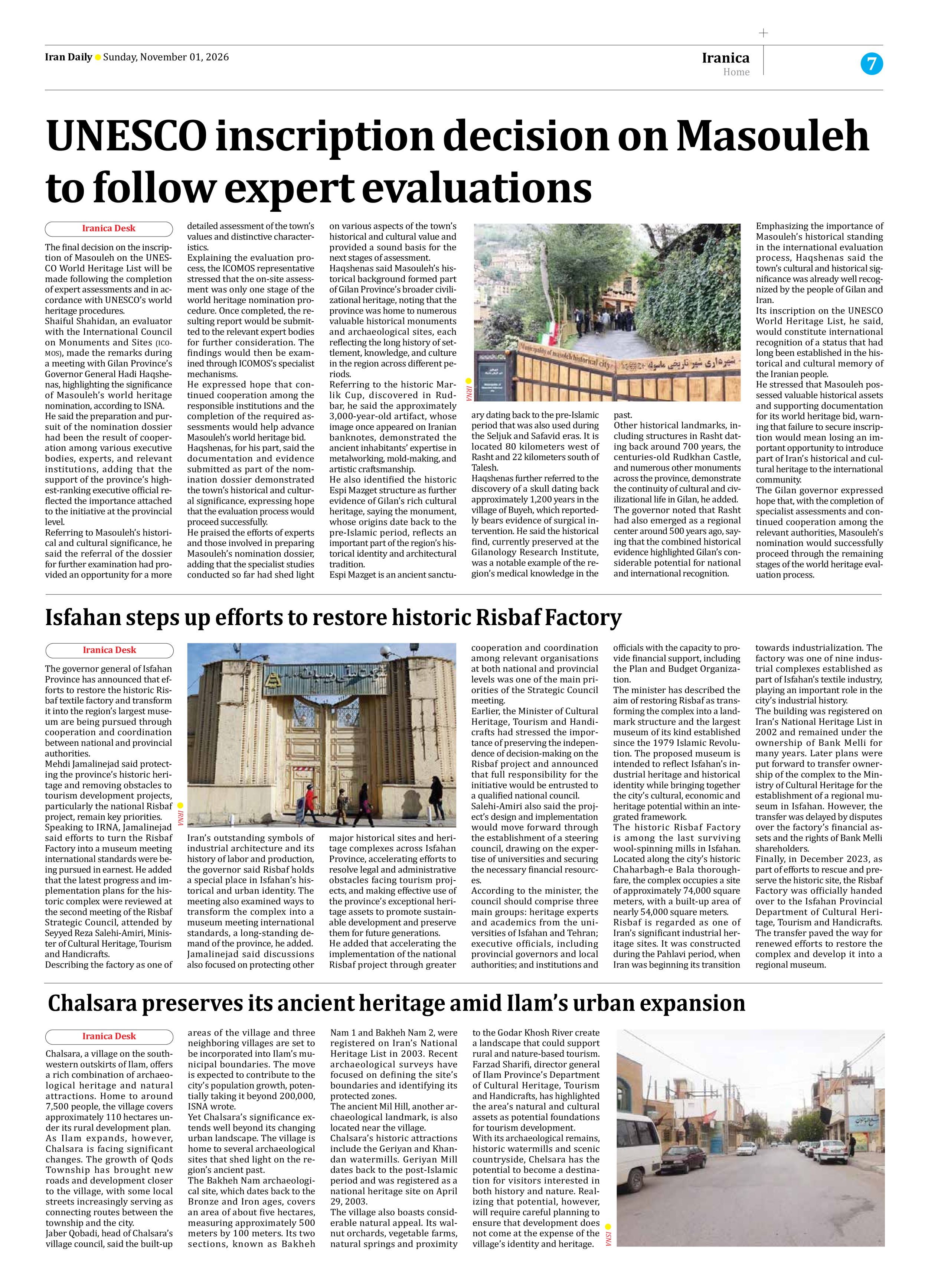
The final decision on the inscription of Masouleh on the UNESCO World Heritage List will be made following the completion of expert assessments and in accordance with UNESCO’s world heritage procedures.
Shaiful Shahidan, an evaluator with the International Council on Monuments and Sites (ICOMOS), made the remarks during a meeting with Gilan Province’s Governor General Hadi Haqshenas, highlighting the significance of Masouleh’s world heritage nomination, according to ISNA.
He said the preparation and pursuit of the nomination dossier had been the result of cooperation among various executive bodies, experts, and relevant institutions, adding that the support of the province’s highest-ranking executive official reflected the importance attached to the initiative at the provincial level.
Referring to Masouleh’s historical and cultural significance, he said the referral of the dossier for further examination had provided an opportunity for a more detailed assessment of the town’s values and distinctive characteristics.
Explaining the evaluation process, the ICOMOS representative stressed that the on-site assessment was only one stage of the world heritage nomination procedure. Once completed, the resulting report would be submitted to the relevant expert bodies for further consideration. The findings would then be examined through ICOMOS’s specialist mechanisms.
He expressed hope that continued cooperation among the responsible institutions and the completion of the required assessments would help advance Masouleh’s world heritage bid.
Haqshenas, for his part, said the documentation and evidence submitted as part of the nomination dossier demonstrated the town’s historical and cultural significance, expressing hope that the evaluation process would proceed successfully.
He praised the efforts of experts and those involved in preparing Masouleh’s nomination dossier, adding that the specialist studies conducted so far had shed light on various aspects of the town’s historical and cultural value and provided a sound basis for the next stages of assessment.
Haqshenas said Masouleh’s historical background formed part of Gilan Province’s broader civilizational heritage, noting that the province was home to numerous valuable historical monuments and archaeological sites, each reflecting the long history of settlement, knowledge, and culture in the region across different periods.
Referring to the historic Marlik Cup, discovered in Rudbar, he said the approximately 3,000-year-old artifact, whose image once appeared on Iranian banknotes, demonstrated the ancient inhabitants’ expertise in metalworking, mold-making, and artistic craftsmanship.
He also identified the historic Espi Mazget structure as further evidence of Gilan’s rich cultural heritage, saying the monument, whose origins date back to the pre-Islamic period, reflects an important part of the region’s historical identity and architectural tradition.
Espi Mazget is an ancient sanctuary dating back to the pre-Islamic period that was also used during the Seljuk and Safavid eras. It is located 80 kilometers west of Rasht and 22 kilometers south of Talesh.
Haqshenas further referred to the discovery of a skull dating back approximately 1,200 years in the village of Buyeh, which reportedly bears evidence of surgical intervention. He said the historical find, currently preserved at the Gilanology Research Institute, was a notable example of the region’s medical knowledge in the past.
Other historical landmarks, including structures in Rasht dating back around 700 years, the centuries-old Rudkhan Castle, and numerous other monuments across the province, demonstrate the continuity of cultural and civilizational life in Gilan, he added.
The governor noted that Rasht had also emerged as a regional center around 500 years ago, saying that the combined historical evidence highlighted Gilan’s considerable potential for national and international recognition.
Emphasizing the importance of Masouleh’s historical standing in the international evaluation process, Haqshenas said the town’s cultural and historical significance was already well recognized by the people of Gilan and Iran.
Its inscription on the UNESCO World Heritage List, he said, would constitute international recognition of a status that had long been established in the historical and cultural memory of the Iranian people.
He stressed that Masouleh possessed valuable historical assets and supporting documentation for its world heritage bid, warning that failure to secure inscription would mean losing an important opportunity to introduce part of Iran’s historical and cultural heritage to the international community.
The Gilan governor expressed hope that, with the completion of specialist assessments and continued cooperation among the relevant authorities, Masouleh’s nomination would successfully proceed through the remaining stages of the world heritage evaluation process.