





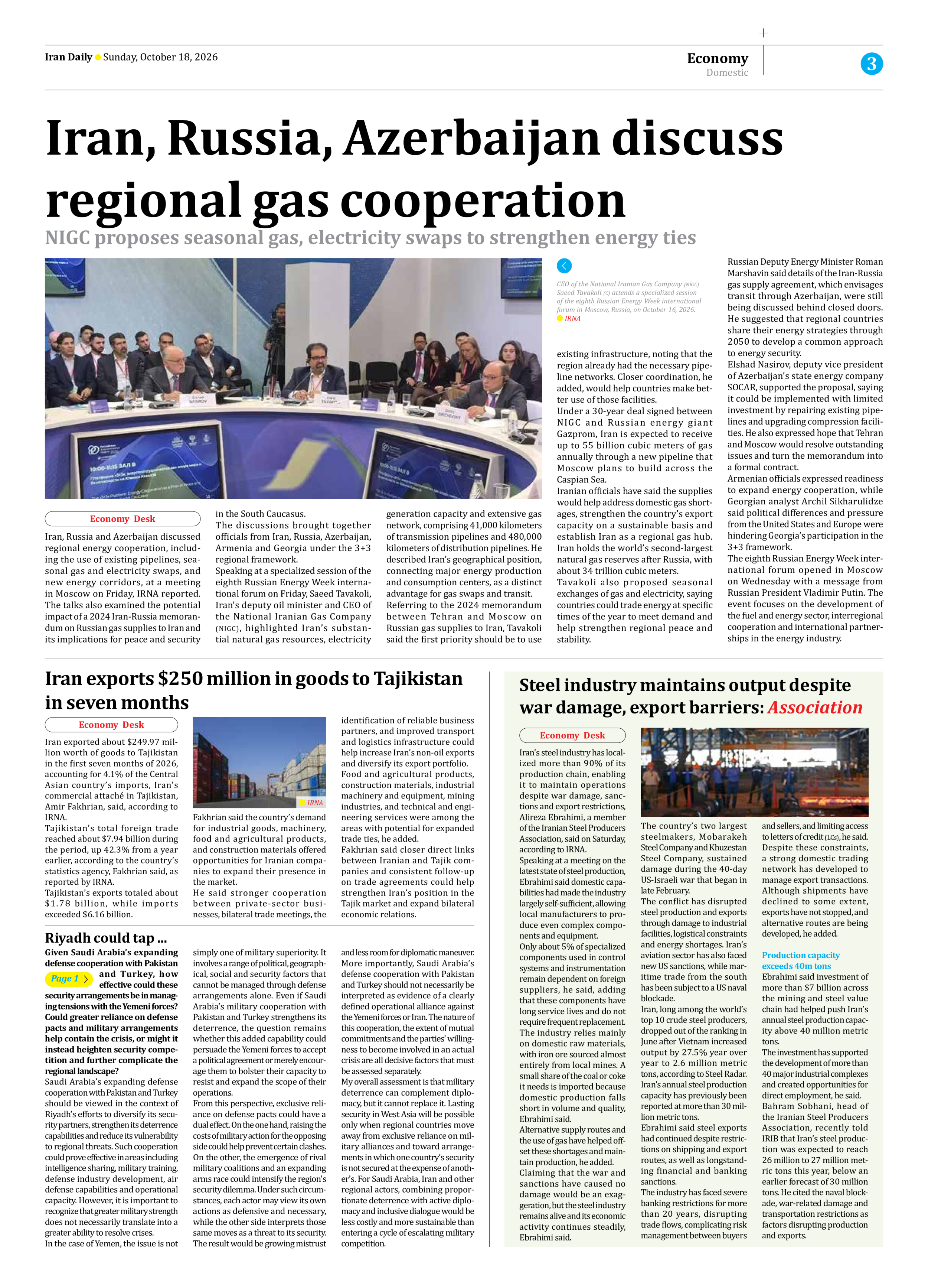


Steel industry maintains output despite war damage, export barriers: Association
Iran’s steel industry has localized more than 90% of its production chain, enabling it to maintain operations despite war damage, sanctions and export restrictions, Alireza Ebrahimi, a member of the Iranian Steel Producers Association, said on Saturday, according to IRNA.
Speaking at a meeting on the latest state of steel production, Ebrahimi said domestic capabilities had made the industry largely self-sufficient, allowing local manufacturers to produce even complex components and equipment.
Only about 5% of specialized components used in control systems and instrumentation remain dependent on foreign suppliers, he said, adding that these components have long service lives and do not require frequent replacement.
The industry relies mainly on domestic raw materials, with iron ore sourced almost entirely from local mines. A small share of the coal or coke it needs is imported because domestic production falls short in volume and quality, Ebrahimi said.
Alternative supply routes and the use of gas have helped offset these shortages and maintain production, he added.
Claiming that the war and sanctions have caused no damage would be an exaggeration, but the steel industry remains alive and its economic activity continues steadily, Ebrahimi said.
The country’s two largest steelmakers, Mobarakeh Steel Company and Khuzestan Steel Company, sustained damage during the 40-day US-Israeli war that began in late February.
The conflict has disrupted steel production and exports through damage to industrial facilities, logistical constraints and energy shortages. Iran’s aviation sector has also faced new US sanctions, while maritime trade from the south has been subject to a US naval blockade.
Iran, long among the world’s top 10 crude steel producers, dropped out of the ranking in June after Vietnam increased output by 27.5% year over year to 2.6 million metric tons, according to Steel Radar. Iran’s annual steel production capacity has previously been reported at more than 30 million metric tons.
Ebrahimi said steel exports had continued despite restrictions on shipping and export routes, as well as longstanding financial and banking sanctions.
The industry has faced severe banking restrictions for more than 20 years, disrupting trade flows, complicating risk management between buyers and sellers, and limiting access to letters of credit (LCs), he said.
Despite these constraints, a strong domestic trading network has developed to manage export transactions. Although shipments have declined to some extent, exports have not stopped, and alternative routes are being developed, he added.
Production capacity exceeds 40m tons
Ebrahimi said investment of more than $7 billion across the mining and steel value chain had helped push Iran’s annual steel production capacity above 40 million metric tons.
The investment has supported the development of more than 40 major industrial complexes and created opportunities for direct employment, he said.
Bahram Sobhani, head of the Iranian Steel Producers Association, recently told IRIB that Iran’s steel production was expected to reach 26 million to 27 million metric tons this year, below an earlier forecast of 30 million tons. He cited the naval blockade, war-related damage and transportation restrictions as factors disrupting production and exports.