







Pezeshkian calls for global action on war-related environmental damage
Iranian President Masoud Pezeshkian called on the international community to ensure that countries facing sanctions or military aggression are not left to shoulder the environmental costs of war and economic restrictions alone.
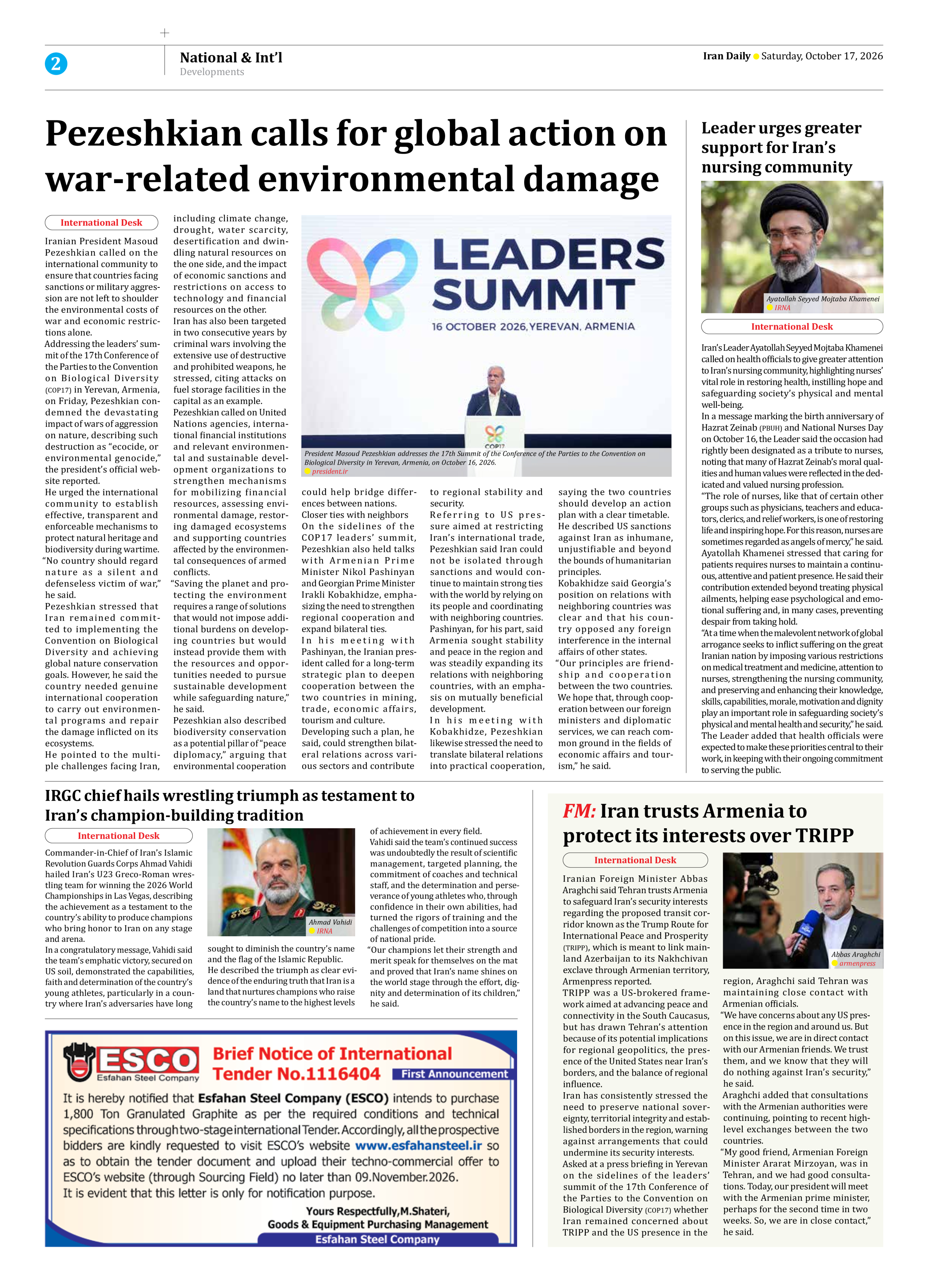
Addressing the leaders’ summit of the 17th Conference of the Parties to the Convention on Biological Diversity (COP17) in Yerevan, Armenia, on Friday, Pezeshkian condemned the devastating impact of wars of aggression on nature, describing such destruction as “ecocide, or environmental genocide,” the president’s official website reported.
He urged the international community to establish effective, transparent and enforceable mechanisms to protect natural heritage and biodiversity during wartime.
“No country should regard nature as a silent and defenseless victim of war,” he said.
Pezeshkian stressed that Iran remained committed to implementing the Convention on Biological Diversity and achieving global nature conservation goals. However, he said the country needed genuine international cooperation to carry out environmental programs and repair the damage inflicted on its ecosystems.
He pointed to the multiple challenges facing Iran, including climate change, drought, water scarcity, desertification and dwindling natural resources on the one side, and the impact of economic sanctions and restrictions on access to technology and financial resources on the other.
Iran has also been targeted in two consecutive years by criminal wars involving the extensive use of destructive and prohibited weapons, he stressed, citing attacks on fuel storage facilities in the capital as an example.
Pezeshkian called on United Nations agencies, international financial institutions and relevant environmental and sustainable development organizations to strengthen mechanisms for mobilizing financial resources, assessing environmental damage, restoring damaged ecosystems and supporting countries affected by the environmental consequences of armed conflicts.
“Saving the planet and protecting the environment requires a range of solutions that would not impose additional burdens on developing countries but would instead provide them with the resources and opportunities needed to pursue sustainable development while safeguarding nature,” he said.
Pezeshkian also described biodiversity conservation as a potential pillar of “peace diplomacy,” arguing that environmental cooperation could help bridge differences between nations.
Closer ties with neighbors
On the sidelines of the COP17 leaders’ summit, Pezeshkian also held talks with Armenian Prime Minister Nikol Pashinyan and Georgian Prime Minister Irakli Kobakhidze, emphasizing the need to strengthen regional cooperation and expand bilateral ties.
In his meeting with Pashinyan, the Iranian president called for a long-term strategic plan to deepen cooperation between the two countries in mining, trade, economic affairs, tourism and culture.
Developing such a plan, he said, could strengthen bilateral relations across various sectors and contribute to regional stability and security.
Referring to US pressure aimed at restricting Iran’s international trade, Pezeshkian said Iran could not be isolated through sanctions and would continue to maintain strong ties with the world by relying on its people and coordinating with neighboring countries.
Pashinyan, for his part, said Armenia sought stability and peace in the region and was steadily expanding its relations with neighboring countries, with an emphasis on mutually beneficial development.
In his meeting with Kobakhidze, Pezeshkian likewise stressed the need to translate bilateral relations into practical cooperation, saying the two countries should develop an action plan with a clear timetable.
He described US sanctions against Iran as inhumane, unjustifiable and beyond the bounds of humanitarian principles.
Kobakhidze said Georgia’s position on relations with neighboring countries was clear and that his country opposed any foreign interference in the internal affairs of other states.
“Our principles are friendship and cooperation between the two countries. We hope that, through cooperation between our foreign ministers and diplomatic services, we can reach common ground in the fields of economic affairs and tourism,” he said.