







CBI governor rejects claims of Iran’s economic collapse as ‘illusion’
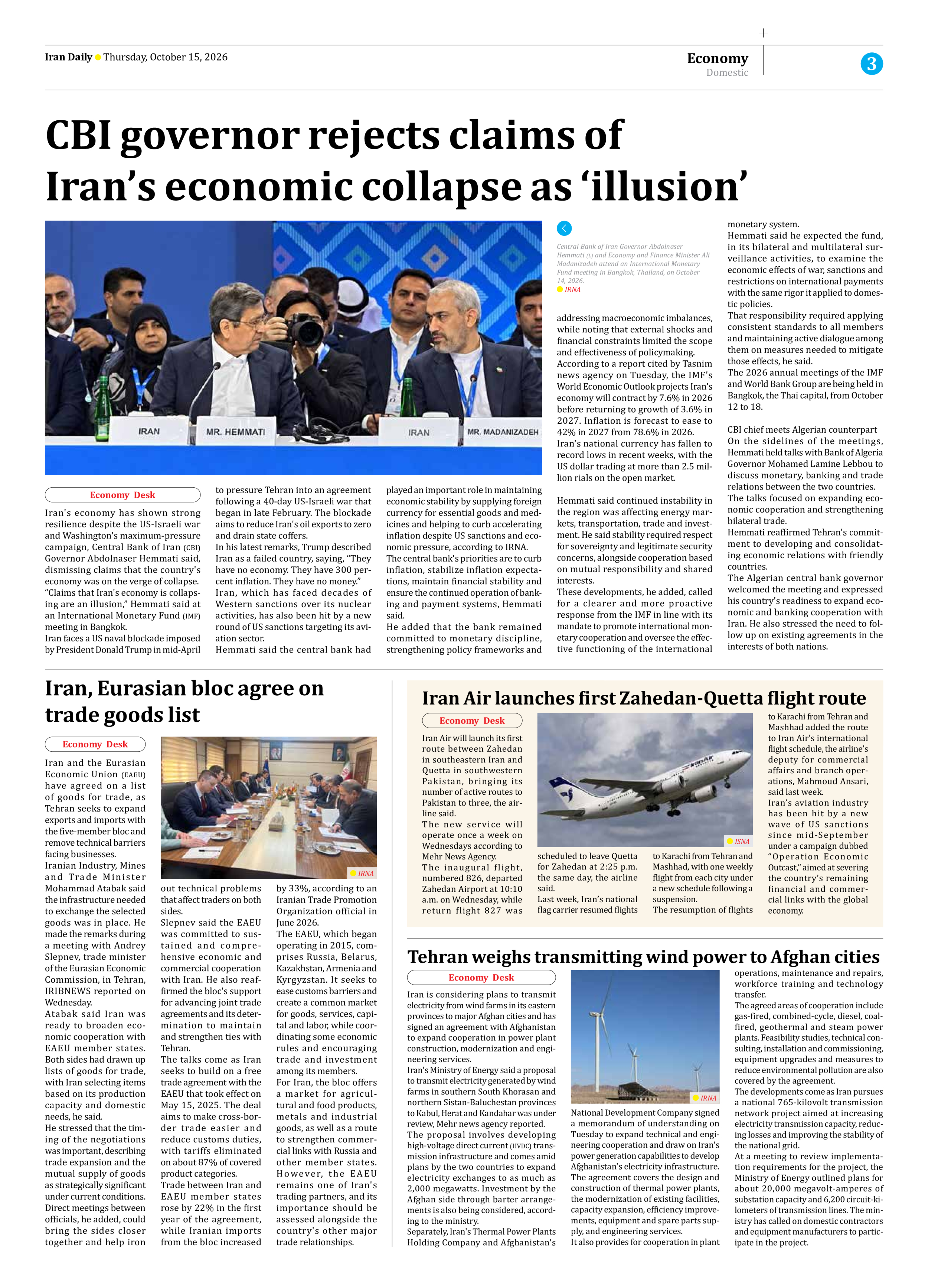
Iran's economy has shown strong resilience despite the US-Israeli war and Washington's maximum-pressure campaign, Central Bank of Iran (CBI) Governor Abdolnaser Hemmati said, dismissing claims that the country's economy was on the verge of collapse.
“Claims that Iran's economy is collapsing are an illusion,” Hemmati said at an International Monetary Fund (IMF) meeting in Bangkok.
Iran faces a US naval blockade imposed by President Donald Trump in mid-April to pressure Tehran into an agreement following a 40-day US-Israeli war that began in late February. The blockade aims to reduce Iran's oil exports to zero and drain state coffers.
In his latest remarks, Trump described Iran as a failed country, saying, “They have no economy. They have 300 percent inflation. They have no money.”
Iran, which has faced decades of Western sanctions over its nuclear activities, has also been hit by a new round of US sanctions targeting its aviation sector.
Hemmati said the central bank had played an important role in maintaining economic stability by supplying foreign currency for essential goods and medicines and helping to curb accelerating inflation despite US sanctions and economic pressure, according to IRNA.
The central bank's priorities are to curb inflation, stabilize inflation expectations, maintain financial stability and ensure the continued operation of banking and payment systems, Hemmati said.
He added that the bank remained committed to monetary discipline, strengthening policy frameworks and addressing macroeconomic imbalances, while noting that external shocks and financial constraints limited the scope and effectiveness of policymaking.
According to a report cited by Tasnim news agency on Tuesday, the IMF's World Economic Outlook projects Iran's economy will contract by 7.6% in 2026 before returning to growth of 3.6% in 2027. Inflation is forecast to ease to 42% in 2027 from 78.6% in 2026.
Iran's national currency has fallen to record lows in recent weeks, with the US dollar trading at more than 2.5 million rials on the open market.
Hemmati said continued instability in the region was affecting energy markets, transportation, trade and investment. He said stability required respect for sovereignty and legitimate security concerns, alongside cooperation based on mutual responsibility and shared interests.
These developments, he added, called for a clearer and more proactive response from the IMF in line with its mandate to promote international monetary cooperation and oversee the effective functioning of the international monetary system.
Hemmati said he expected the fund, in its bilateral and multilateral surveillance activities, to examine the economic effects of war, sanctions and restrictions on international payments with the same rigor it applied to domestic policies.
That responsibility required applying consistent standards to all members and maintaining active dialogue among them on measures needed to mitigate those effects, he said.
The 2026 annual meetings of the IMF and World Bank Group are being held in Bangkok, the Thai capital, from October 12 to 18.
CBI chief meets Algerian counterpart
On the sidelines of the meetings, Hemmati held talks with Bank of Algeria Governor Mohamed Lamine Lebbou to discuss monetary, banking and trade relations between the two countries.
The talks focused on expanding economic cooperation and strengthening bilateral trade.
Hemmati reaffirmed Tehran's commitment to developing and consolidating economic relations with friendly countries.
The Algerian central bank governor welcomed the meeting and expressed his country's readiness to expand economic and banking cooperation with Iran. He also stressed the need to follow up on existing agreements in the interests of both nations.