





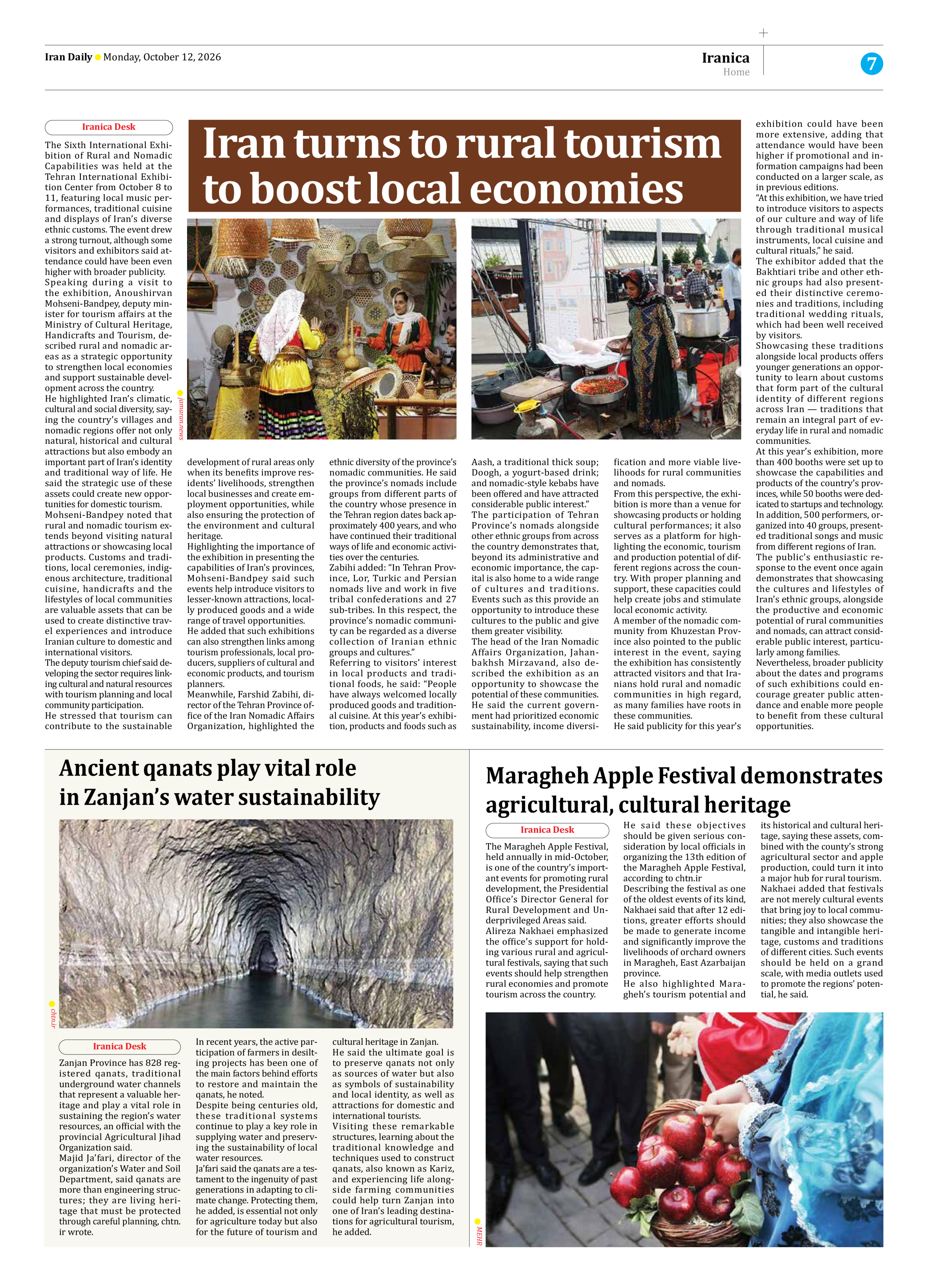


Ancient qanats play vital role in Zanjan’s water sustainability
Zanjan Province has 828 registered qanats, traditional underground water channels that represent a valuable heritage and play a vital role in sustaining the region’s water resources, an official with the provincial Agricultural Jihad Organization said.
Majid Ja’fari, director of the organization’s Water and Soil Department, said qanats are more than engineering structures; they are living heritage that must be protected through careful planning, chtn.ir wrote.
In recent years, the active participation of farmers in desilting projects has been one of the main factors behind efforts to restore and maintain the qanats, he noted.
Despite being centuries old, these traditional systems continue to play a key role in supplying water and preserving the sustainability of local water resources.
Ja’fari said the qanats are a testament to the ingenuity of past generations in adapting to climate change. Protecting them, he added, is essential not only for agriculture today but also for the future of tourism and cultural heritage in Zanjan.
He said the ultimate goal is to preserve qanats not only as sources of water but also as symbols of sustainability and local identity, as well as attractions for domestic and international tourists.
Visiting these remarkable structures, learning about the traditional knowledge and techniques used to construct qanats, also known as Kariz, and experiencing life alongside farming communities could help turn Zanjan into one of Iran’s leading destinations for agricultural tourism, he added.