







Tehran-Almaty trade rises to over $430m in 2025
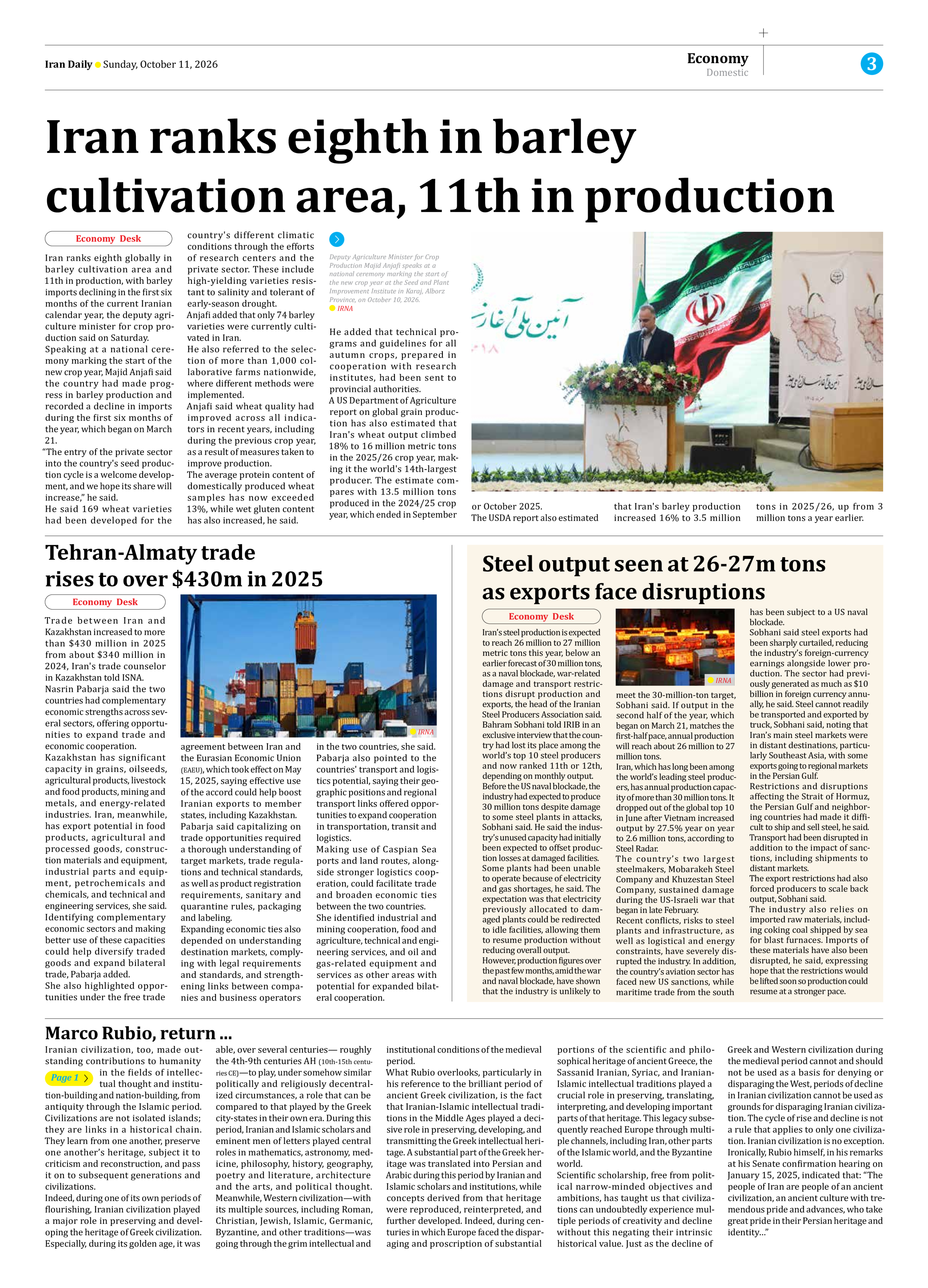
Trade between Iran and Kazakhstan increased to more than $430 million in 2025 from about $340 million in 2024, Iran's trade counselor in Kazakhstan told ISNA.
Nasrin Pabarja said the two countries had complementary economic strengths across several sectors, offering opportunities to expand trade and economic cooperation.
Kazakhstan has significant capacity in grains, oilseeds, agricultural products, livestock and food products, mining and metals, and energy-related industries. Iran, meanwhile, has export potential in food products, agricultural and processed goods, construction materials and equipment, industrial parts and equipment, petrochemicals and chemicals, and technical and engineering services, she said.
Identifying complementary economic sectors and making better use of these capacities could help diversify traded goods and expand bilateral trade, Pabarja added.
She also highlighted opportunities under the free trade agreement between Iran and the Eurasian Economic Union (EAEU), which took effect on May 15, 2025, saying effective use of the accord could help boost Iranian exports to member states, including Kazakhstan.
Pabarja said capitalizing on trade opportunities required a thorough understanding of target markets, trade regulations and technical standards, as well as product registration requirements, sanitary and quarantine rules, packaging and labeling.
Expanding economic ties also depended on understanding destination markets, complying with legal requirements and standards, and strengthening links between companies and business operators in the two countries, she said.
Pabarja also pointed to the countries' transport and logistics potential, saying their geographic positions and regional transport links offered opportunities to expand cooperation in transportation, transit and logistics.
Making use of Caspian Sea ports and land routes, alongside stronger logistics cooperation, could facilitate trade and broaden economic ties between the two countries.
She identified industrial and mining cooperation, food and agriculture, technical and engineering services, and oil and gas-related equipment and services as other areas with potential for expanded bilateral cooperation.