







TPO plans new transport links to ease impact of sanctions, trade restrictions
Iran's Trade Promotion Organization is planning a series of measures to strengthen transport and logistics links and mitigate the impact of sanctions and trade restrictions, including agreements on transport and trade, a meeting of the heads of free zones in Iran and Pakistan, electronic customs documents and a joint session with railway officials from Iran, Turkmenistan, Kazakhstan and China.
Amir Roshanbakhsh Qanbari, deputy head of international business development at the Trade Promotion Organization, outlined the plans at a news conference on the sidelines of the seventh Transport, Logistics and Related Industries Exhibition, ILNA reported.
Iran's southern ports remain under a US naval blockade imposed by President Donald Trump in mid-April, aimed at pressuring Tehran into an agreement after a 40-day US-Israeli war that began in late February. Already under decades of Western sanctions over its nuclear programs, the country also faces a new wave of US sanctions targeting its aviation sector.
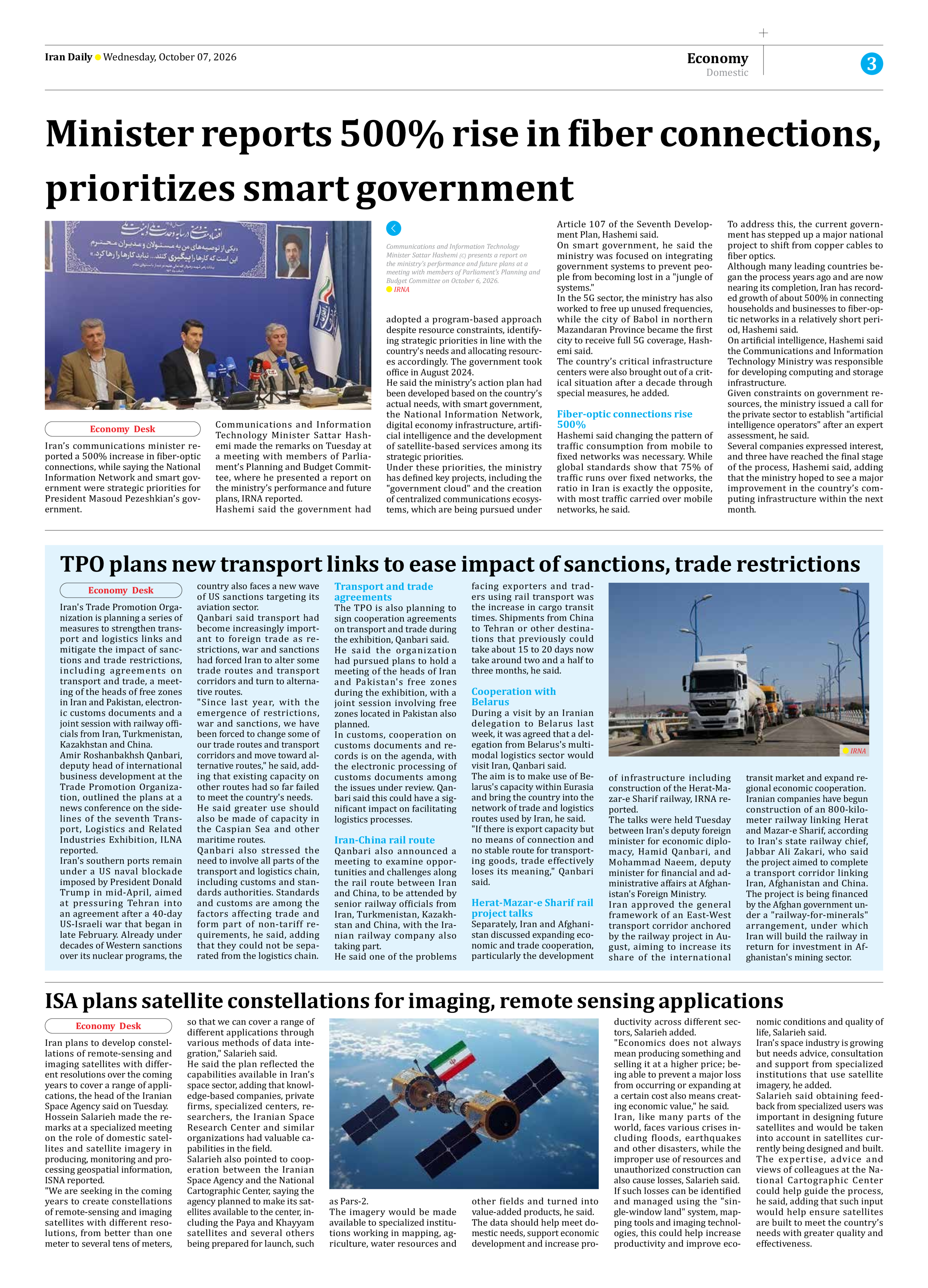
Qanbari said transport had become increasingly important to foreign trade as restrictions, war and sanctions had forced Iran to alter some trade routes and transport corridors and turn to alternative routes.
"Since last year, with the emergence of restrictions, war and sanctions, we have been forced to change some of our trade routes and transport corridors and move toward alternative routes," he said, adding that existing capacity on other routes had so far failed to meet the country's needs.
He said greater use should also be made of capacity in the Caspian Sea and other maritime routes.
Qanbari also stressed the need to involve all parts of the transport and logistics chain, including customs and standards authorities. Standards and customs are among the factors affecting trade and form part of non-tariff requirements, he said, adding that they could not be separated from the logistics chain.
Transport and trade agreements
The TPO is also planning to sign cooperation agreements on transport and trade during the exhibition, Qanbari said.
He said the organization had pursued plans to hold a meeting of the heads of Iran and Pakistan's free zones during the exhibition, with a joint session involving free zones located in Pakistan also planned.
In customs, cooperation on customs documents and records is on the agenda, with the electronic processing of customs documents among the issues under review. Qanbari said this could have a significant impact on facilitating logistics processes.
Iran-China rail route
Qanbari also announced a meeting to examine opportunities and challenges along the rail route between Iran and China, to be attended by senior railway officials from Iran, Turkmenistan, Kazakhstan and China, with the Iranian railway company also taking part.
He said one of the problems facing exporters and traders using rail transport was the increase in cargo transit times. Shipments from China to Tehran or other destinations that previously could take about 15 to 20 days now take around two and a half to three months, he said.
Cooperation with Belarus
During a visit by an Iranian delegation to Belarus last week, it was agreed that a delegation from Belarus's multimodal logistics sector would visit Iran, Qanbari said.
The aim is to make use of Belarus's capacity within Eurasia and bring the country into the network of trade and logistics routes used by Iran, he said.
"If there is export capacity but no means of connection and no stable route for transporting goods, trade effectively loses its meaning," Qanbari said.
Herat-Mazar-e Sharif rail project talks
Separately, Iran and Afghanistan discussed expanding economic and trade cooperation, particularly the development of infrastructure including construction of the Herat-Mazar-e Sharif railway, IRNA reported.
The talks were held Tuesday between Iran's deputy foreign minister for economic diplomacy, Hamid Qanbari, and Mohammad Naeem, deputy minister for financial and administrative affairs at Afghanistan's Foreign Ministry.
Iran approved the general framework of an East-West transport corridor anchored by the railway project in August, aiming to increase its share of the international transit market and expand regional economic cooperation.
Iranian companies have begun construction of an 800-kilometer railway linking Herat and Mazar-e Sharif, according to Iran's state railway chief, Jabbar Ali Zakari, who said the project aimed to complete a transport corridor linking Iran, Afghanistan and China. The project is being financed by the Afghan government under a "railway-for-minerals" arrangement, under which Iran will build the railway in return for investment in Afghanistan's mining sector.