







Minister reports 500% rise in fiber connections, prioritizes smart government
Iran’s communications minister reported a 500% increase in fiber-optic connections, while saying the National Information Network and smart government were strategic priorities for President Masoud Pezeshkian’s government.
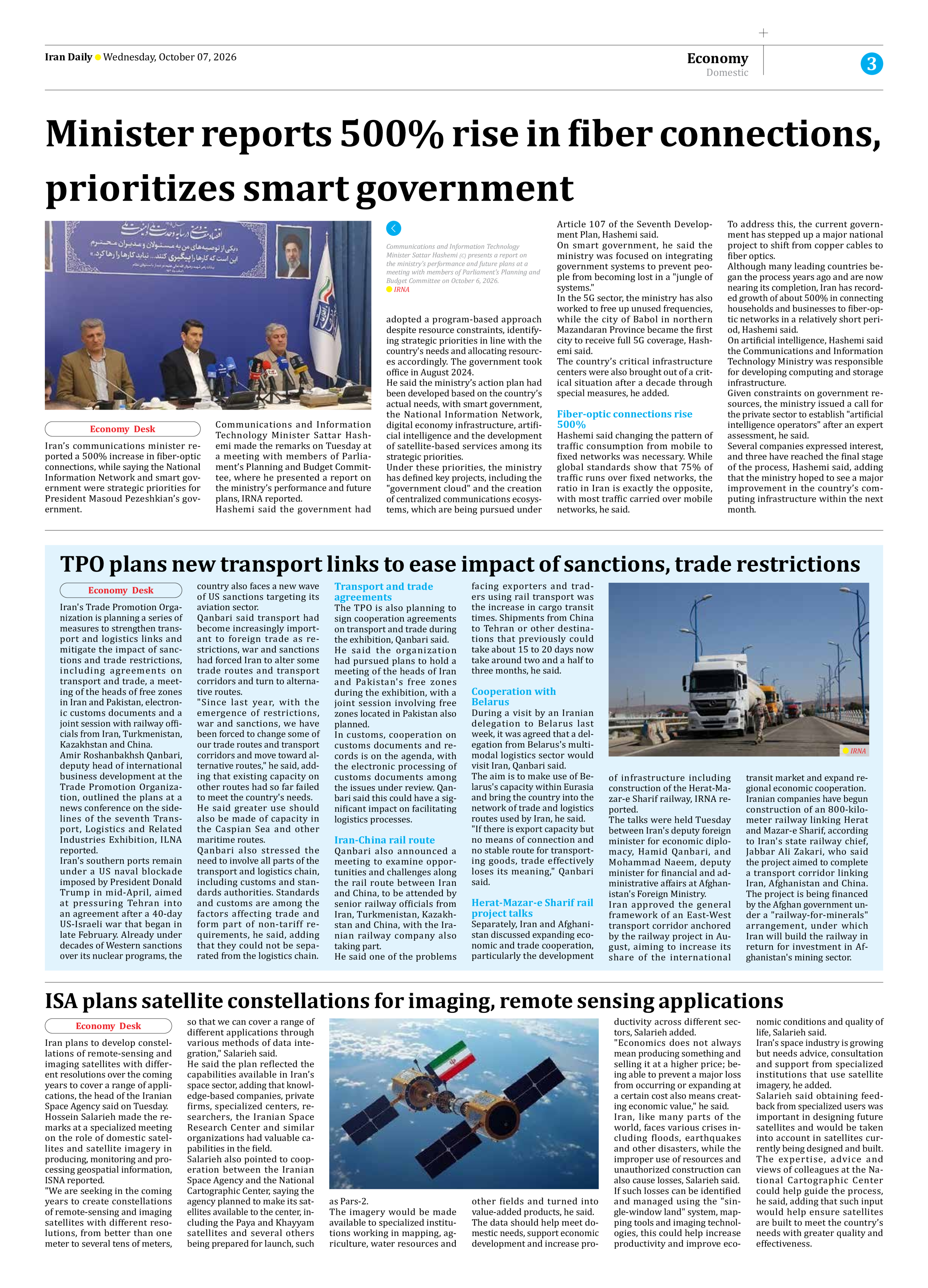
Communications and Information Technology Minister Sattar Hashemi made the remarks on Tuesday at a meeting with members of Parliament’s Planning and Budget Committee, where he presented a report on the ministry’s performance and future plans, IRNA reported.
Hashemi said the government had adopted a program-based approach despite resource constraints, identifying strategic priorities in line with the country's needs and allocating resources accordingly. The government took office in August 2024.
He said the ministry’s action plan had been developed based on the country’s actual needs, with smart government, the National Information Network, digital economy infrastructure, artificial intelligence and the development of satellite-based services among its strategic priorities.
Under these priorities, the ministry has defined key projects, including the "government cloud" and the creation of centralized communications ecosystems, which are being pursued under Article 107 of the Seventh Development Plan, Hashemi said.
On smart government, he said the ministry was focused on integrating government systems to prevent people from becoming lost in a "jungle of systems."
In the 5G sector, the ministry has also worked to free up unused frequencies, while the city of Babol in northern Mazandaran Province became the first city to receive full 5G coverage, Hashemi said.
The country’s critical infrastructure centers were also brought out of a critical situation after a decade through special measures, he added.
Fiber-optic connections rise 500%
Hashemi said changing the pattern of traffic consumption from mobile to fixed networks was necessary. While global standards show that 75% of traffic runs over fixed networks, the ratio in Iran is exactly the opposite, with most traffic carried over mobile networks, he said.
To address this, the current government has stepped up a major national project to shift from copper cables to fiber optics.
Although many leading countries began the process years ago and are now nearing its completion, Iran has recorded growth of about 500% in connecting households and businesses to fiber-optic networks in a relatively short period, Hashemi said.
On artificial intelligence, Hashemi said the Communications and Information Technology Ministry was responsible for developing computing and storage infrastructure.
Given constraints on government resources, the ministry issued a call for the private sector to establish "artificial intelligence operators" after an expert assessment, he said.
Several companies expressed interest, and three have reached the final stage of the process, Hashemi said, adding that the ministry hoped to see a major improvement in the country’s computing infrastructure within the next month.