





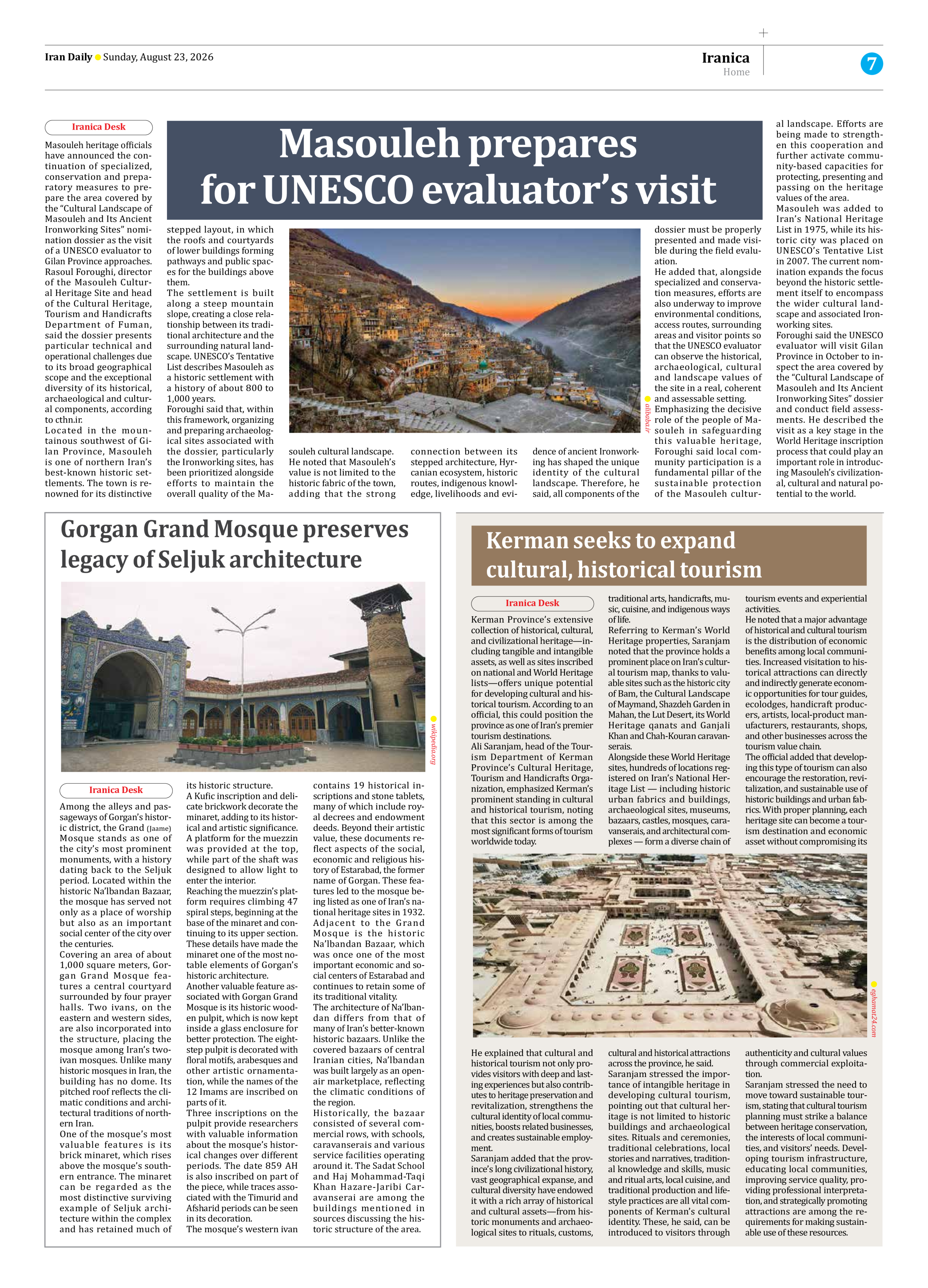


Gorgan Grand Mosque preserves legacy of Seljuk architecture
Among the alleys and passageways of Gorgan’s historic district, the Grand (Jaame) Mosque stands as one of the city’s most prominent monuments, with a history dating back to the Seljuk period. Located within the historic Na’lbandan Bazaar, the mosque has served not only as a place of worship but also as an important social center of the city over the centuries.
Covering an area of about 1,000 square meters, Gorgan Grand Mosque features a central courtyard surrounded by four prayer halls. Two ivans, on the eastern and western sides, are also incorporated into the structure, placing the mosque among Iran’s two-ivan mosques. Unlike many historic mosques in Iran, the building has no dome. Its pitched roof reflects the climatic conditions and architectural traditions of northern Iran.
One of the mosque’s most valuable features is its brick minaret, which rises above the mosque’s southern entrance. The minaret can be regarded as the most distinctive surviving example of Seljuk architecture within the complex and has retained much of its historic structure.
A Kufic inscription and delicate brickwork decorate the minaret, adding to its historical and artistic significance. A platform for the muezzin was provided at the top, while part of the shaft was designed to allow light to enter the interior.
Reaching the muezzin’s platform requires climbing 47 spiral steps, beginning at the base of the minaret and continuing to its upper section. These details have made the minaret one of the most notable elements of Gorgan’s historic architecture.
Another valuable feature associated with Gorgan Grand Mosque is its historic wooden pulpit, which is now kept inside a glass enclosure for better protection. The eight-step pulpit is decorated with floral motifs, arabesques and other artistic ornamentation, while the names of the 12 Imams are inscribed on parts of it.
Three inscriptions on the pulpit provide researchers with valuable information about the mosque’s historical changes over different periods. The date 859 AH is also inscribed on part of the piece, while traces associated with the Timurid and Afsharid periods can be seen in its decoration.
The mosque’s western ivan contains 19 historical inscriptions and stone tablets, many of which include royal decrees and endowment deeds. Beyond their artistic value, these documents reflect aspects of the social, economic and religious history of Estarabad, the former name of Gorgan. These features led to the mosque being listed as one of Iran’s national heritage sites in 1932.
Adjacent to the Grand Mosque is the historic Na’lbandan Bazaar, which was once one of the most important economic and social centers of Estarabad and continues to retain some of its traditional vitality.
The architecture of Na’lbandan differs from that of many of Iran’s better-known historic bazaars. Unlike the covered bazaars of central Iranian cities, Na’lbandan was built largely as an open-air marketplace, reflecting the climatic conditions of the region.
Historically, the bazaar consisted of several commercial rows, with schools, caravanserais and various service facilities operating around it. The Sadat School and Haj Mohammad-Taqi Khan Hazare-Jaribi Caravanserai are among the buildings mentioned in sources discussing the historic structure of the area.