







Masouleh prepares for UNESCO evaluator’s visit
Masouleh heritage officials have announced the continuation of specialized, conservation and preparatory measures to prepare the area covered by the “Cultural Landscape of Masouleh and Its Ancient Ironworking Sites” nomination dossier as the visit of a UNESCO evaluator to Gilan Province approaches.
Rasoul Foroughi, director of the Masouleh Cultural Heritage Site and head of the Cultural Heritage, Tourism and Handicrafts Department of Fuman, said the dossier presents particular technical and operational challenges due to its broad geographical scope and the exceptional diversity of its historical, archaeological and cultural components, according to cthn.ir.
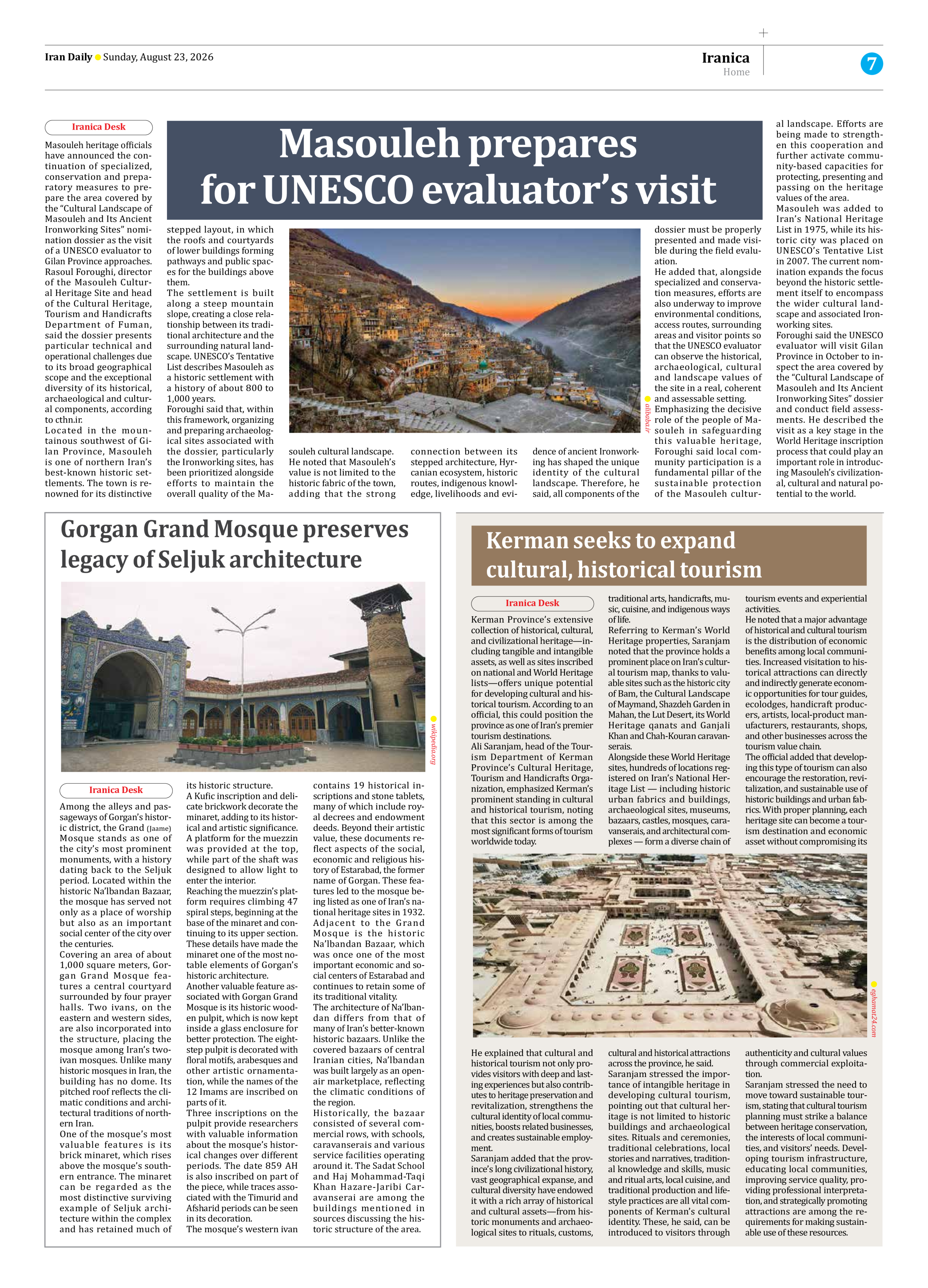
Located in the mountainous southwest of Gilan Province, Masouleh is one of northern Iran’s best-known historic settlements. The town is renowned for its distinctive stepped layout, in which the roofs and courtyards of lower buildings forming pathways and public spaces for the buildings above them.
The settlement is built along a steep mountain slope, creating a close relationship between its traditional architecture and the surrounding natural landscape. UNESCO’s Tentative List describes Masouleh as a historic settlement with a history of about 800 to 1,000 years.
Foroughi said that, within this framework, organizing and preparing archaeological sites associated with the dossier, particularly the Ironworking sites, has been prioritized alongside efforts to maintain the overall quality of the Masouleh cultural landscape.
He noted that Masouleh’s value is not limited to the historic fabric of the town, adding that the strong connection between its stepped architecture, Hyrcanian ecosystem, historic routes, indigenous knowledge, livelihoods and evidence of ancient Ironworking has shaped the unique identity of the cultural landscape. Therefore, he said, all components of the dossier must be properly presented and made visible during the field evaluation.
He added that, alongside specialized and conservation measures, efforts are also underway to improve environmental conditions, access routes, surrounding areas and visitor points so that the UNESCO evaluator can observe the historical, archaeological, cultural and landscape values of the site in a real, coherent and assessable setting.
Emphasizing the decisive role of the people of Masouleh in safeguarding this valuable heritage, Foroughi said local community participation is a fundamental pillar of the sustainable protection of the Masouleh cultural landscape. Efforts are being made to strengthen this cooperation and further activate community-based capacities for protecting, presenting and passing on the heritage values of the area.
Masouleh was added to Iran’s National Heritage List in 1975, while its historic city was placed on UNESCO’s Tentative List in 2007. The current nomination expands the focus beyond the historic settlement itself to encompass the wider cultural landscape and associated Ironworking sites.
Foroughi said the UNESCO evaluator will visit Gilan Province in October to inspect the area covered by the “Cultural Landscape of Masouleh and Its Ancient Ironworking Sites” dossier and conduct field assessments. He described the visit as a key stage in the World Heritage inscription process that could play an important role in introducing Masouleh’s civilizational, cultural and natural potential to the world.