







New techs, AI top priority for agriculture improvement: Minister
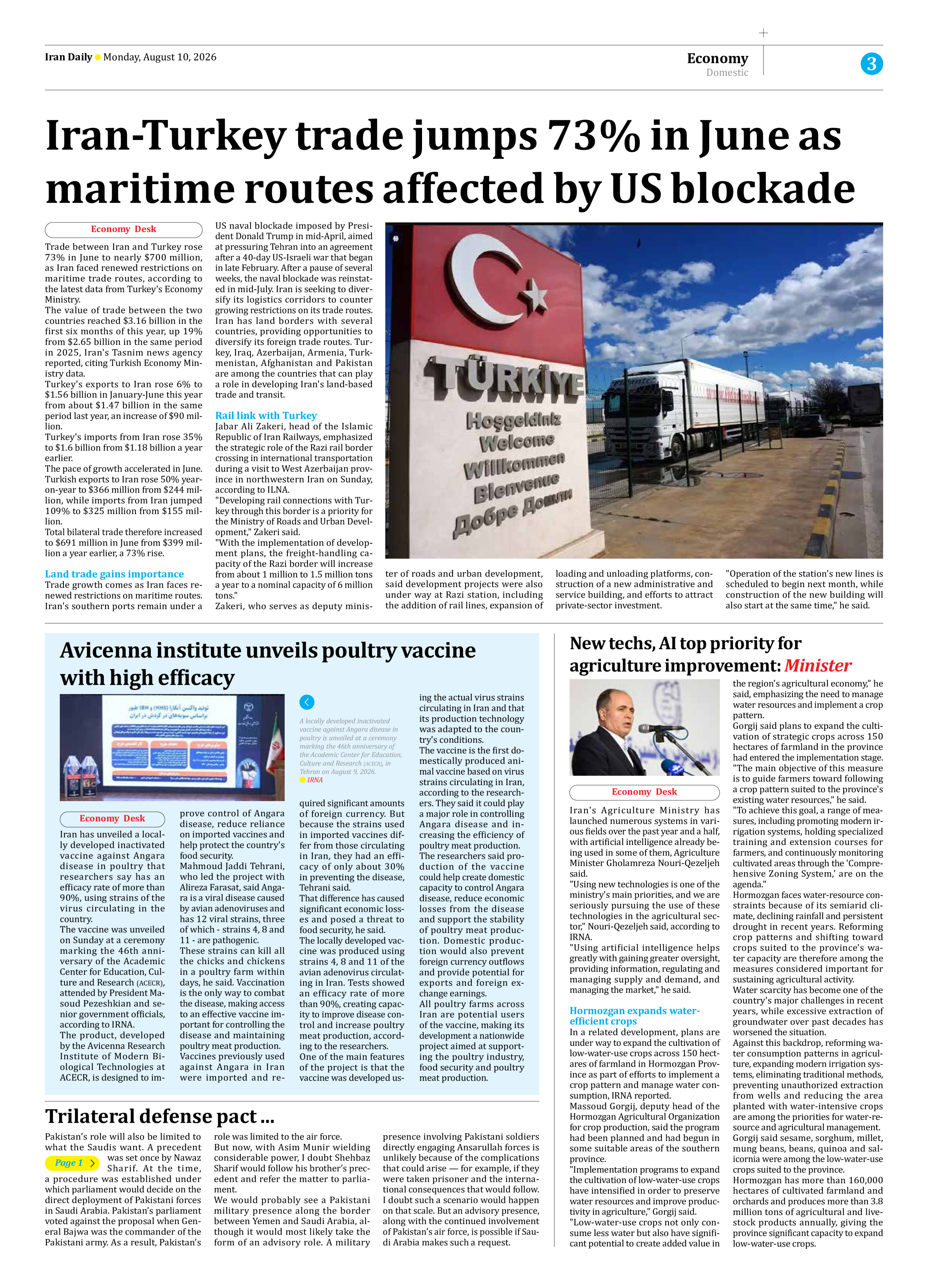
Iran's Agriculture Ministry has launched numerous systems in various fields over the past year and a half, with artificial intelligence already being used in some of them, Agriculture Minister Gholamreza Nouri-Qezeljeh said.
"Using new technologies is one of the ministry's main priorities, and we are seriously pursuing the use of these technologies in the agricultural sector," Nouri-Qezeljeh said, according to IRNA.
"Using artificial intelligence helps greatly with gaining greater oversight, providing information, regulating and managing supply and demand, and managing the market," he said.
Hormozgan expands water-efficient crops
In a related development, plans are under way to expand the cultivation of low-water-use crops across 150 hectares of farmland in Hormozgan Province as part of efforts to implement a crop pattern and manage water consumption, IRNA reported.
Massoud Gorgij, deputy head of the Hormozgan Agricultural Organization for crop production, said the program had been planned and had begun in some suitable areas of the southern province.
"Implementation programs to expand the cultivation of low-water-use crops have intensified in order to preserve water resources and improve productivity in agriculture," Gorgij said.
"Low-water-use crops not only consume less water but also have significant potential to create added value in the region's agricultural economy," he said, emphasizing the need to manage water resources and implement a crop pattern.
Gorgij said plans to expand the cultivation of strategic crops across 150 hectares of farmland in the province had entered the implementation stage.
"The main objective of this measure is to guide farmers toward following a crop pattern suited to the province's existing water resources," he said.
"To achieve this goal, a range of measures, including promoting modern irrigation systems, holding specialized training and extension courses for farmers, and continuously monitoring cultivated areas through the 'Comprehensive Zoning System,' are on the agenda."
Hormozgan faces water-resource constraints because of its semiarid climate, declining rainfall and persistent drought in recent years. Reforming crop patterns and shifting toward crops suited to the province's water capacity are therefore among the measures considered important for sustaining agricultural activity.
Water scarcity has become one of the country's major challenges in recent years, while excessive extraction of groundwater over past decades has worsened the situation.
Against this backdrop, reforming water consumption patterns in agriculture, expanding modern irrigation systems, eliminating traditional methods, preventing unauthorized extraction from wells and reducing the area planted with water-intensive crops are among the priorities for water-resource and agricultural management.
Gorgij said sesame, sorghum, millet, mung beans, beans, quinoa and salicornia were among the low-water-use crops suited to the province.
Hormozgan has more than 160,000 hectares of cultivated farmland and orchards and produces more than 3.8 million tons of agricultural and livestock products annually, giving the province significant capacity to expand low-water-use crops.