





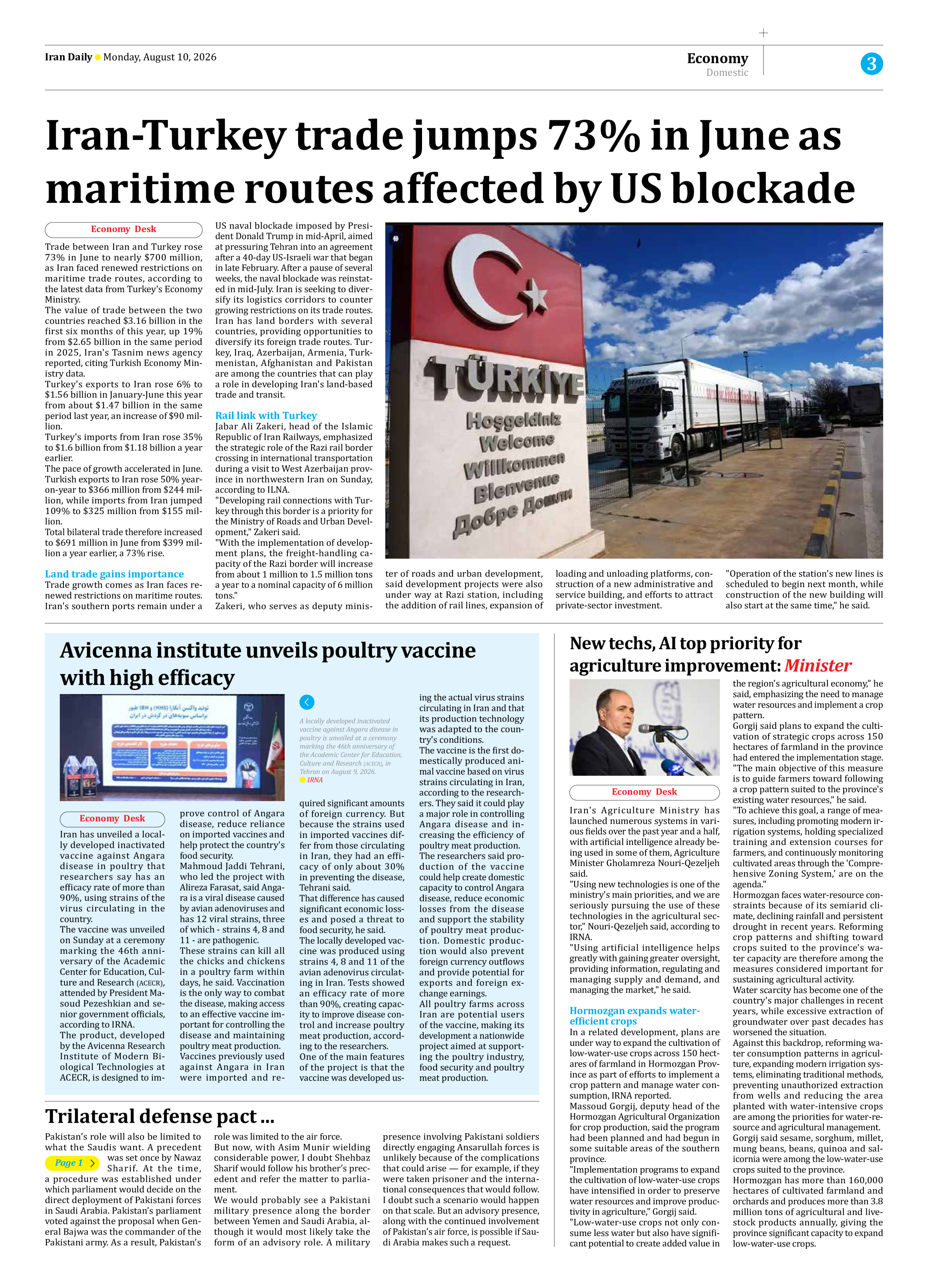


Iran-Turkey trade jumps 73% in June as maritime routes affected by US blockade
Trade between Iran and Turkey rose 73% in June to nearly $700 million, as Iran faced renewed restrictions on maritime trade routes, according to the latest data from Turkey's Economy Ministry.
The value of trade between the two countries reached $3.16 billion in the first six months of this year, up 19% from $2.65 billion in the same period in 2025, Iran's Tasnim news agency reported, citing Turkish Economy Ministry data.
Turkey's exports to Iran rose 6% to $1.56 billion in January-June this year from about $1.47 billion in the same period last year, an increase of $90 million.
Turkey's imports from Iran rose 35% to $1.6 billion from $1.18 billion a year earlier.
The pace of growth accelerated in June. Turkish exports to Iran rose 50% year-on-year to $366 million from $244 million, while imports from Iran jumped 109% to $325 million from $155 million.
Total bilateral trade therefore increased to $691 million in June from $399 million a year earlier, a 73% rise.
Land trade gains importance
Trade growth comes as Iran faces renewed restrictions on maritime routes. Iran's southern ports remain under a US naval blockade imposed by President Donald Trump in mid-April, aimed at pressuring Tehran into an agreement after a 40-day US-Israeli war that began in late February. After a pause of several weeks, the naval blockade was reinstated in mid-July. Iran is seeking to diversify its logistics corridors to counter growing restrictions on its trade routes.
Iran has land borders with several countries, providing opportunities to diversify its foreign trade routes. Turkey, Iraq, Azerbaijan, Armenia, Turkmenistan, Afghanistan and Pakistan are among the countries that can play a role in developing Iran's land-based trade and transit.
Rail link with Turkey
Jabar Ali Zakeri, head of the Islamic Republic of Iran Railways, emphasized the strategic role of the Razi rail border crossing in international transportation during a visit to West Azerbaijan province in northwestern Iran on Sunday, according to ILNA.
"Developing rail connections with Turkey through this border is a priority for the Ministry of Roads and Urban Development," Zakeri said.
"With the implementation of development plans, the freight-handling capacity of the Razi border will increase from about 1 million to 1.5 million tons a year to a nominal capacity of 6 million tons."
Zakeri, who serves as deputy minister of roads and urban development, said development projects were also under way at Razi station, including the addition of rail lines, expansion of loading and unloading platforms, construction of a new administrative and service building, and efforts to attract private-sector investment.
"Operation of the station's new lines is scheduled to begin next month, while construction of the new building will also start at the same time," he said.