







UNESCO committee approves Hegmataneh conservation report
The conservation report submitted by Iran’s Ministry of Cultural Heritage, Tourism and Handicrafts on the UNESCO-listed Hegmataneh archaeological site in Hamedan Province has been reviewed and approved by members of the UNESCO World Heritage Committee during its 48th session, currently underway in Busan, South Korea.
The committee assessed the measures taken to protect, conserve, manage, and continuously monitor the World Heritage property. It welcomed Iran’s efforts to safeguard the Hegmataneh site and emphasized the importance of maintaining the current conservation and management approach.
Under the committee’s decision, Iran is required to continue implementing its conservation, management, and monitoring programs for the historic site and submit an updated report on the latest measures and progress to the UNESCO World Heritage Centre by the end of 2027.
The committee’s approval of the conservation report reflects its confidence in the management and protection of Hegmataneh, one of the oldest centers of civilization in Iran and the world. It also indicates that the conservation policies implemented by the Ministry of Cultural Heritage, Tourism and Handicrafts are in line with the requirements of the World Heritage Convention and international conservation standards.
Hegmataneh, one of the most significant cradles of Iranian civilization, was inscribed on the UNESCO World Heritage List during the 46th session of the World Heritage Committee. The continuation of specialized monitoring and conservation programs is expected to ensure the preservation of the site’s Outstanding Universal Value for future generations.
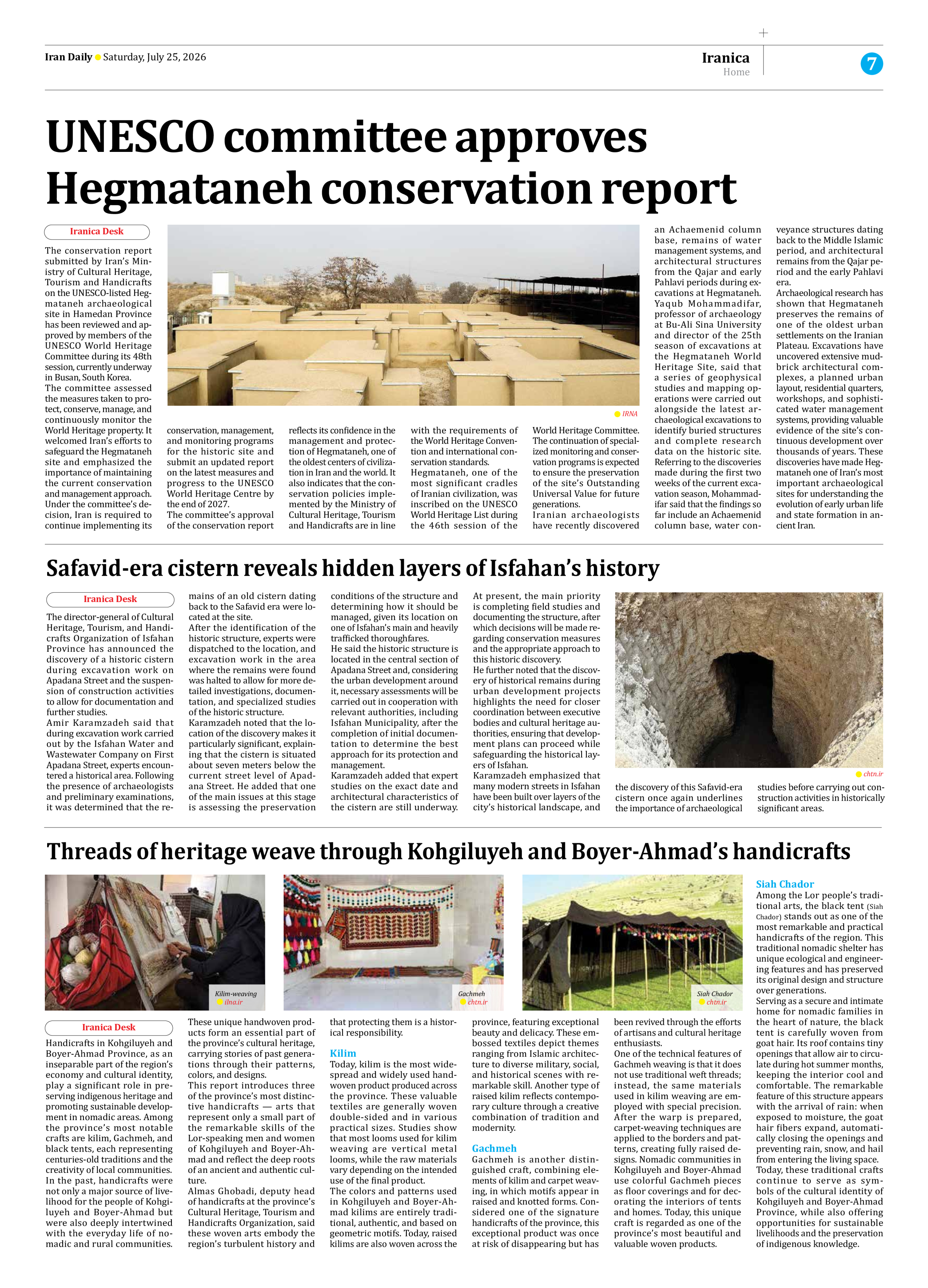
Iranian archaeologists have recently discovered an Achaemenid column base, remains of water management systems, and architectural structures from the Qajar and early Pahlavi periods during excavations at Hegmataneh.
Yaqub Mohammadifar, professor of archaeology at Bu-Ali Sina University and director of the 25th season of excavations at the Hegmataneh World Heritage Site, said that a series of geophysical studies and mapping operations were carried out alongside the latest archaeological excavations to identify buried structures and complete research data on the historic site.
Referring to the discoveries made during the first two weeks of the current excavation season, Mohammadifar said that the findings so far include an Achaemenid column base, water conveyance structures dating back to the Middle Islamic period, and architectural remains from the Qajar period and the early Pahlavi era.
Archaeological research has shown that Hegmataneh preserves the remains of one of the oldest urban settlements on the Iranian Plateau. Excavations have uncovered extensive mud-brick architectural complexes, a planned urban layout, residential quarters, workshops, and sophisticated water management systems, providing valuable evidence of the site’s continuous development over thousands of years. These discoveries have made Hegmataneh one of Iran’s most important archaeological sites for understanding the evolution of early urban life and state formation in ancient Iran.