







Pasargadae demonstrates origins of Persian Garden design
In July 2004, the ancient city of Pasargadae was inscribed as Iran’s fifth UNESCO World Heritage Site, recognizing not only the renowned Tomb of Cyrus the Great but also one of the world’s earliest and most remarkable examples of royal urban planning, Persian garden design, monumental architecture, and state formation in the ancient world.
Among Iran’s UNESCO-listed sites, Pasargadae holds a special place as the first capital of the Achaemenid Empire and one of the most influential archaeological complexes in the development of Persian architecture, city planning, and landscape design, according to chtn.ir.
During its 28th session, held in Suzhou, China, in July 2004, the UNESCO World Heritage Committee unanimously approved the inscription of Pasargadae as Iran’s fifth World Heritage Site, further reinforcing the global significance of Achaemenid civilization, according to chtn.ir.
Situated in the Morghab Plain of Fars Province, about 70 kilometers north of Persepolis, Pasargadae was founded by Cyrus the Great, the founder of the Achaemenid Empire, in the mid-sixth century BCE. It became the first capital of one of the largest empires of the ancient world.
Unlike many ancient capitals that served primarily political purposes, Pasargadae presented a new vision of the relationship between power, architecture, nature, and urban planning — an approach that was later reflected in other Achaemenid royal complexes.
The world heritage property encompasses some of the finest surviving examples of Achaemenid architecture, including the Tomb of Cyrus the Great, the Private Palace, the Audience Palace, the Gate Palace, the Royal Garden, stone watercourses, Tall-e Takht (the Citadel Terrace), the Tomb of Cambyses, the Sacred Precinct, the Mozaffari Caravanserai, and the Tang-e Bolaghi archaeological landscape.
Archaeologists regard Pasargadae as one of the earliest known examples of an integrated royal capital, where architecture, the natural landscape, water-management systems, and gardens were designed as parts of a unified plan.
One of the site’s most significant features is the Royal Garden of Pasargadae, which many scholars consider the earliest known example of the Persian Chahar Bagh (four-part garden). This design later inspired the creation of historic gardens across Iran, Central Asia, the Indian subcontinent, and even parts of Europe.
Its sophisticated water-management system, carefully planned network of stone channels, and harmonious integration of architecture with nature are among the defining characteristics that contribute to the site’s Outstanding Universal Value.
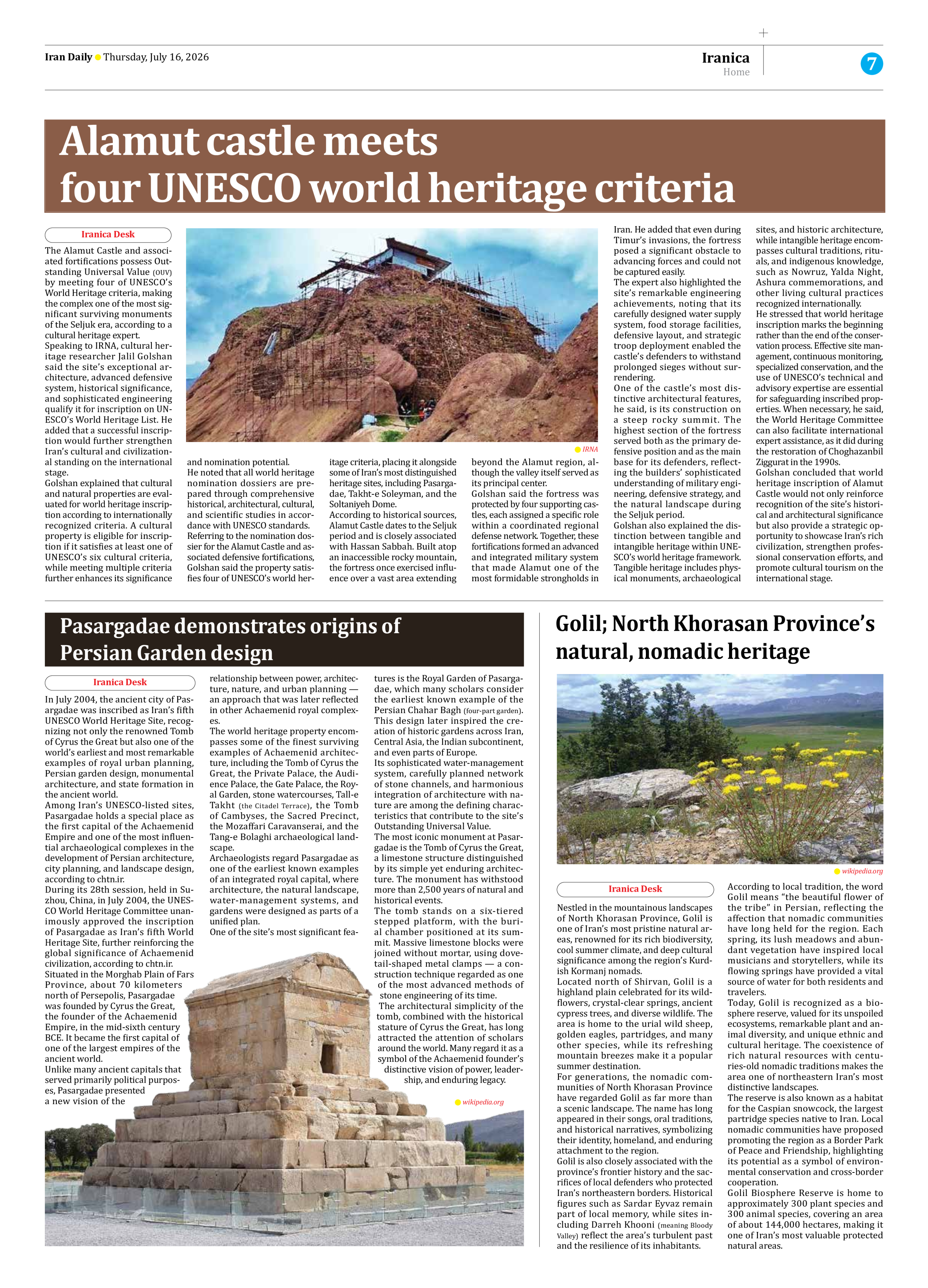
The most iconic monument at Pasargadae is the Tomb of Cyrus the Great, a limestone structure distinguished by its simple yet enduring architecture. The monument has withstood more than 2,500 years of natural and historical events.
The tomb stands on a six-tiered stepped platform, with the burial chamber positioned at its summit. Massive limestone blocks were joined without mortar, using dovetail-shaped metal clamps — a construction technique regarded as one of the most advanced methods of stone engineering of its time.
The architectural simplicity of the tomb, combined with the historical stature of Cyrus the Great, has long attracted the attention of scholars around the world. Many regard it as a symbol of the Achaemenid founder’s distinctive vision of power, leadership, and enduring legacy.