







Alamut castle meets four UNESCO world heritage criteria
The Alamut Castle and associated fortifications possess Outstanding Universal Value (OUV) by meeting four of UNESCO’s World Heritage criteria, making the complex one of the most significant surviving monuments of the Seljuk era, according to a cultural heritage expert.
Speaking to IRNA, cultural heritage researcher Jalil Golshan said the site’s exceptional architecture, advanced defensive system, historical significance, and sophisticated engineering qualify it for inscription on UNESCO’s World Heritage List. He added that a successful inscription would further strengthen Iran’s cultural and civilizational standing on the international stage.
Golshan explained that cultural and natural properties are evaluated for world heritage inscription according to internationally recognized criteria. A cultural property is eligible for inscription if it satisfies at least one of UNESCO’s six cultural criteria, while meeting multiple criteria further enhances its significance and nomination potential.
He noted that all world heritage nomination dossiers are prepared through comprehensive historical, architectural, cultural, and scientific studies in accordance with UNESCO standards.
Referring to the nomination dossier for the Alamut Castle and associated defensive fortifications, Golshan said the property satisfies four of UNESCO’s world heritage criteria, placing it alongside some of Iran’s most distinguished heritage sites, including Pasargadae, Takht-e Soleyman, and the Soltaniyeh Dome.
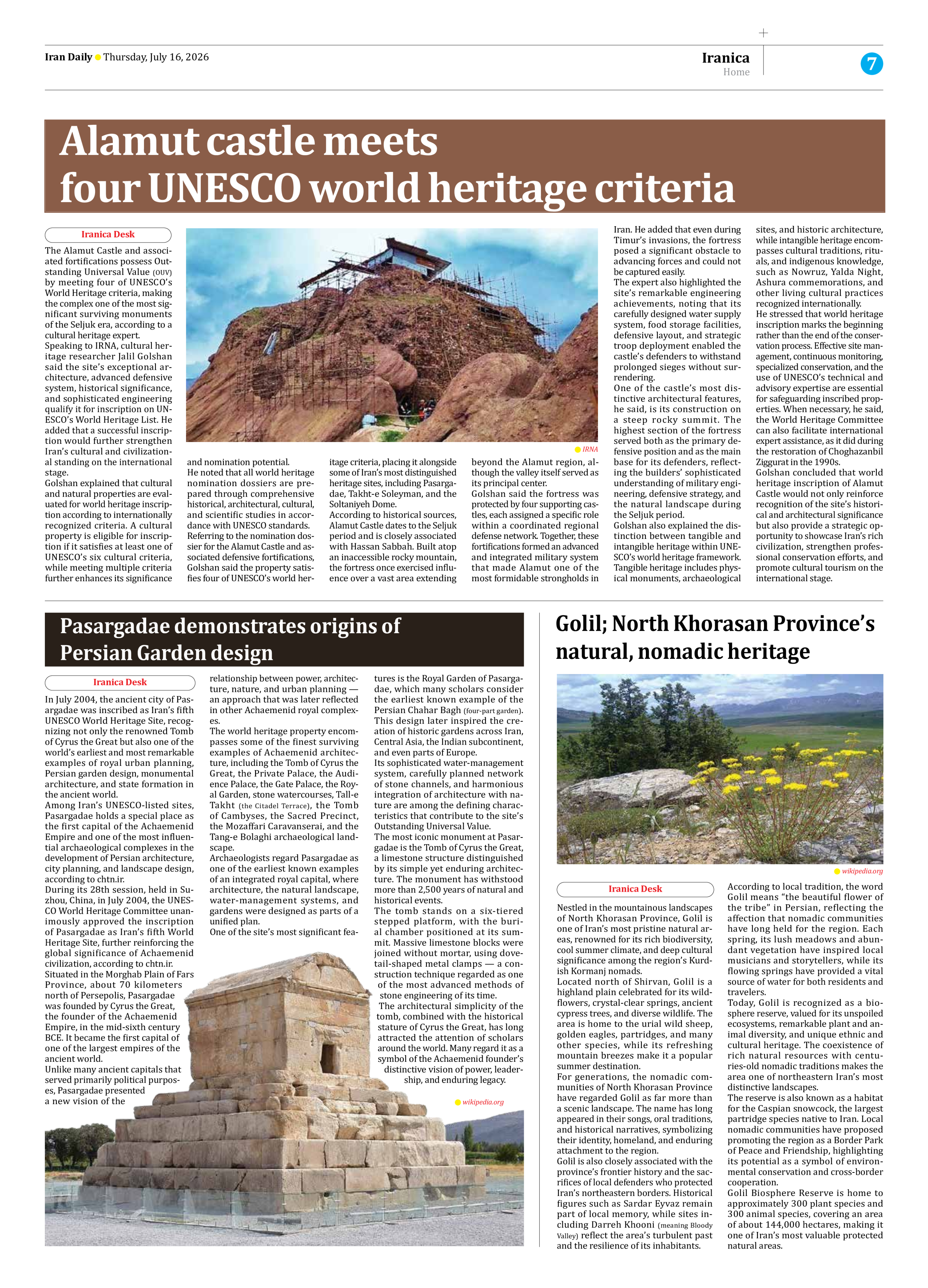
According to historical sources, Alamut Castle dates to the Seljuk period and is closely associated with Hassan Sabbah. Built atop an inaccessible rocky mountain, the fortress once exercised influence over a vast area extending beyond the Alamut region, although the valley itself served as its principal center.
Golshan said the fortress was protected by four supporting castles, each assigned a specific role within a coordinated regional defense network. Together, these fortifications formed an advanced and integrated military system that made Alamut one of the most formidable strongholds in Iran. He added that even during Timur’s invasions, the fortress posed a significant obstacle to advancing forces and could not be captured easily.
The expert also highlighted the site’s remarkable engineering achievements, noting that its carefully designed water supply system, food storage facilities, defensive layout, and strategic troop deployment enabled the castle’s defenders to withstand prolonged sieges without surrendering.
One of the castle’s most distinctive architectural features, he said, is its construction on a steep rocky summit. The highest section of the fortress served both as the primary defensive position and as the main base for its defenders, reflecting the builders’ sophisticated understanding of military engineering, defensive strategy, and the natural landscape during the Seljuk period.
Golshan also explained the distinction between tangible and intangible heritage within UNESCO’s world heritage framework. Tangible heritage includes physical monuments, archaeological sites, and historic architecture, while intangible heritage encompasses cultural traditions, rituals, and indigenous knowledge, such as Nowruz, Yalda Night, Ashura commemorations, and other living cultural practices recognized internationally.
He stressed that world heritage inscription marks the beginning rather than the end of the conservation process. Effective site management, continuous monitoring, specialized conservation, and the use of UNESCO’s technical and advisory expertise are essential for safeguarding inscribed properties. When necessary, he said, the World Heritage Committee can also facilitate international expert assistance, as it did during the restoration of Choghazanbil Ziggurat in the 1990s.
Golshan concluded that world heritage inscription of Alamut Castle would not only reinforce recognition of the site’s historical and architectural significance but also provide a strategic opportunity to showcase Iran’s rich civilization, strengthen professional conservation efforts, and promote cultural tourism on the international stage.