







Iran raps US revocation of oil waivers as ‘flagrant violation’ of MoU
Iran's Foreign Ministry on Wednesday strongly condemned the US move to revoke a temporarily sanctions waiver for Iranian oil sales as a breach of a memorandum of understanding signed between Washington and Tehran, warning that the US would bear responsibility for the consequences of a breach of the agreement.
The ministry said in a statement early on Wednesday that the United States' move to constituted a "flagrant violation" of Clause 10 of the memorandum of understanding that ended the recent war.
According to IRNA, the statement said that less than 20 days after the signing of the Islamabad memorandum, the cancellation of the general license issued on June 21 was "another sign of the US ruling body's bad faith, instability, and unreliability."
It added that over the past 20 days, the United States, either directly or through actions by Israel against Lebanon, had repeatedly committed both minor and major violations of various provisions of the memorandum.
The ministry said Iran had acted in "complete good faith" since signing the June 18 memorandum, using all available means to fulfill its commitments under the agreement.
"Despite this, the US government, in line with its longstanding practice, has sought to justify its own violations with various pretexts while simultaneously breaching its commitments," the statement said.
According to Reuters, the US Treasury on Tuesday re-imposed sanctions on Iranian oil as a US official said alleged Iranian attacks on vessels in the Strait of Hormuz were "wholly unacceptable" and would have consequences.
The ministry warned of the consequences of US treaty violations and said Iran would take any measures it deemed necessary to protect its national interests and national security.
Iran's Deputy Foreign Minister for Legal and International Affairs, Kazem Gharibabadi, also warned on Tuesday that Tehran would take "firm measures" to safeguard its national interests and national security in response to “successive US violations of the Pakistan-mediated memorandum of understanding between Tehran and Washington.”
In a post on X following reports that Washington had revoked the sanctions waiver, Gharibabadi said the decision constituted a "flagrant violation" of Clause 10 of the understanding, while the renewed actions amounted to a "serious violation" of the memorandum's first and second provisions.
The US Treasury had authorized Iranian oil sales until August 21 last month as part of the fragile agreement between Tehran and Washington. Tuesday's decision shortened that wind-down period, setting a new expiration date of July 17.
The Treasury Department's Office of Foreign Assets Control (OFAC) withdrew General License X, issued on June 21, and replaced it with a narrower authorization, General License X1, which allows a wind-down period for transactions until July 17 but prohibits any new purchases or loading of Iranian-origin crude oil and petroleum products from July 7.
Iranian officials have not claimed responsibility for reports that three tankers were struck by unknown projectiles in and near the Strait of Hormuz in recent days.
Under the agreement with the United States, Iran had pledged safe passage for ships through the Strait of Hormuz. Tehran has said vessels should instead use a northern route under Iranian control rather than a route along Oman's coast protected by the US Navy.
A US official said negotiators continued to work in good faith toward a final agreement with Iran despite the latest escalation. Another US official, speaking on condition of anonymity, said preliminary indications suggested Iran had fired at three commercial vessels, according to Reuters.
The Strait of Hormuz, a narrow waterway between Iran and Oman, is one of the world's most important energy chokepoints. Before the 40-day US-Israeli war against Iran that began on February 28, about one-fifth of global oil and liquefied natural gas shipments passed through the strategic strait each day.
Any prolonged disruption could drive up energy prices and increase pressure on consumers and governments already grappling with higher fuel costs.
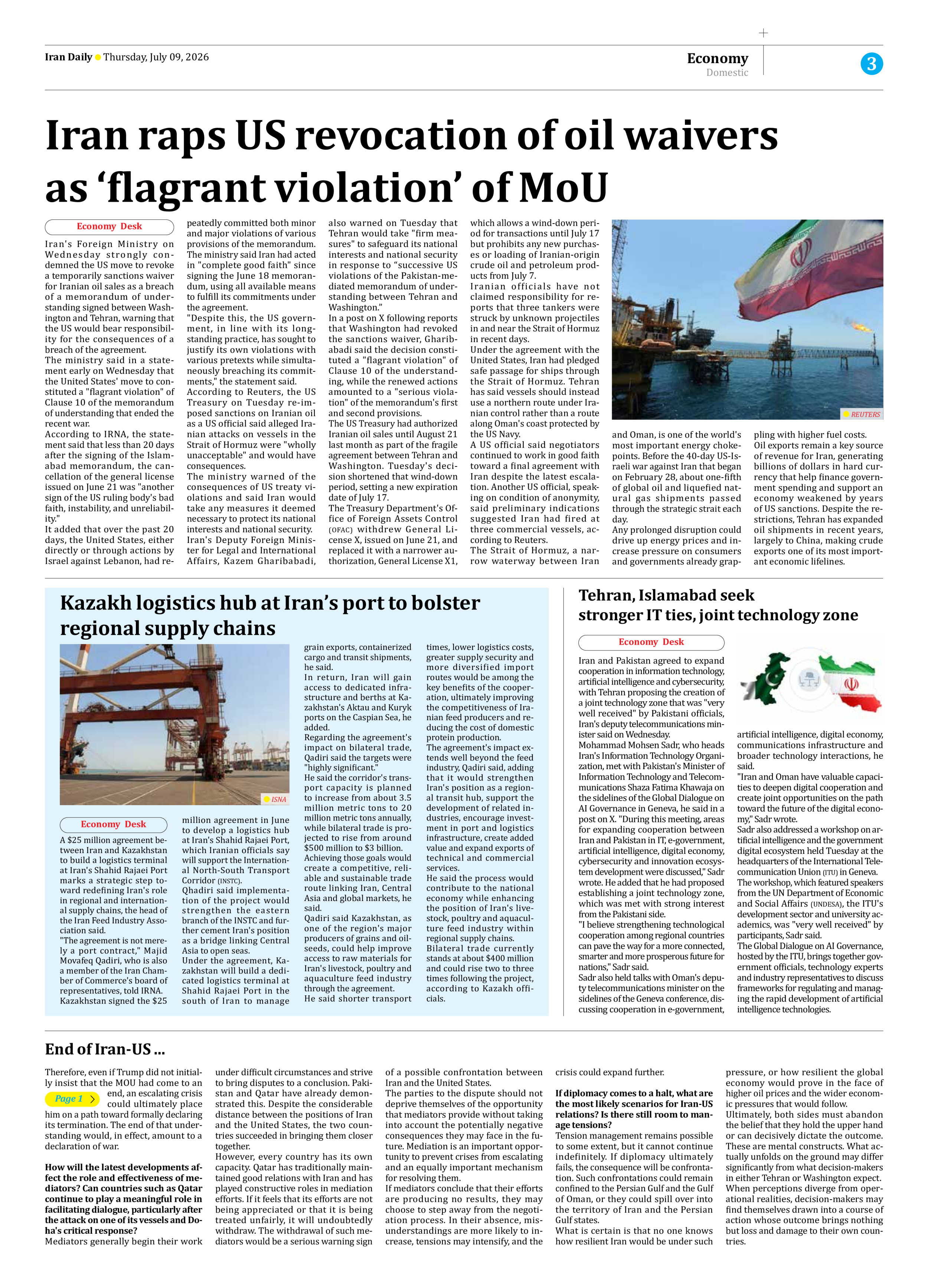
Oil exports remain a key source of revenue for Iran, generating billions of dollars in hard currency that help finance government spending and support an economy weakened by years of US sanctions. Despite the restrictions, Tehran has expanded oil shipments in recent years, largely to China, making crude exports one of its most important economic lifelines.