







Eastern Iran’s windmill heritage moves toward global recognition
The member of Iran’s Parliament representing Khaf and Roshtkhar has announced that the UNESCO world heritage nomination dossier for the region’s historic windmills is being finalized through coordinated efforts among the provinces of Khorasan Razavi, South Khorasan, and Sistan and Baluchestan, in cooperation with the Ministry of Cultural Heritage, Tourism and Handicrafts.
Speaking to ISNA, Amir Tavakoliroudi said UNESCO has proposed registering the traditional windmills of Nashtifan as part of a broader, multi-provincial heritage package covering the three eastern provinces. He added that the proposal has been discussed with the governor-general of Khorasan Razavi, and that a recent joint meeting of the governors of the three provinces was held in the same region to define responsibilities and ensure completion of the nomination file by January for submission to UNESCO.
Following this coordination, he said, local authorities in Khaf have prepared a detailed checklist to address remaining obstacles. A joint session involving members of the Islamic City Council, the mayor, officials from the Cultural Heritage Department, the Housing Foundation, and the Ministry of Roads and Urban Development agreed to proceed with clearing and safeguarding the buffer zones surrounding the windmills.
Tavakoliroudi described tourism as the world’s third-largest economic sector, noting that investment in each segment of the industry can generate between seven and nine jobs and contribute significantly to local economic growth.
He emphasized that tourism is one of the key development potentials of Khaf and Roshtkhar, adding that Khaf ranks as the second most visited destination in Khorasan Razavi Province, reflecting its strong capacity for targeted tourism development.
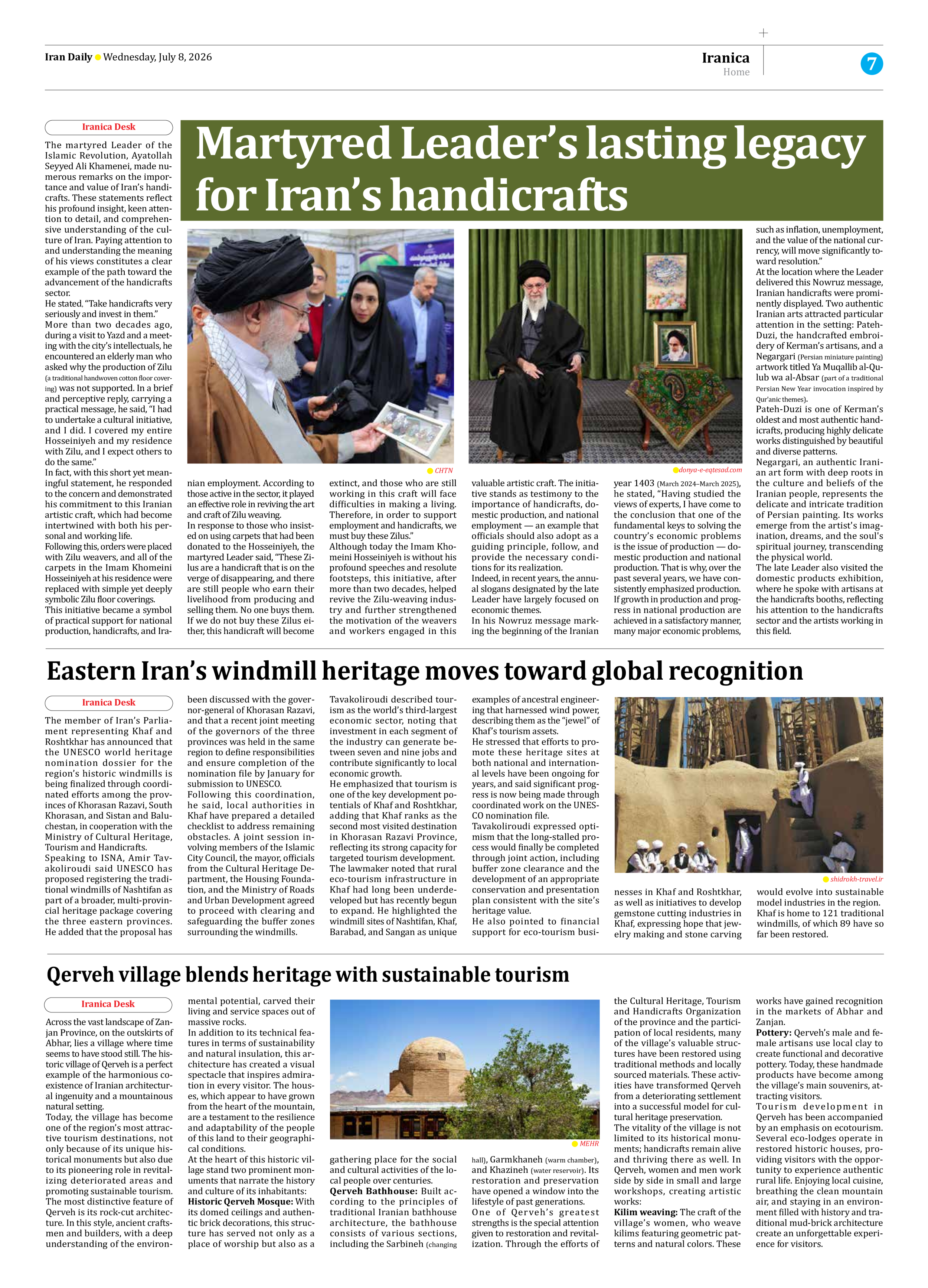
The lawmaker noted that rural eco-tourism infrastructure in Khaf had long been underdeveloped but has recently begun to expand. He highlighted the windmill sites of Nashtifan, Khaf, Barabad, and Sangan as unique examples of ancestral engineering that harnessed wind power, describing them as the “jewel” of Khaf’s tourism assets.
He stressed that efforts to promote these heritage sites at both national and international levels have been ongoing for years, and said significant progress is now being made through coordinated work on the UNESCO nomination file.
Tavakoliroudi expressed optimism that the long-stalled process would finally be completed through joint action, including buffer zone clearance and the development of an appropriate conservation and presentation plan consistent with the site’s heritage value.
He also pointed to financial support for eco-tourism businesses in Khaf and Roshtkhar, as well as initiatives to develop gemstone cutting industries in Khaf, expressing hope that jewelry making and stone carving would evolve into sustainable model industries in the region.
Khaf is home to 121 traditional windmills, of which 89 have so far been restored.