







Martyred Leader’s lasting legacy for Iran’s handicrafts
The martyred Leader of the Islamic Revolution, Ayatollah Seyyed Ali Khamenei, made numerous remarks on the importance and value of Iran’s handicrafts. These statements reflect his profound insight, keen attention to detail, and comprehensive understanding of the culture of Iran. Paying attention to and understanding the meaning of his views constitutes a clear example of the path toward the advancement of the handicrafts sector.
He stated, “Take handicrafts very seriously and invest in them.”
More than two decades ago, during a visit to Yazd and a meeting with the city’s intellectuals, he encountered an elderly man who asked why the production of Zilu (a traditional handwoven cotton floor covering) was not supported. In a brief and perceptive reply, carrying a practical message, he said, “I had to undertake a cultural initiative, and I did. I covered my entire Hosseiniyeh and my residence with Zilu, and I expect others to do the same.”
In fact, with this short yet meaningful statement, he responded to the concern and demonstrated his commitment to this Iranian artistic craft, which had become intertwined with both his personal and working life.
Following this, orders were placed with Zilu weavers, and all of the carpets in the Imam Khomeini Hosseiniyeh at his residence were replaced with simple yet deeply symbolic Zilu floor coverings.
This initiative became a symbol of practical support for national production, handicrafts, and Iranian employment. According to those active in the sector, it played an effective role in reviving the art and craft of Zilu weaving.
In response to those who insisted on using carpets that had been donated to the Hosseiniyeh, the martyred Leader said, “These Zilus are a handicraft that is on the verge of disappearing, and there are still people who earn their livelihood from producing and selling them. No one buys them. If we do not buy these Zilus either, this handicraft will become extinct, and those who are still working in this craft will face difficulties in making a living. Therefore, in order to support employment and handicrafts, we must buy these Zilus.”
Although today the Imam Khomeini Hosseiniyeh is without his profound speeches and resolute footsteps, this initiative, after more than two decades, helped revive the Zilu-weaving industry and further strengthened the motivation of the weavers and workers engaged in this valuable artistic craft. The initiative stands as testimony to the importance of handicrafts, domestic production, and national employment — an example that officials should also adopt as a guiding principle, follow, and provide the necessary conditions for its realization.
Indeed, in recent years, the annual slogans designated by the late Leader have largely focused on economic themes.
In his Nowruz message marking the beginning of the Iranian year 1403 (March 2024–March 2025), he stated, “Having studied the views of experts, I have come to the conclusion that one of the fundamental keys to solving the country’s economic problems is the issue of production — domestic production and national production. That is why, over the past several years, we have consistently emphasized production. If growth in production and progress in national production are achieved in a satisfactory manner, many major economic problems, such as inflation, unemployment, and the value of the national currency, will move significantly toward resolution.”
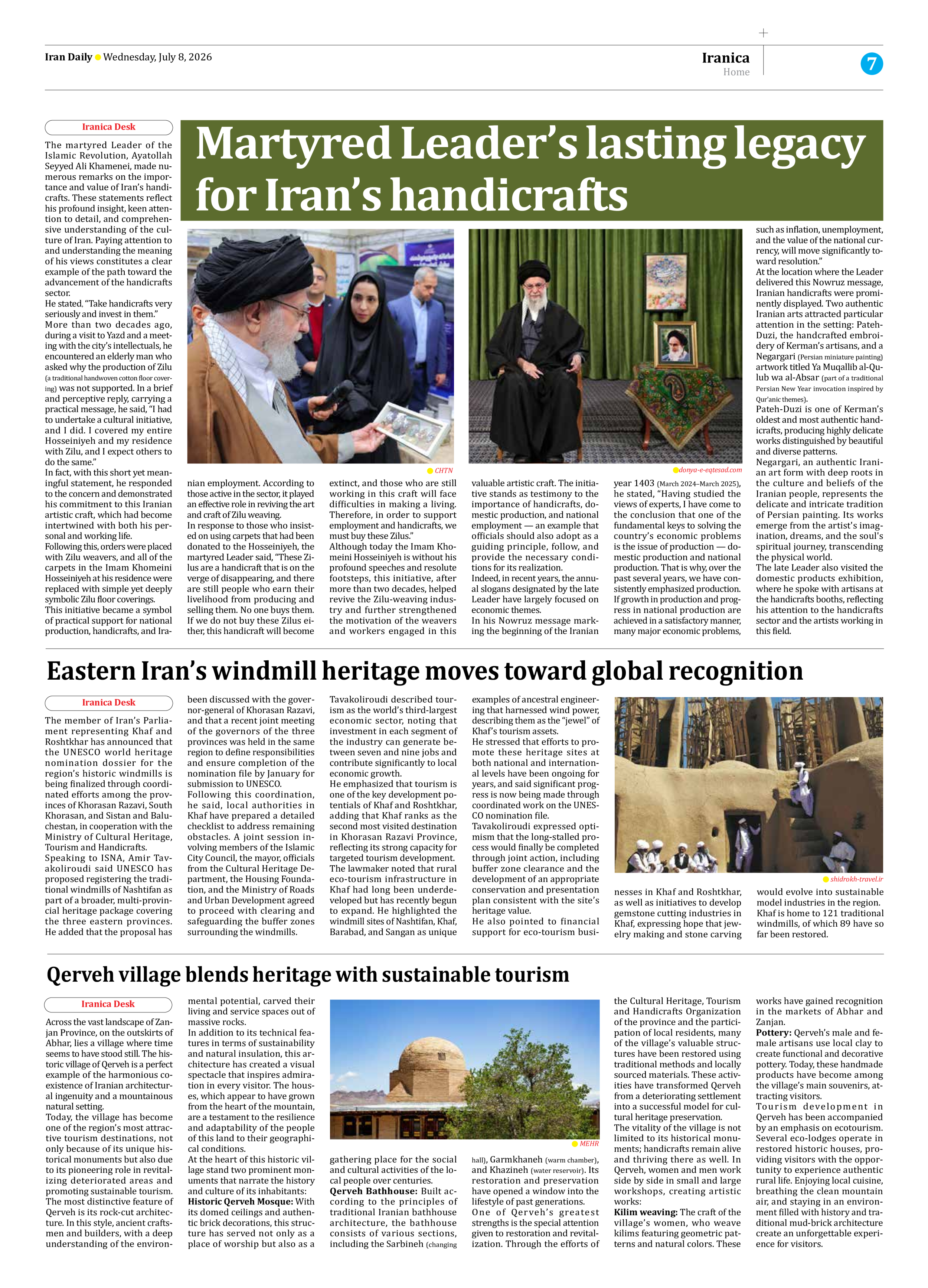
At the location where the Leader delivered this Nowruz message, Iranian handicrafts were prominently displayed. Two authentic Iranian arts attracted particular attention in the setting: Pateh-Duzi, the handcrafted embroidery of Kerman’s artisans, and a Negargari (Persian miniature painting) artwork titled Ya Muqallib al-Qulub wa al-Absar (part of a traditional Persian New Year invocation inspired by Qur'anic themes).
Pateh-Duzi is one of Kerman’s oldest and most authentic handicrafts, producing highly delicate works distinguished by beautiful and diverse patterns.
Negargari, an authentic Iranian art form with deep roots in the culture and beliefs of the Iranian people, represents the delicate and intricate tradition of Persian painting. Its works emerge from the artist's imagination, dreams, and the soul's spiritual journey, transcending the physical world.
The late Leader also visited the domestic products exhibition, where he spoke with artisans at the handicrafts booths, reflecting his attention to the handicrafts sector and the artists working in this field.