





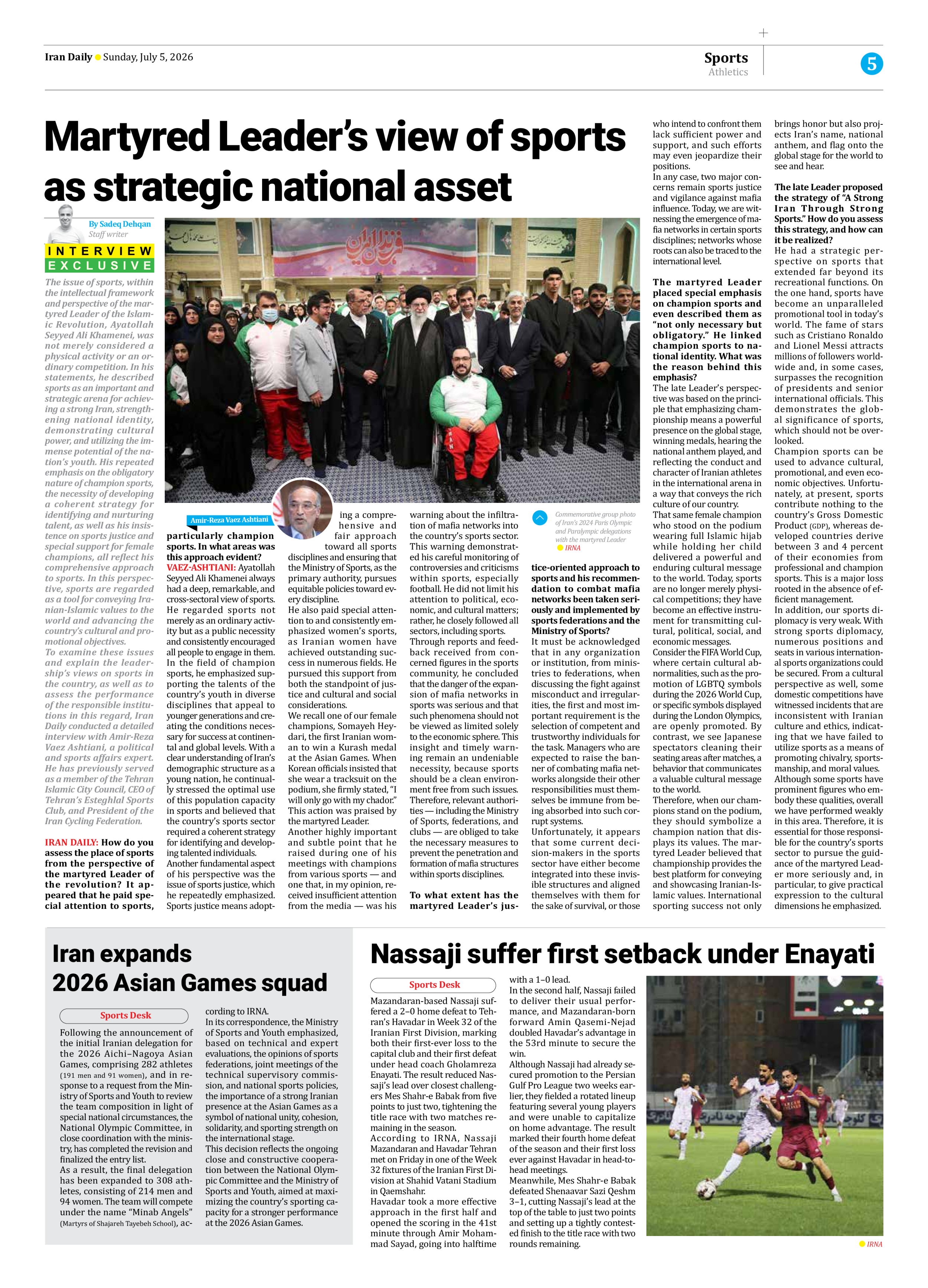


Martyred Leader’s view of sports as strategic national asset
By Sadeq Dehqan
Staff writer
The issue of sports, within the intellectual framework and perspective of the martyred Leader of the Islamic Revolution, Ayatollah Seyyed Ali Khamenei, was not merely considered a physical activity or an ordinary competition. In his statements, he described sports as an important and strategic arena for achieving a strong Iran, strengthening national identity, demonstrating cultural power, and utilizing the immense potential of the nation’s youth. His repeated emphasis on the obligatory nature of champion sports, the necessity of developing a coherent strategy for identifying and nurturing talent, as well as his insistence on sports justice and special support for female champions, all reflect his comprehensive approach to sports. In this perspective, sports are regarded as a tool for conveying Iranian-Islamic values to the world and advancing the country’s cultural and promotional objectives.
To examine these issues and explain the leadership’s views on sports in the country, as well as to assess the performance of the responsible institutions in this regard, Iran Daily conducted a detailed interview with Amir-Reza Vaez Ashtiani, a political and sports affairs expert. He has previously served as a member of the Tehran Islamic City Council, CEO of Tehran’s Esteghlal Sports Club, and President of the Iran Cycling Federation.
IRAN DAILY: How do you assess the place of sports from the perspective of the martyred Leader of the revolution? It appeared that he paid special attention to sports, particularly champion sports. In what areas was this approach evident?
Vaez-Ashtiani: Ayatollah Seyyed Ali Khamenei always had a deep, remarkable, and cross-sectoral view of sports. He regarded sports not merely as an ordinary activity but as a public necessity and consistently encouraged all people to engage in them. In the field of champion sports, he emphasized supporting the talents of the country’s youth in diverse disciplines that appeal to younger generations and creating the conditions necessary for success at continental and global levels. With a clear understanding of Iran’s demographic structure as a young nation, he continually stressed the optimal use of this population capacity in sports and believed that the country’s sports sector required a coherent strategy for identifying and developing talented individuals.
Another fundamental aspect of his perspective was the issue of sports justice, which he repeatedly emphasized. Sports justice means adopting a comprehensive and fair approach toward all sports disciplines and ensuring that the Ministry of Sports, as the primary authority, pursues equitable policies toward every discipline.
He also paid special attention to and consistently emphasized women’s sports, as Iranian women have achieved outstanding success in numerous fields. He pursued this support from both the standpoint of justice and cultural and social considerations.
We recall one of our female champions, Somayeh Heydari, the first Iranian woman to win a Kurash medal at the Asian Games. When Korean officials insisted that she wear a tracksuit on the podium, she firmly stated, “I will only go with my chador.” This action was praised by the martyred Leader.
Another highly important and subtle point that he raised during one of his meetings with champions from various sports — and one that, in my opinion, received insufficient attention from the media — was his warning about the infiltration of mafia networks into the country’s sports sector. This warning demonstrated his careful monitoring of controversies and criticisms within sports, especially football. He did not limit his attention to political, economic, and cultural matters; rather, he closely followed all sectors, including sports.
Through reports and feedback received from concerned figures in the sports community, he concluded that the danger of the expansion of mafia networks in sports was serious and that such phenomena should not be viewed as limited solely to the economic sphere. This insight and timely warning remain an undeniable necessity, because sports should be a clean environment free from such issues. Therefore, relevant authorities — including the Ministry of Sports, federations, and clubs — are obliged to take the necessary measures to prevent the penetration and formation of mafia structures within sports disciplines.
To what extent has the martyred Leader’s justice-oriented approach to sports and his recommendation to combat mafia networks been taken seriously and implemented by sports federations and the Ministry of Sports?
It must be acknowledged that in any organization or institution, from ministries to federations, when discussing the fight against misconduct and irregularities, the first and most important requirement is the selection of competent and trustworthy individuals for the task. Managers who are expected to raise the banner of combating mafia networks alongside their other responsibilities must themselves be immune from being absorbed into such corrupt systems.
Unfortunately, it appears that some current decision-makers in the sports sector have either become integrated into these invisible structures and aligned themselves with them for the sake of survival, or those who intend to confront them lack sufficient power and support, and such efforts may even jeopardize their positions.
In any case, two major concerns remain sports justice and vigilance against mafia influence. Today, we are witnessing the emergence of mafia networks in certain sports disciplines; networks whose roots can also be traced to the international level.
The martyred Leader placed special emphasis on champion sports and even described them as “not only necessary but obligatory.” He linked champion sports to national identity. What was the reason behind this emphasis?
The late Leader’s perspective was based on the principle that emphasizing championship means a powerful presence on the global stage, winning medals, hearing the national anthem played, and reflecting the conduct and character of Iranian athletes in the international arena in a way that conveys the rich culture of our country.
That same female champion who stood on the podium wearing full Islamic hijab while holding her child delivered a powerful and enduring cultural message to the world. Today, sports are no longer merely physical competitions; they have become an effective instrument for transmitting cultural, political, social, and economic messages.
Consider the FIFA World Cup, where certain cultural abnormalities, such as the promotion of LGBTQ symbols during the 2026 World Cup, or specific symbols displayed during the London Olympics, are openly promoted. By contrast, we see Japanese spectators cleaning their seating areas after matches, a behavior that communicates a valuable cultural message to the world.
Therefore, when our champions stand on the podium, they should symbolize a champion nation that displays its values. The martyred Leader believed that championship provides the best platform for conveying and showcasing Iranian-Islamic values. International sporting success not only brings honor but also projects Iran’s name, national anthem, and flag onto the global stage for the world to see and hear.
The late Leader proposed the strategy of “A Strong Iran Through Strong Sports.” How do you assess this strategy, and how can it be realized?
He had a strategic perspective on sports that extended far beyond its recreational functions. On the one hand, sports have become an unparalleled promotional tool in today’s world. The fame of stars such as Cristiano Ronaldo and Lionel Messi attracts millions of followers worldwide and, in some cases, surpasses the recognition of presidents and senior international officials. This demonstrates the global significance of sports, which should not be overlooked.
Champion sports can be used to advance cultural, promotional, and even economic objectives. Unfortunately, at present, sports contribute nothing to the country’s Gross Domestic Product (GDP), whereas developed countries derive between 3 and 4 percent of their economies from professional and champion sports. This is a major loss rooted in the absence of efficient management.
In addition, our sports diplomacy is very weak. With strong sports diplomacy, numerous positions and seats in various international sports organizations could be secured. From a cultural perspective as well, some domestic competitions have witnessed incidents that are inconsistent with Iranian culture and ethics, indicating that we have failed to utilize sports as a means of promoting chivalry, sportsmanship, and moral values.
Although some sports have prominent figures who embody these qualities, overall we have performed weakly in this area. Therefore, it is essential for those responsible for the country’s sports sector to pursue the guidance of the martyred Leader more seriously and, in particular, to give practical expression to the cultural dimensions he emphasized.