







Iran in talks with Turkey to import power for petrochemical plants damaged in war
Iran has begun negotiations with Turkey to secure electricity imports for its petrochemical industry after power plants serving the sector were damaged during the recent US-Israeli war, a senior energy official said Thursday.
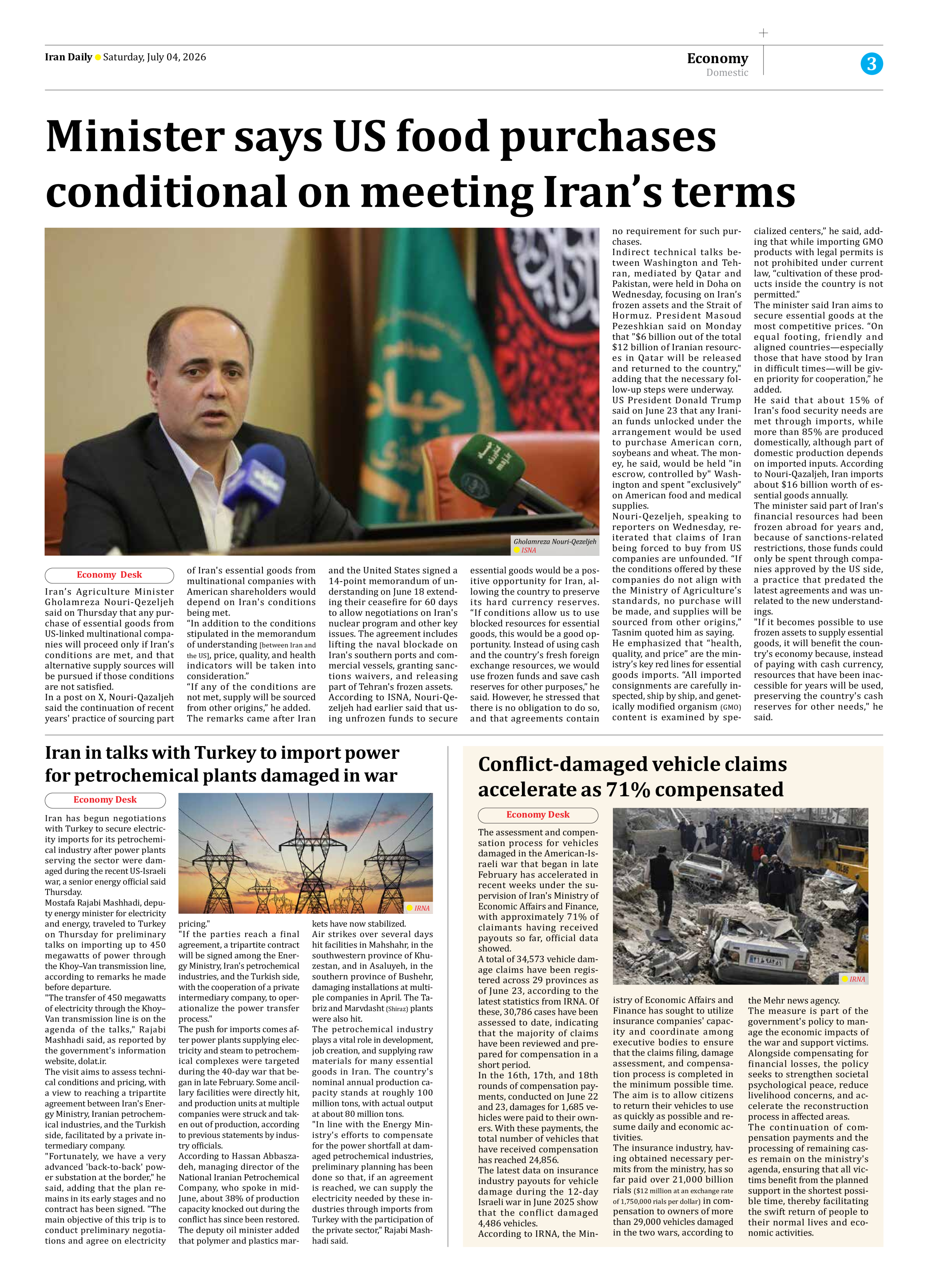
Mostafa Rajabi Mashhadi, deputy energy minister for electricity and energy, traveled to Turkey on Thursday for preliminary talks on importing up to 450 megawatts of power through the Khoy–Van transmission line, according to remarks he made before departure.
"The transfer of 450 megawatts of electricity through the Khoy–Van transmission line is on the agenda of the talks," Rajabi Mashhadi said, as reported by the government's information website, dolat.ir.
The visit aims to assess technical conditions and pricing, with a view to reaching a tripartite agreement between Iran's Energy Ministry, Iranian petrochemical industries, and the Turkish side, facilitated by a private intermediary company.
"Fortunately, we have a very advanced 'back-to-back' power substation at the border," he said, adding that the plan remains in its early stages and no contract has been signed. "The main objective of this trip is to conduct preliminary negotiations and agree on electricity pricing."
"If the parties reach a final agreement, a tripartite contract will be signed among the Energy Ministry, Iran's petrochemical industries, and the Turkish side, with the cooperation of a private intermediary company, to operationalize the power transfer process."
The push for imports comes after power plants supplying electricity and steam to petrochemical complexes were targeted during the 40-day war that began in late February. Some ancillary facilities were directly hit, and production units at multiple companies were struck and taken out of production, according to previous statements by industry officials.
According to Hassan Abbaszadeh, managing director of the National Iranian Petrochemical Company, who spoke in mid-June, about 38% of production capacity knocked out during the conflict has since been restored. The deputy oil minister added that polymer and plastics markets have now stabilized.
Air strikes over several days hit facilities in Mahshahr, in the southwestern province of Khuzestan, and in Asaluyeh, in the southern province of Bushehr, damaging installations at multiple companies in April. The Tabriz and Marvdasht (Shiraz) plants were also hit.
The petrochemical industry plays a vital role in development, job creation, and supplying raw materials for many essential goods in Iran. The country's nominal annual production capacity stands at roughly 100 million tons, with actual output at about 80 million tons.
"In line with the Energy Ministry's efforts to compensate for the power shortfall at damaged petrochemical industries, preliminary planning has been done so that, if an agreement is reached, we can supply the electricity needed by these industries through imports from Turkey with the participation of the private sector," Rajabi Mashhadi said.