







Minister says US food purchases conditional on meeting Iran’s terms
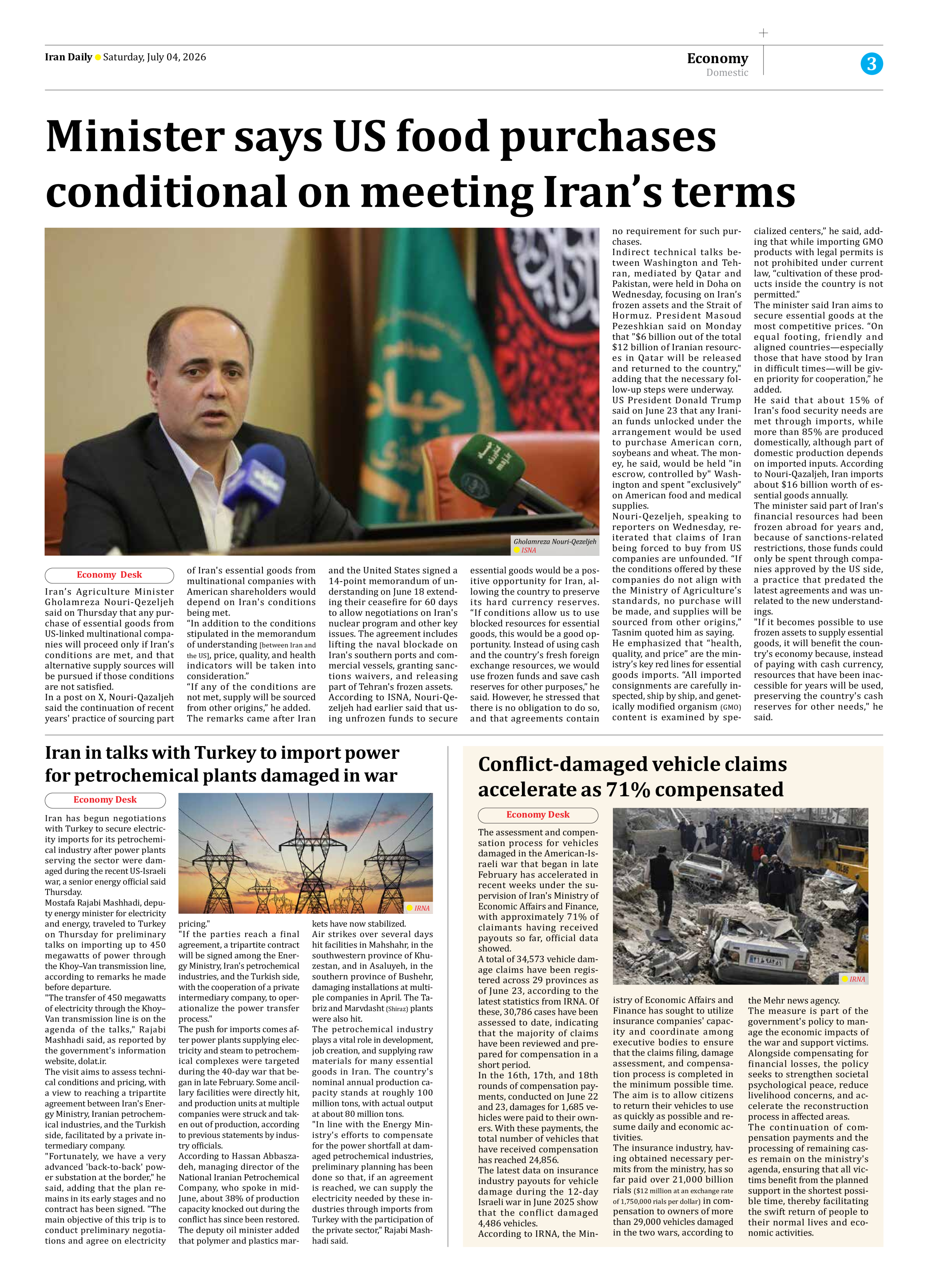
Iran’s Agriculture Minister Gholamreza Nouri-Qezeljeh said on Thursday that any purchase of essential goods from US-linked multinational companies will proceed only if Iran’s conditions are met, and that alternative supply sources will be pursued if those conditions are not satisfied.
In a post on X, Nouri-Qazaljeh said the continuation of recent years' practice of sourcing part of Iran's essential goods from multinational companies with American shareholders would depend on Iran's conditions being met.
“In addition to the conditions stipulated in the memorandum of understanding [between Iran and the US], price, quality, and health indicators will be taken into consideration.”
“If any of the conditions are not met, supply will be sourced from other origins,” he added.
The remarks came after Iran and the United States signed a 14-point memorandum of understanding on June 18 extending their ceasefire for 60 days to allow negotiations on Iran's nuclear program and other key issues. The agreement includes lifting the naval blockade on Iran's southern ports and commercial vessels, granting sanctions waivers, and releasing part of Tehran's frozen assets.
According to ISNA, Nouri-Qezeljeh had earlier said that using unfrozen funds to secure essential goods would be a positive opportunity for Iran, allowing the country to preserve its hard currency reserves. “If conditions allow us to use blocked resources for essential goods, this would be a good opportunity. Instead of using cash and the country’s fresh foreign exchange resources, we would use frozen funds and save cash reserves for other purposes,” he said. However, he stressed that there is no obligation to do so, and that agreements contain no requirement for such purchases.
Indirect technical talks between Washington and Tehran, mediated by Qatar and Pakistan, were held in Doha on Wednesday, focusing on Iran’s frozen assets and the Strait of Hormuz. President Masoud Pezeshkian said on Monday that "$6 billion out of the total $12 billion of Iranian resources in Qatar will be released and returned to the country," adding that the necessary follow-up steps were underway.
US President Donald Trump said on June 23 that any Iranian funds unlocked under the arrangement would be used to purchase American corn, soybeans and wheat. The money, he said, would be held "in escrow, controlled by" Washington and spent "exclusively" on American food and medical supplies.
Nouri-Qezeljeh, speaking to reporters on Wednesday, reiterated that claims of Iran being forced to buy from US companies are unfounded. “If the conditions offered by these companies do not align with the Ministry of Agriculture’s standards, no purchase will be made, and supplies will be sourced from other origins,” Tasnim quoted him as saying.
He emphasized that “health, quality, and price” are the ministry’s key red lines for essential goods imports. “All imported consignments are carefully inspected, ship by ship, and genetically modified organism (GMO) content is examined by specialized centers,” he said, adding that while importing GMO products with legal permits is not prohibited under current law, “cultivation of these products inside the country is not permitted.”
The minister said Iran aims to secure essential goods at the most competitive prices. “On equal footing, friendly and aligned countries—especially those that have stood by Iran in difficult times—will be given priority for cooperation,” he added.
He said that about 15% of Iran's food security needs are met through imports, while more than 85% are produced domestically, although part of domestic production depends on imported inputs. According to Nouri-Qazaljeh, Iran imports about $16 billion worth of essential goods annually.
The minister said part of Iran's financial resources had been frozen abroad for years and, because of sanctions-related restrictions, those funds could only be spent through companies approved by the US side, a practice that predated the latest agreements and was unrelated to the new understandings.
"If it becomes possible to use frozen assets to supply essential goods, it will benefit the country's economy because, instead of paying with cash currency, resources that have been inaccessible for years will be used, preserving the country's cash reserves for other needs," he said.