







Nashtifan windmills show Iran’s ancient mastery of wind power
The windmills of Nashtifan in northeastern Iran stand among the most remarkable examples of indigenous engineering and climate-adapted architecture. Long before the concepts of renewable energy and sustainable development entered modern discourse, Iranian communities had learned to harness the power of the wind to grind grain and sustain local livelihoods.
In a commentary provided to ISNA, Hamidreza Nasseri, a faculty member at the University of Tehran’s Faculty of Natural Resources and head of the university’s International Desert Research Center, highlighted the significance of Iran’s historic windmills and called for renewed efforts to secure their international recognition.
According to Nasseri, deserts and arid regions are often associated with drought, dust storms, soil erosion, and advancing sands. Yet focusing solely on these challenges overlooks another reality: deserts have also been landscapes of innovation and wisdom. Throughout history, Iranian communities developed ingenious responses to harsh environmental conditions, including qanats, water reservoirs, mud-brick ice houses, Persian gardens, and windmills.
Rather than fighting against nature, Nasseri argued, Iran’s ancestors learned to understand their environment and transform its limitations into opportunities. In places where rainfall was scarce, qanats brought water to settlements; where scorching heat prevailed, ice houses preserved cool water; and where powerful winds swept across the landscape, windmills converted natural energy into a source of food security.
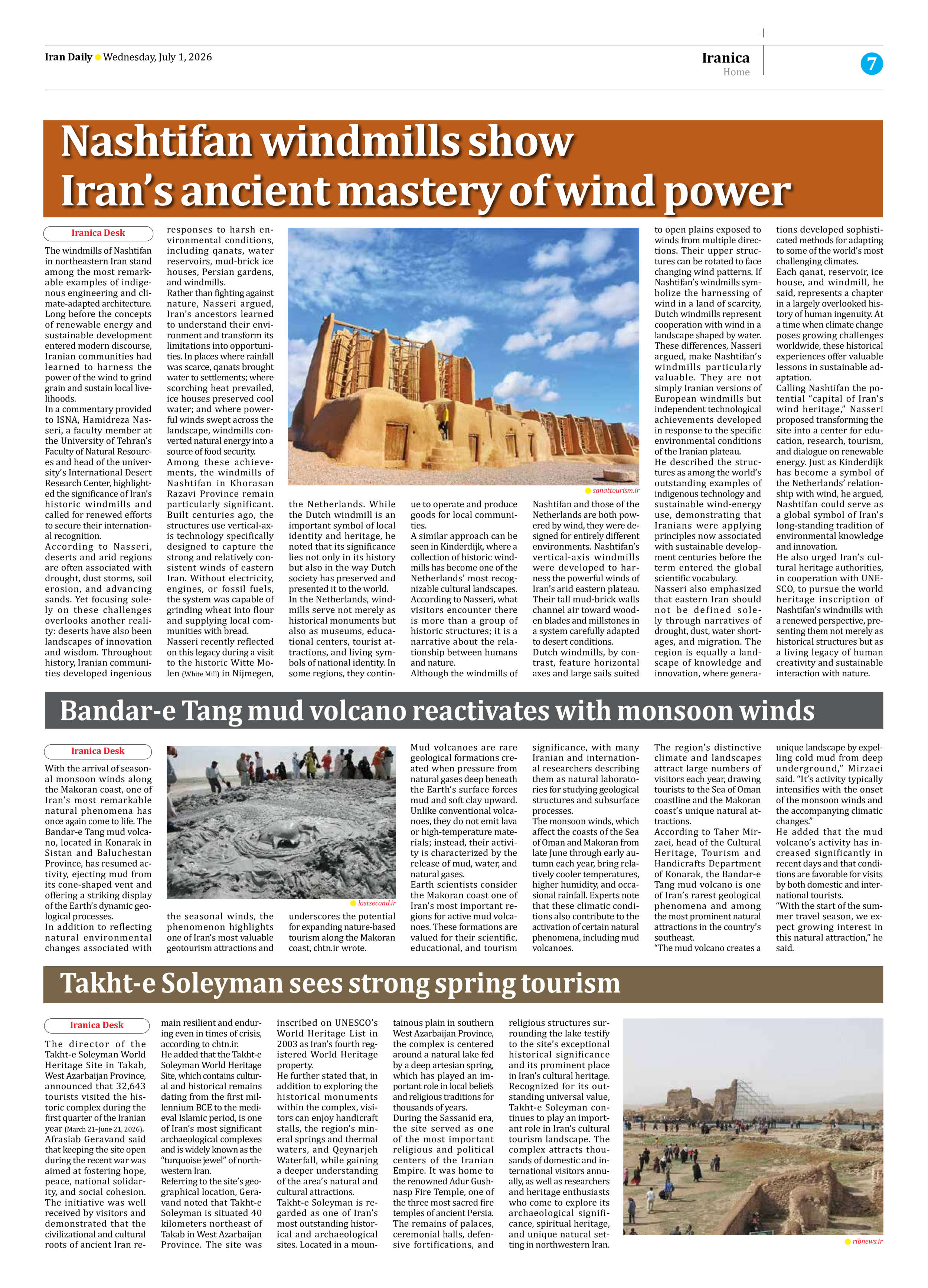
Among these achievements, the windmills of Nashtifan in Khorasan Razavi Province remain particularly significant. Built centuries ago, the structures use vertical-axis technology specifically designed to capture the strong and relatively consistent winds of eastern Iran. Without electricity, engines, or fossil fuels, the system was capable of grinding wheat into flour and supplying local communities with bread.
Nasseri recently reflected on this legacy during a visit to the historic Witte Molen (White Mill) in Nijmegen, the Netherlands. While the Dutch windmill is an important symbol of local identity and heritage, he noted that its significance lies not only in its history but also in the way Dutch society has preserved and presented it to the world.
In the Netherlands, windmills serve not merely as historical monuments but also as museums, educational centers, tourist attractions, and living symbols of national identity. In some regions, they continue to operate and produce goods for local communities.
A similar approach can be seen in Kinderdijk, where a collection of historic windmills has become one of the Netherlands’ most recognizable cultural landscapes. According to Nasseri, what visitors encounter there is more than a group of historic structures; it is a narrative about the relationship between humans and nature.
Although the windmills of Nashtifan and those of the Netherlands are both powered by wind, they were designed for entirely different environments. Nashtifan’s vertical-axis windmills were developed to harness the powerful winds of Iran’s arid eastern plateau. Their tall mud-brick walls channel air toward wooden blades and millstones in a system carefully adapted to desert conditions.
Dutch windmills, by contrast, feature horizontal axes and large sails suited to open plains exposed to winds from multiple directions. Their upper structures can be rotated to face changing wind patterns. If Nashtifan’s windmills symbolize the harnessing of wind in a land of scarcity, Dutch windmills represent cooperation with wind in a landscape shaped by water.
These differences, Nasseri argued, make Nashtifan’s windmills particularly valuable. They are not simply Iranian versions of European windmills but independent technological achievements developed in response to the specific environmental conditions of the Iranian plateau.
He described the structures as among the world’s outstanding examples of indigenous technology and sustainable wind-energy use, demonstrating that Iranians were applying principles now associated with sustainable development centuries before the term entered the global scientific vocabulary.
Nasseri also emphasized that eastern Iran should not be defined solely through narratives of drought, dust, water shortages, and migration. The region is equally a landscape of knowledge and innovation, where generations developed sophisticated methods for adapting to some of the world’s most challenging climates.
Each qanat, reservoir, ice house, and windmill, he said, represents a chapter in a largely overlooked history of human ingenuity. At a time when climate change poses growing challenges worldwide, these historical experiences offer valuable lessons in sustainable adaptation.
Calling Nashtifan the potential “capital of Iran’s wind heritage,” Nasseri proposed transforming the site into a center for education, research, tourism, and dialogue on renewable energy. Just as Kinderdijk has become a symbol of the Netherlands’ relationship with wind, he argued, Nashtifan could serve as a global symbol of Iran’s long-standing tradition of environmental knowledge and innovation.
He also urged Iran’s cultural heritage authorities, in cooperation with UNESCO, to pursue the world heritage inscription of Nashtifan’s windmills with a renewed perspective, presenting them not merely as historical structures but as a living legacy of human creativity and sustainable interaction with nature.