







Kolgah Zarrin excavations offer new insights into ancient Elymais Civilization
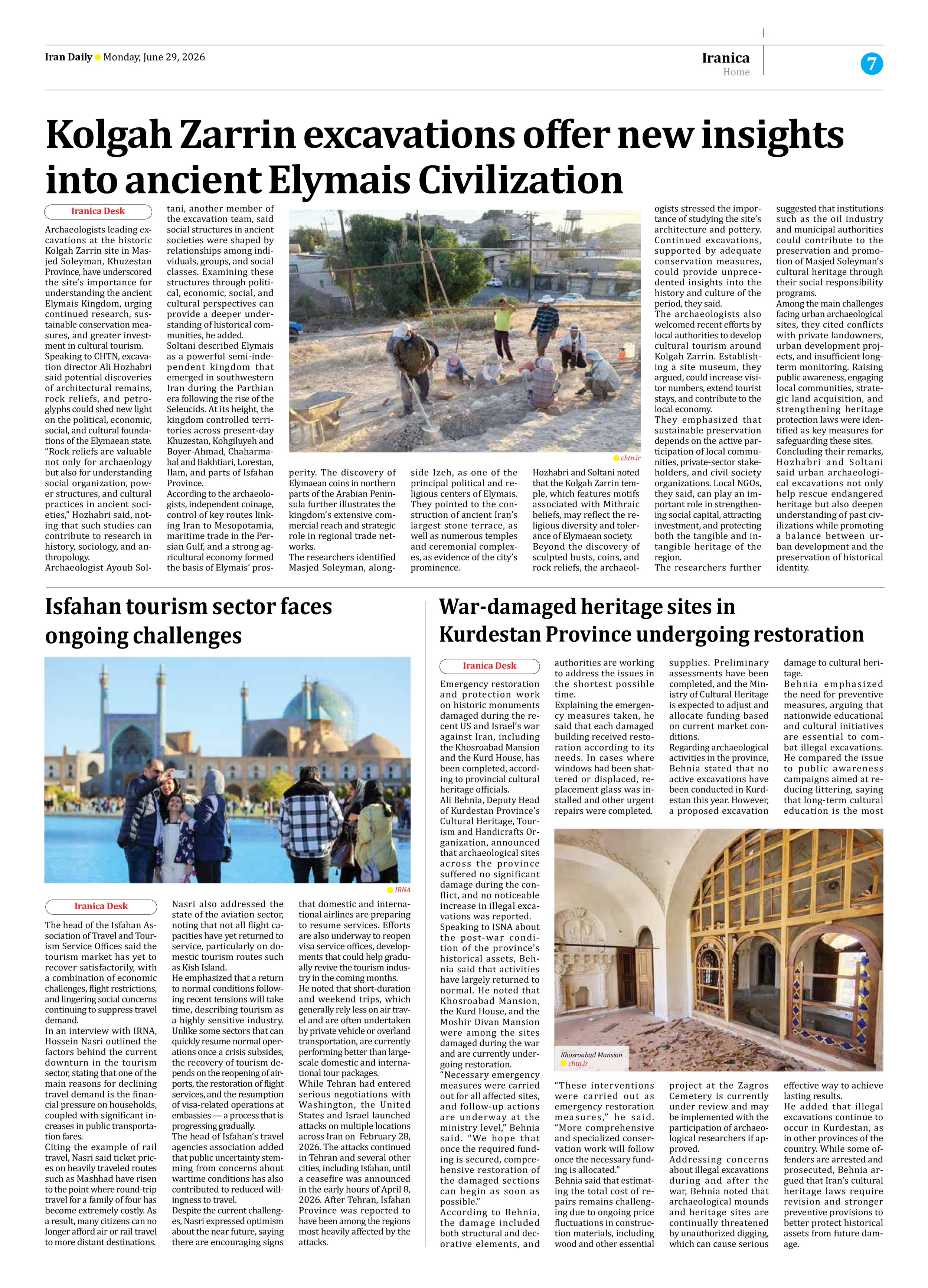
Archaeologists leading excavations at the historic Kolgah Zarrin site in Masjed Soleyman, Khuzestan Province, have underscored the site’s importance for understanding the ancient Elymais Kingdom, urging continued research, sustainable conservation measures, and greater investment in cultural tourism.
Speaking to CHTN, excavation director Ali Hozhabri said potential discoveries of architectural remains, rock reliefs, and petroglyphs could shed new light on the political, economic, social, and cultural foundations of the Elymaean state.
“Rock reliefs are valuable not only for archaeology but also for understanding social organization, power structures, and cultural practices in ancient societies,” Hozhabri said, noting that such studies can contribute to research in history, sociology, and anthropology.
Archaeologist Ayoub Soltani, another member of the excavation team, said social structures in ancient societies were shaped by relationships among individuals, groups, and social classes. Examining these structures through political, economic, social, and cultural perspectives can provide a deeper understanding of historical communities, he added.
Soltani described Elymais as a powerful semi-independent kingdom that emerged in southwestern Iran during the Parthian era following the rise of the Seleucids. At its height, the kingdom controlled territories across present-day Khuzestan, Kohgiluyeh and Boyer-Ahmad, Chaharmahal and Bakhtiari, Lorestan, Ilam, and parts of Isfahan Province.
According to the archaeologists, independent coinage, control of key routes linking Iran to Mesopotamia, maritime trade in the Persian Gulf, and a strong agricultural economy formed the basis of Elymais’ prosperity. The discovery of Elymaean coins in northern parts of the Arabian Peninsula further illustrates the kingdom’s extensive commercial reach and strategic role in regional trade networks.
The researchers identified Masjed Soleyman, alongside Izeh, as one of the principal political and religious centers of Elymais. They pointed to the construction of ancient Iran’s largest stone terrace, as well as numerous temples and ceremonial complexes, as evidence of the city’s prominence.
Hozhabri and Soltani noted that the Kolgah Zarrin temple, which features motifs associated with Mithraic beliefs, may reflect the religious diversity and tolerance of Elymaean society.
Beyond the discovery of sculpted busts, coins, and rock reliefs, the archaeologists stressed the importance of studying the site’s architecture and pottery. Continued excavations, supported by adequate conservation measures, could provide unprecedented insights into the history and culture of the period, they said.
The archaeologists also welcomed recent efforts by local authorities to develop cultural tourism around Kolgah Zarrin. Establishing a site museum, they argued, could increase visitor numbers, extend tourist stays, and contribute to the local economy.
They emphasized that sustainable preservation depends on the active participation of local communities, private-sector stakeholders, and civil society organizations. Local NGOs, they said, can play an important role in strengthening social capital, attracting investment, and protecting both the tangible and intangible heritage of the region.
The researchers further suggested that institutions such as the oil industry and municipal authorities could contribute to the preservation and promotion of Masjed Soleyman’s cultural heritage through their social responsibility programs.
Among the main challenges facing urban archaeological sites, they cited conflicts with private landowners, urban development projects, and insufficient long-term monitoring. Raising public awareness, engaging local communities, strategic land acquisition, and strengthening heritage protection laws were identified as key measures for safeguarding these sites.
Concluding their remarks, Hozhabri and Soltani said urban archaeological excavations not only help rescue endangered heritage but also deepen understanding of past civilizations while promoting a balance between urban development and the preservation of historical identity.