







Martian Mountains offer surreal landscape in Chabahar
When the name Mars comes up, many people imagine images sent back by NASA missions — a dry, lifeless world marked by strange ridges and rugged terrain. Yet one does not need to travel millions of kilometers to witness a Martian-like landscape.
In southeastern Iran, between Chabahar and Gwatar, lies a remarkable mountain range known as the “Martian Mountains” or “Miniature Mountains.” For years, this natural formation has been regarded as one of the country’s most unusual geological attractions, Mehr News Agency wrote.
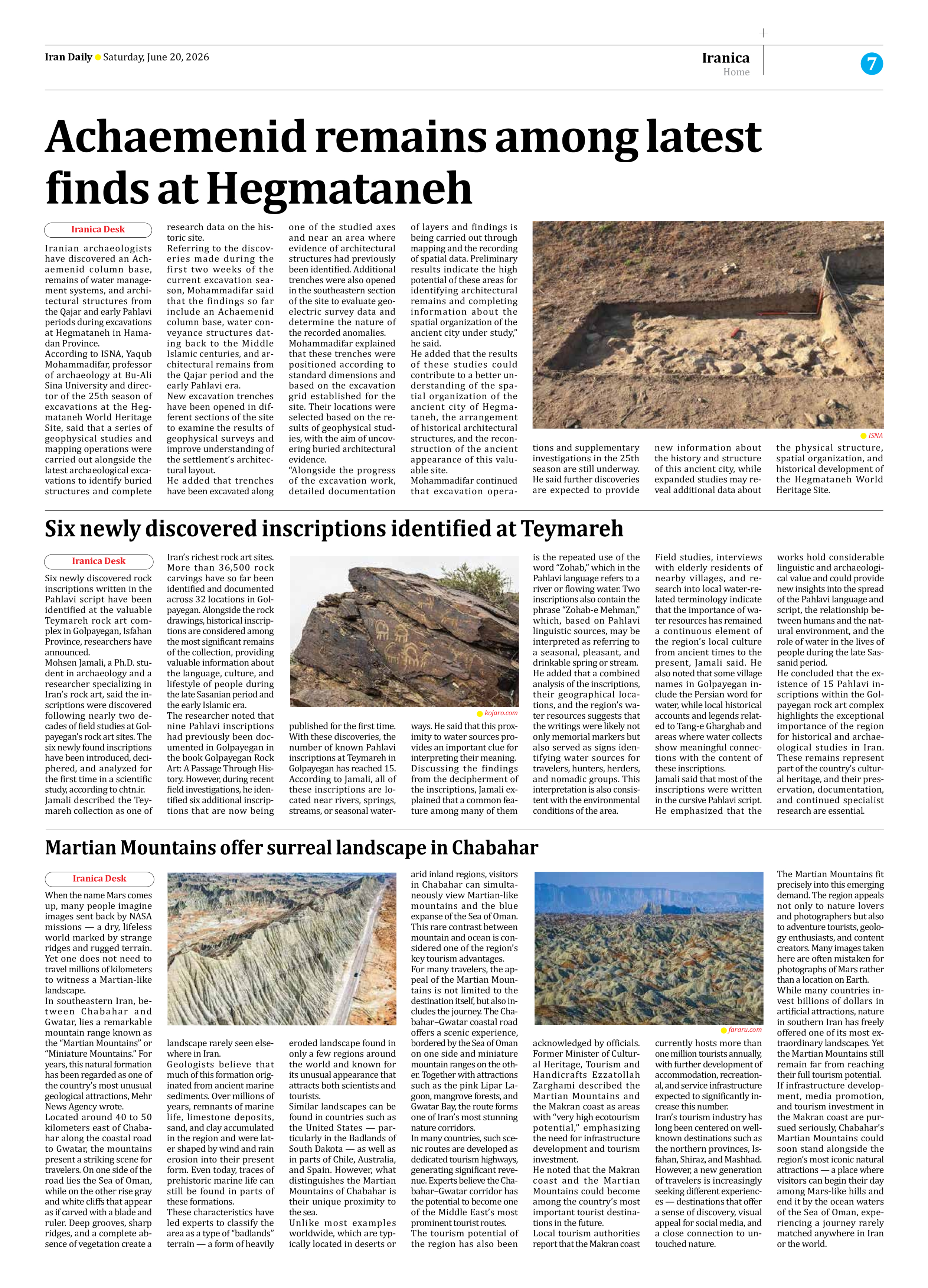
Located around 40 to 50 kilometers east of Chabahar along the coastal road to Gwatar, the mountains present a striking scene for travelers. On one side of the road lies the Sea of Oman, while on the other rise gray and white cliffs that appear as if carved with a blade and ruler. Deep grooves, sharp ridges, and a complete absence of vegetation create a landscape rarely seen elsewhere in Iran.
Geologists believe that much of this formation originated from ancient marine sediments. Over millions of years, remnants of marine life, limestone deposits, sand, and clay accumulated in the region and were later shaped by wind and rain erosion into their present form. Even today, traces of prehistoric marine life can still be found in parts of these formations.
These characteristics have led experts to classify the area as a type of “badlands” terrain — a form of heavily eroded landscape found in only a few regions around the world and known for its unusual appearance that attracts both scientists and tourists.
Similar landscapes can be found in countries such as the United States — particularly in the Badlands of South Dakota — as well as in parts of Chile, Australia, and Spain. However, what distinguishes the Martian Mountains of Chabahar is their unique proximity to the sea.
Unlike most examples worldwide, which are typically located in deserts or arid inland regions, visitors in Chabahar can simultaneously view Martian-like mountains and the blue expanse of the Sea of Oman. This rare contrast between mountain and ocean is considered one of the region’s key tourism advantages.
For many travelers, the appeal of the Martian Mountains is not limited to the destination itself, but also includes the journey. The Chabahar–Gwatar coastal road offers a scenic experience, bordered by the Sea of Oman on one side and miniature mountain ranges on the other. Together with attractions such as the pink Lipar Lagoon, mangrove forests, and Gwatar Bay, the route forms one of Iran’s most stunning nature corridors.
In many countries, such scenic routes are developed as dedicated tourism highways, generating significant revenue. Experts believe the Chabahar–Gwatar corridor has the potential to become one of the Middle East’s most prominent tourist routes.
The tourism potential of the region has also been acknowledged by officials. Former Minister of Cultural Heritage, Tourism and Handicrafts Ezzatollah Zarghami described the Martian Mountains and the Makran coast as areas with “very high ecotourism potential,” emphasizing the need for infrastructure development and tourism investment.
He noted that the Makran coast and the Martian Mountains could become among the country’s most important tourist destinations in the future.
Local tourism authorities report that the Makran coast currently hosts more than one million tourists annually, with further development of accommodation, recreational, and service infrastructure expected to significantly increase this number.
Iran’s tourism industry has long been centered on well-known destinations such as the northern provinces, Isfahan, Shiraz, and Mashhad. However, a new generation of travelers is increasingly seeking different experiences — destinations that offer a sense of discovery, visual appeal for social media, and a close connection to untouched nature.
The Martian Mountains fit precisely into this emerging demand. The region appeals not only to nature lovers and photographers but also to adventure tourists, geology enthusiasts, and content creators. Many images taken here are often mistaken for photographs of Mars rather than a location on Earth.
While many countries invest billions of dollars in artificial attractions, nature in southern Iran has freely offered one of its most extraordinary landscapes. Yet the Martian Mountains still remain far from reaching their full tourism potential.
If infrastructure development, media promotion, and tourism investment in the Makran coast are pursued seriously, Chabahar’s Martian Mountains could soon stand alongside the region’s most iconic natural attractions — a place where visitors can begin their day among Mars-like hills and end it by the ocean waters of the Sea of Oman, experiencing a journey rarely matched anywhere in Iran or the world.