







Achaemenid remains among latest finds at Hegmataneh
Iranian archaeologists have discovered an Achaemenid column base, remains of water management systems, and architectural structures from the Qajar and early Pahlavi periods during excavations at Hegmataneh in Hamadan Province.
According to ISNA, Yaqub Mohammadifar, professor of archaeology at Bu-Ali Sina University and director of the 25th season of excavations at the Hegmataneh World Heritage Site, said that a series of geophysical studies and mapping operations were carried out alongside the latest archaeological excavations to identify buried structures and complete research data on the historic site.
Referring to the discoveries made during the first two weeks of the current excavation season, Mohammadifar said that the findings so far include an Achaemenid column base, water conveyance structures dating back to the Middle Islamic centuries, and architectural remains from the Qajar period and the early Pahlavi era.
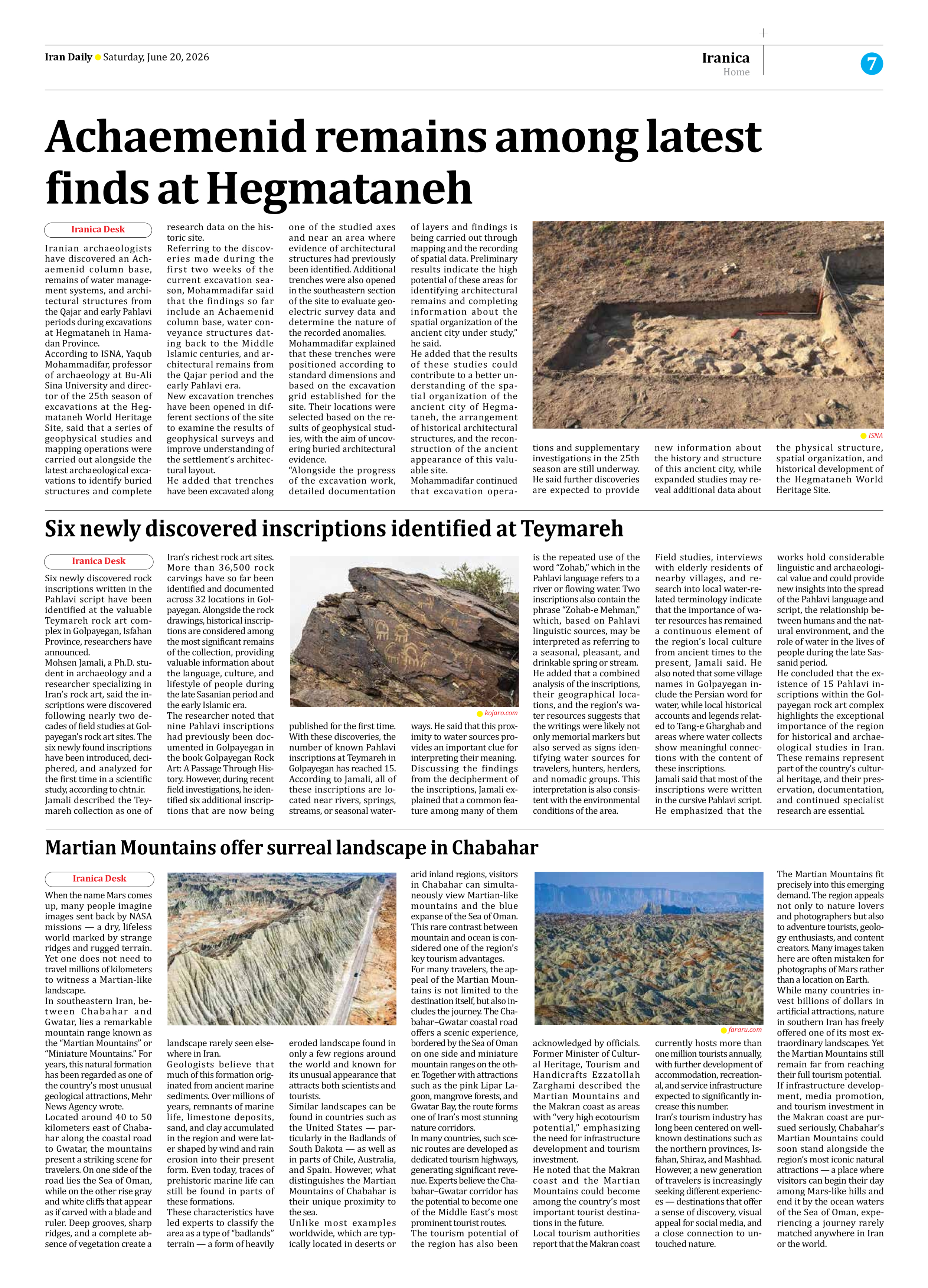
New excavation trenches have been opened in different sections of the site to examine the results of geophysical surveys and improve understanding of the settlement’s architectural layout.
He added that trenches have been excavated along one of the studied axes and near an area where evidence of architectural structures had previously been identified. Additional trenches were also opened in the southeastern section of the site to evaluate geoelectric survey data and determine the nature of the recorded anomalies.
Mohammadifar explained that these trenches were positioned according to standard dimensions and based on the excavation grid established for the site. Their locations were selected based on the results of geophysical studies, with the aim of uncovering buried architectural evidence.
“Alongside the progress of the excavation work, detailed documentation of layers and findings is being carried out through mapping and the recording of spatial data. Preliminary results indicate the high potential of these areas for identifying architectural remains and completing information about the spatial organization of the ancient city under study,” he said.
He added that the results of these studies could contribute to a better understanding of the spatial organization of the ancient city of Hegmataneh, the arrangement of historical architectural structures, and the reconstruction of the ancient appearance of this valuable site.
Mohammadifar continued that excavation operations and supplementary investigations in the 25th season are still underway. He said further discoveries are expected to provide new information about the history and structure of this ancient city, while expanded studies may reveal additional data about the physical structure, spatial organization, and historical development of the Hegmataneh World Heritage Site.