







Six newly discovered inscriptions identified at Teymareh
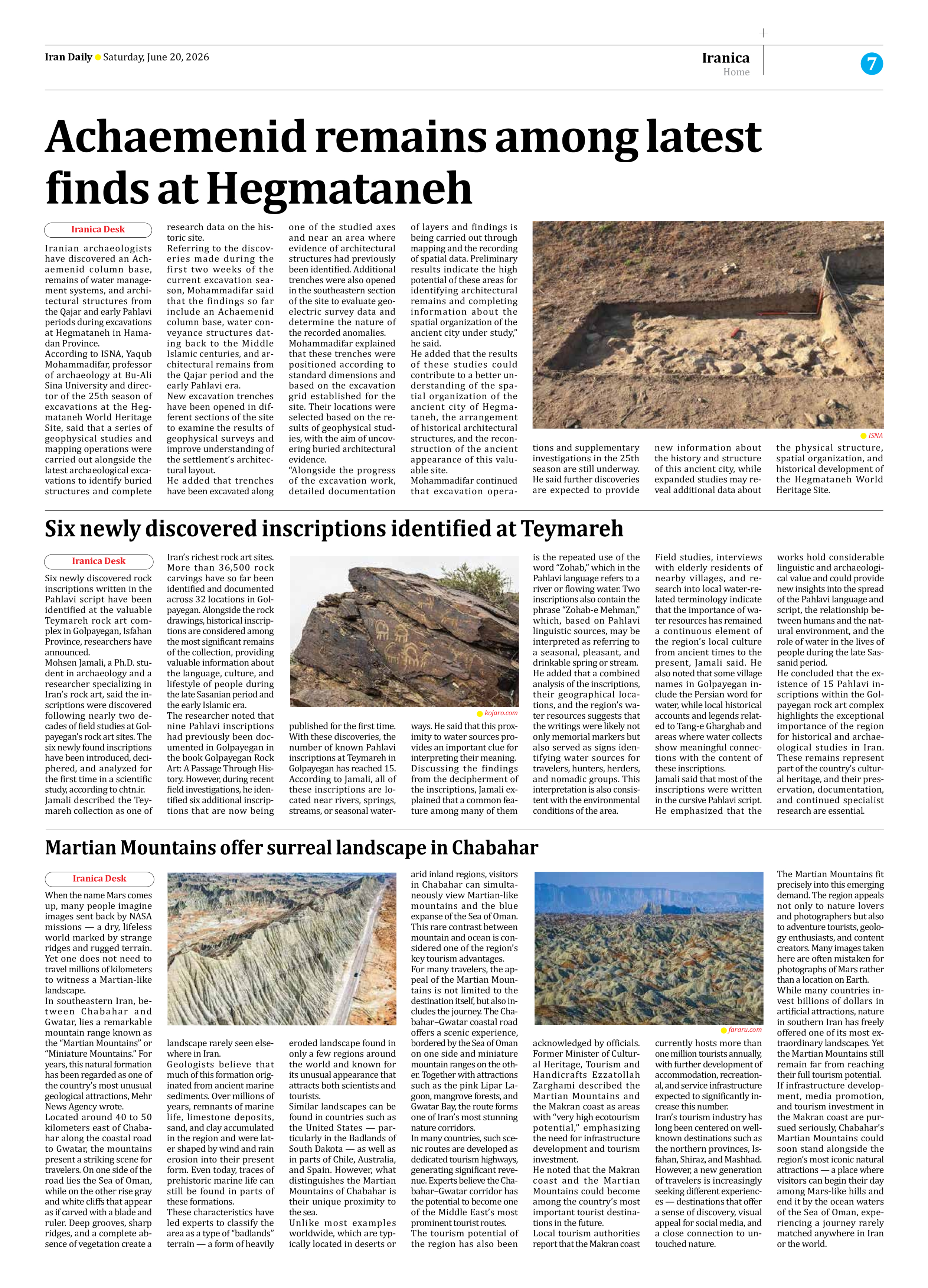
Six newly discovered rock inscriptions written in the Pahlavi script have been identified at the valuable Teymareh rock art complex in Golpayegan, Isfahan Province, researchers have announced.
Mohsen Jamali, a Ph.D. student in archaeology and a researcher specializing in Iran’s rock art, said the inscriptions were discovered following nearly two decades of field studies at Golpayegan’s rock art sites. The six newly found inscriptions have been introduced, deciphered, and analyzed for the first time in a scientific study, according to chtn.ir.
Jamali described the Teymareh collection as one of Iran’s richest rock art sites. More than 36,500 rock carvings have so far been identified and documented across 32 locations in Golpayegan. Alongside the rock drawings, historical inscriptions are considered among the most significant remains of the collection, providing valuable information about the language, culture, and lifestyle of people during the late Sasanian period and the early Islamic era.
The researcher noted that nine Pahlavi inscriptions had previously been documented in Golpayegan in the book Golpayegan Rock Art: A Passage Through History. However, during recent field investigations, he identified six additional inscriptions that are now being published for the first time. With these discoveries, the number of known Pahlavi inscriptions at Teymareh in Golpayegan has reached 15.
According to Jamali, all of these inscriptions are located near rivers, springs, streams, or seasonal waterways. He said that this proximity to water sources provides an important clue for interpreting their meaning.
Discussing the findings from the decipherment of the inscriptions, Jamali explained that a common feature among many of them is the repeated use of the word “Zohab,” which in the Pahlavi language refers to a river or flowing water. Two inscriptions also contain the phrase “Zohab-e Mehman,” which, based on Pahlavi linguistic sources, may be interpreted as referring to a seasonal, pleasant, and drinkable spring or stream.
He added that a combined analysis of the inscriptions, their geographical locations, and the region’s water resources suggests that the writings were likely not only memorial markers but also served as signs identifying water sources for travelers, hunters, herders, and nomadic groups. This interpretation is also consistent with the environmental conditions of the area.
Field studies, interviews with elderly residents of nearby villages, and research into local water-related terminology indicate that the importance of water resources has remained a continuous element of the region’s local culture from ancient times to the present, Jamali said. He also noted that some village names in Golpayegan include the Persian word for water, while local historical accounts and legends related to Tang-e Gharghab and areas where water collects show meaningful connections with the content of these inscriptions.
Jamali said that most of the inscriptions were written in the cursive Pahlavi script. He emphasized that the works hold considerable linguistic and archaeological value and could provide new insights into the spread of the Pahlavi language and script, the relationship between humans and the natural environment, and the role of water in the lives of people during the late Sassanid period.
He concluded that the existence of 15 Pahlavi inscriptions within the Golpayegan rock art complex highlights the exceptional importance of the region for historical and archaeological studies in Iran. These remains represent part of the country’s cultural heritage, and their preservation, documentation, and continued specialist research are essential.