







Qalibaf urges shift from military to economic front to ease public woes
Infrastructure reform required for China partnership
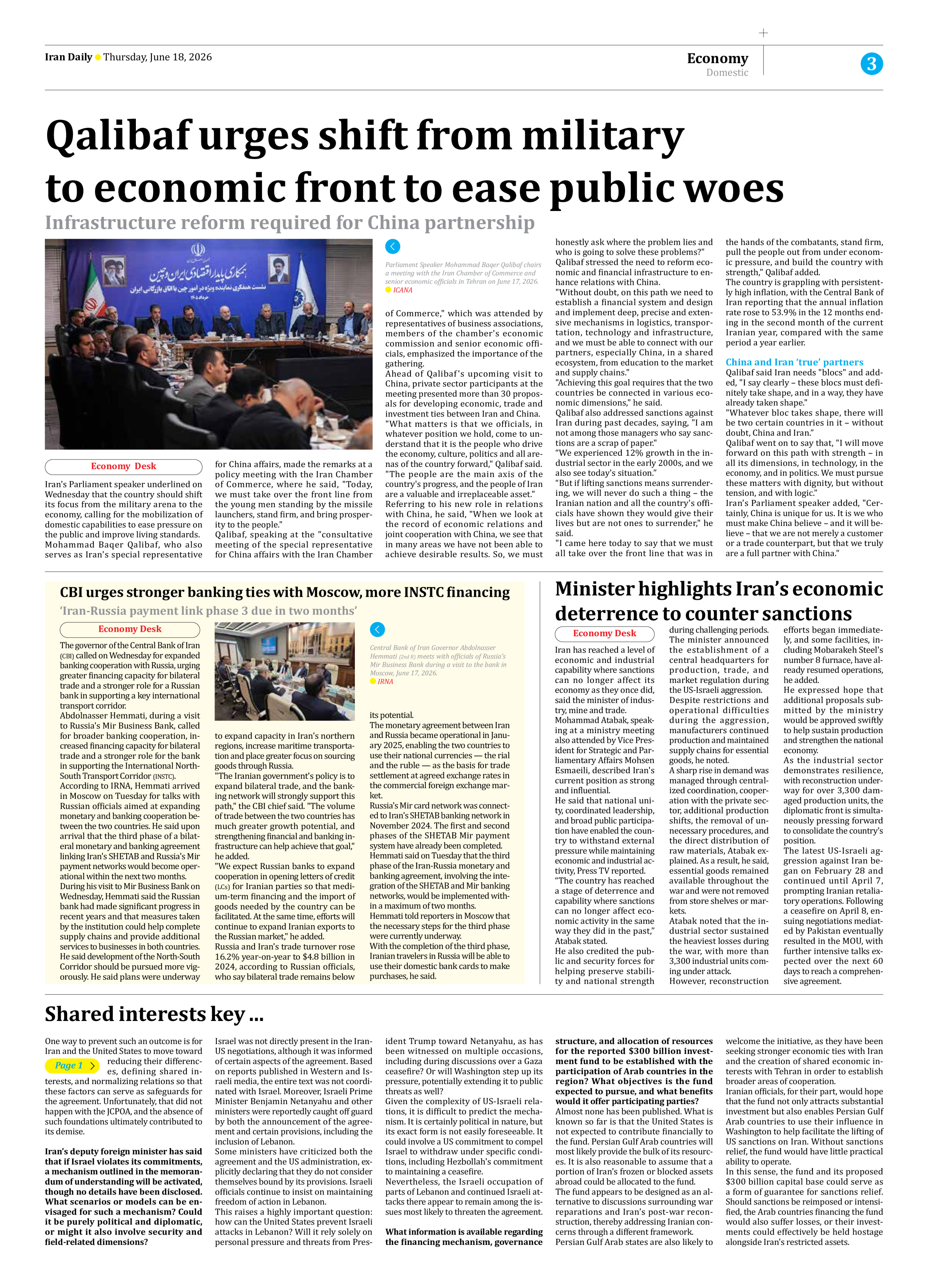
Iran’s Parliament speaker underlined on Wednesday that the country should shift its focus from the military arena to the economy, calling for the mobilization of domestic capabilities to ease pressure on the public and improve living standards.
Mohammad Baqer Qalibaf, who also serves as Iran's special representative for China affairs, made the remarks at a policy meeting with the Iran Chamber of Commerce, where he said, "Today, we must take over the front line from the young men standing by the missile launchers, stand firm, and bring prosperity to the people."
Qalibaf, speaking at the "consultative meeting of the special representative for China affairs with the Iran Chamber of Commerce," which was attended by representatives of business associations, members of the chamber's economic commission and senior economic officials, emphasized the importance of the gathering.
Ahead of Qalibaf's upcoming visit to China, private sector participants at the meeting presented more than 30 proposals for developing economic, trade and investment ties between Iran and China.
"What matters is that we officials, in whatever position we hold, come to understand that it is the people who drive the economy, culture, politics and all arenas of the country forward," Qalibaf said.
"The people are the main axis of the country's progress, and the people of Iran are a valuable and irreplaceable asset."
Referring to his new role in relations with China, he said, "When we look at the record of economic relations and joint cooperation with China, we see that in many areas we have not been able to achieve desirable results. So, we must honestly ask where the problem lies and who is going to solve these problems?"
Qalibaf stressed the need to reform economic and financial infrastructure to enhance relations with China.
"Without doubt, on this path we need to establish a financial system and design and implement deep, precise and extensive mechanisms in logistics, transportation, technology and infrastructure, and we must be able to connect with our partners, especially China, in a shared ecosystem, from education to the market and supply chains."
"Achieving this goal requires that the two countries be connected in various economic dimensions," he said.
Qalibaf also addressed sanctions against Iran during past decades, saying, "I am not among those managers who say sanctions are a scrap of paper."
“We experienced 12% growth in the industrial sector in the early 2000s, and we also see today's situation.”
“But if lifting sanctions means surrendering, we will never do such a thing – the Iranian nation and all the country's officials have shown they would give their lives but are not ones to surrender," he said.
"I came here today to say that we must all take over the front line that was in the hands of the combatants, stand firm, pull the people out from under economic pressure, and build the country with strength," Qalibaf added.
The country is grappling with persistently high inflation, with the Central Bank of Iran reporting that the annual inflation rate rose to 53.9% in the 12 months ending in the second month of the current Iranian year, compared with the same period a year earlier.
China and Iran ‘true’ partners
Qalibaf said Iran needs "blocs" and added, "I say clearly – these blocs must definitely take shape, and in a way, they have already taken shape."
"Whatever bloc takes shape, there will be two certain countries in it – without doubt, China and Iran.”
Qalibaf went on to say that, "I will move forward on this path with strength – in all its dimensions, in technology, in the economy, and in politics. We must pursue these matters with dignity, but without tension, and with logic.”
Iran’s Parliament speaker added, "Certainly, China is unique for us. It is we who must make China believe – and it will believe – that we are not merely a customer or a trade counterpart, but that we truly are a full partner with China."