







Gov’t moves to restore Internet access after wartime blackout
A specialized Iranian government body overseeing cyberspace approved a plan to reconnect the country to the global Internet, the semi-official Fars news agency reported on Monday, after months of severe restrictions imposed over the recent US-Israeli aggression against Iran.
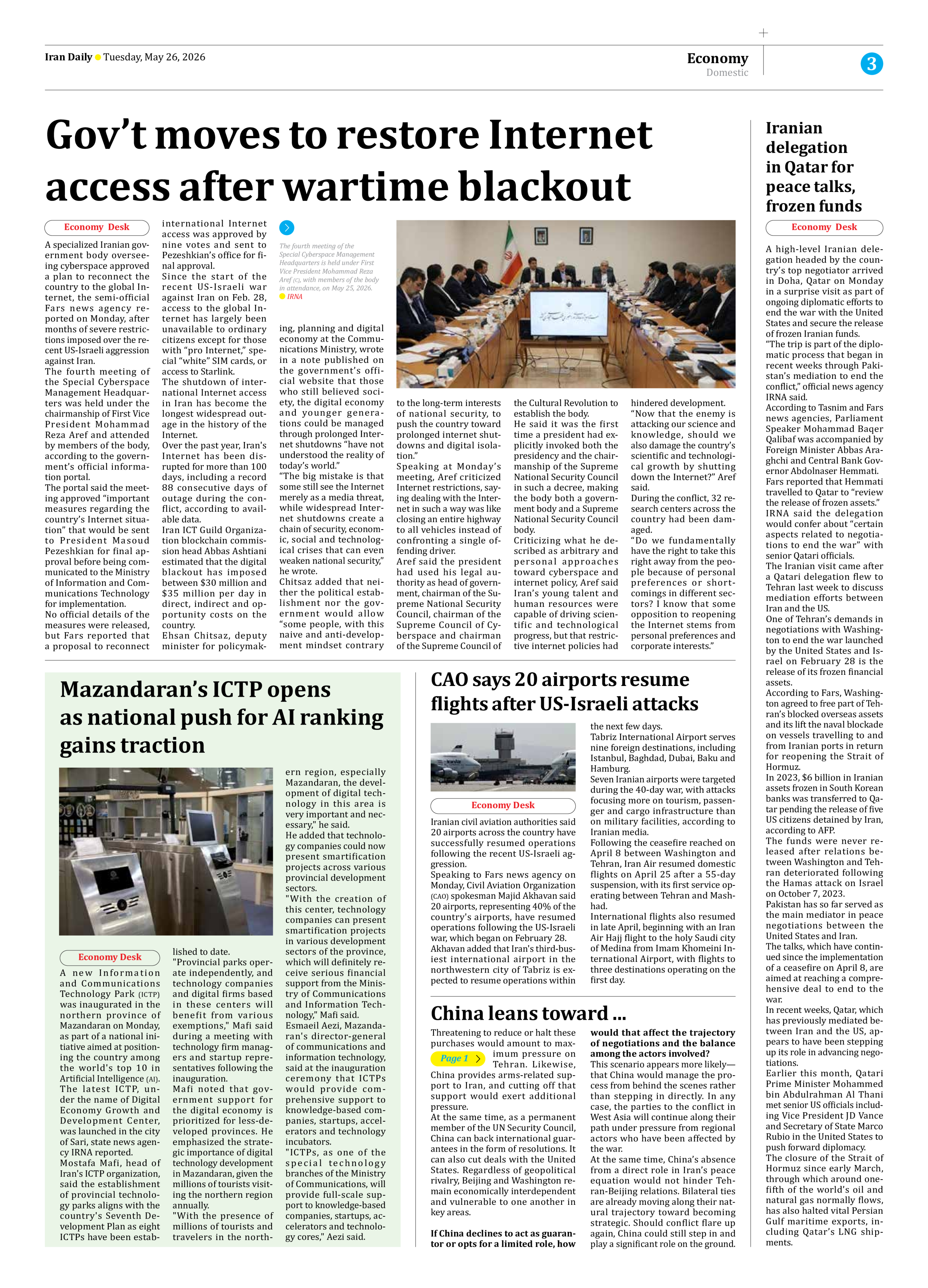
The fourth meeting of the Special Cyberspace Management Headquarters was held under the chairmanship of First Vice President Mohammad Reza Aref and attended by members of the body, according to the government’s official information portal.
The portal said the meeting approved “important measures regarding the country’s Internet situation” that would be sent to President Masoud Pezeshkian for final approval before being communicated to the Ministry of Information and Communications Technology for implementation.
No official details of the measures were released, but Fars reported that a proposal to reconnect international Internet access was approved by nine votes and sent to Pezeshkian’s office for final approval.
Since the start of the recent US-Israeli war against Iran on Feb. 28, access to the global Internet has largely been unavailable to ordinary citizens except for those with “pro Internet,” special “white” SIM cards, or access to Starlink.
The shutdown of international Internet access in Iran has become the longest widespread outage in the history of the Internet.
Over the past year, Iran's Internet has been disrupted for more than 100 days, including a record 88 consecutive days of outage during the conflict, according to available data.
Iran ICT Guild Organization blockchain commission head Abbas Ashtiani estimated that the digital blackout has imposed between $30 million and $35 million per day in direct, indirect and opportunity costs on the country.
Ehsan Chitsaz, deputy minister for policymaking, planning and digital economy at the Communications Ministry, wrote in a note published on the government’s official website that those who still believed society, the digital economy and younger generations could be managed through prolonged Internet shutdowns “have not understood the reality of today’s world.”
“The big mistake is that some still see the Internet merely as a media threat, while widespread Internet shutdowns create a chain of security, economic, social and technological crises that can even weaken national security,” he wrote.
Chitsaz added that neither the political establishment nor the government would allow “some people, with this naive and anti-development mindset contrary to the long-term interests of national security, to push the country toward prolonged internet shutdowns and digital isolation.”
Speaking at Monday’s meeting, Aref criticized Internet restrictions, saying dealing with the Internet in such a way was like closing an entire highway to all vehicles instead of confronting a single offending driver.
Aref said the president had used his legal authority as head of government, chairman of the Supreme National Security Council, chairman of the Supreme Council of Cyberspace and chairman of the Supreme Council of the Cultural Revolution to establish the body.
He said it was the first time a president had explicitly invoked both the presidency and the chairmanship of the Supreme National Security Council in such a decree, making the body both a government body and a Supreme National Security Council body.
Criticizing what he described as arbitrary and personal approaches toward cyberspace and internet policy, Aref said Iran’s young talent and human resources were capable of driving scientific and technological progress, but that restrictive internet policies had hindered development.
“Now that the enemy is attacking our science and knowledge, should we also damage the country’s scientific and technological growth by shutting down the Internet?” Aref said.
During the conflict, 32 research centers across the country had been damaged.
“Do we fundamentally have the right to take this right away from the people because of personal preferences or shortcomings in different sectors? I know that some opposition to reopening the Internet stems from personal preferences and corporate interests.”