







Caviar exports near $8m in 42 global markets despite challenges
By Sadeq Dehqan
Staff writer
Iran’s caviar exports have risen steadily, reaching nearly $8 million annually and expanding to 42 countries worldwide, the secretary-general of Iran’s Union of Aquatic Production and Trade told Iran Daily.
Ali-Akbar Khodaei said Iran’s caviar export revenues climbed from $3.188 million in 2023 to around $6 million in 2024, adding that official figures for 2025 had not yet been released but estimates suggested exports reached between $7.8 million and $8 million by March 2026.
Khodaei said caviar export volumes also increased, with shipments rising to 7,130 kilograms in the 10-month period from March 20, 2025 to January 19, 2026, from 6,200 kilograms in the same period a year earlier, marking a 14% increase.
He said exports dropped to zero after February this year because flight suspensions after disrupted shipments, most of which are transported by air.
Khodaei said exporters quickly shifted to alternative routes, sending cargo overland to neighboring countries before forwarding shipments to global destinations through other flights. He added that flights had now largely resumed and the problem had been mostly resolved.
International flights departing from Iran, which were halted after the start of the US-Israeli aggression against Iran in late February.
He said Europe accounted for the largest share of Iran’s export markets, alongside neighboring Arab countries, other Asian states and African markets.
Khodaei said prolonged wartime conditions posed a threat to exports, but added that Iranian exporters would seek to turn the challenge into an opportunity by expanding marketing efforts, accessing new markets and developing alternative export routes.
He said exporters hoped to rapidly offset any losses in neighboring Arab markets, particularly the United Arab Emirates, while expanding sales in new destinations.
Khodaei said Iran was seeking to direct more exports toward Russia, Turkey, African countries and Southeast Asia to create new markets.
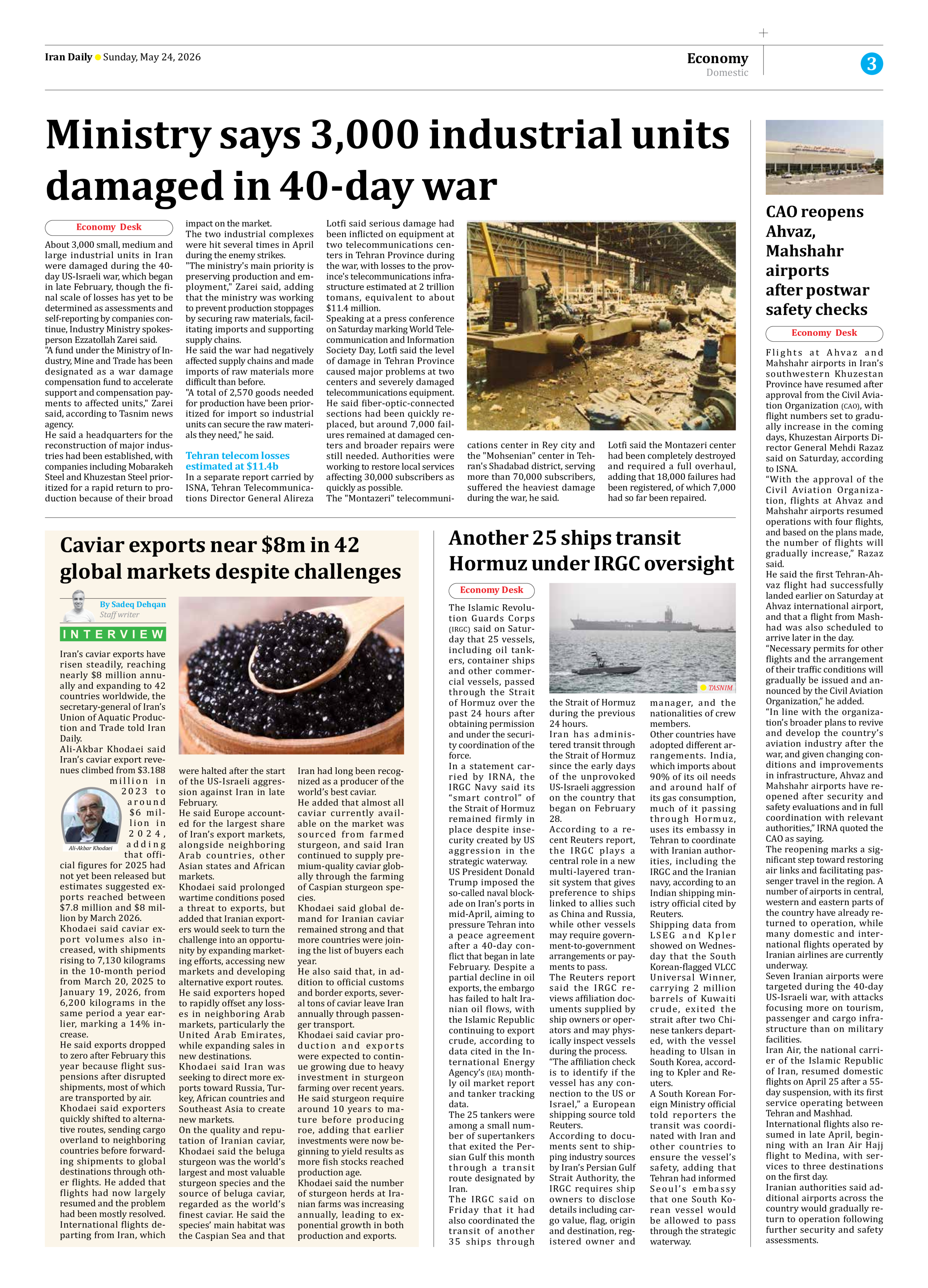
On the quality and reputation of Iranian caviar, Khodaei said the beluga sturgeon was the world’s largest and most valuable sturgeon species and the source of beluga caviar, regarded as the world’s finest caviar. He said the species’ main habitat was the Caspian Sea and that Iran had long been recognized as a producer of the world’s best caviar.
He added that almost all caviar currently available on the market was sourced from farmed sturgeon, and said Iran continued to supply premium-quality caviar globally through the farming of Caspian sturgeon species.
Khodaei said global demand for Iranian caviar remained strong and that more countries were joining the list of buyers each year.
He also said that, in addition to official customs and border exports, several tons of caviar leave Iran annually through passenger transport.
Khodaei said caviar production and exports were expected to continue growing due to heavy investment in sturgeon farming over recent years.
He said sturgeon require around 10 years to mature before producing roe, adding that earlier investments were now beginning to yield results as more fish stocks reached production age.
Khodaei said the number of sturgeon herds at Iranian farms was increasing annually, leading to exponential growth in both production and exports.