





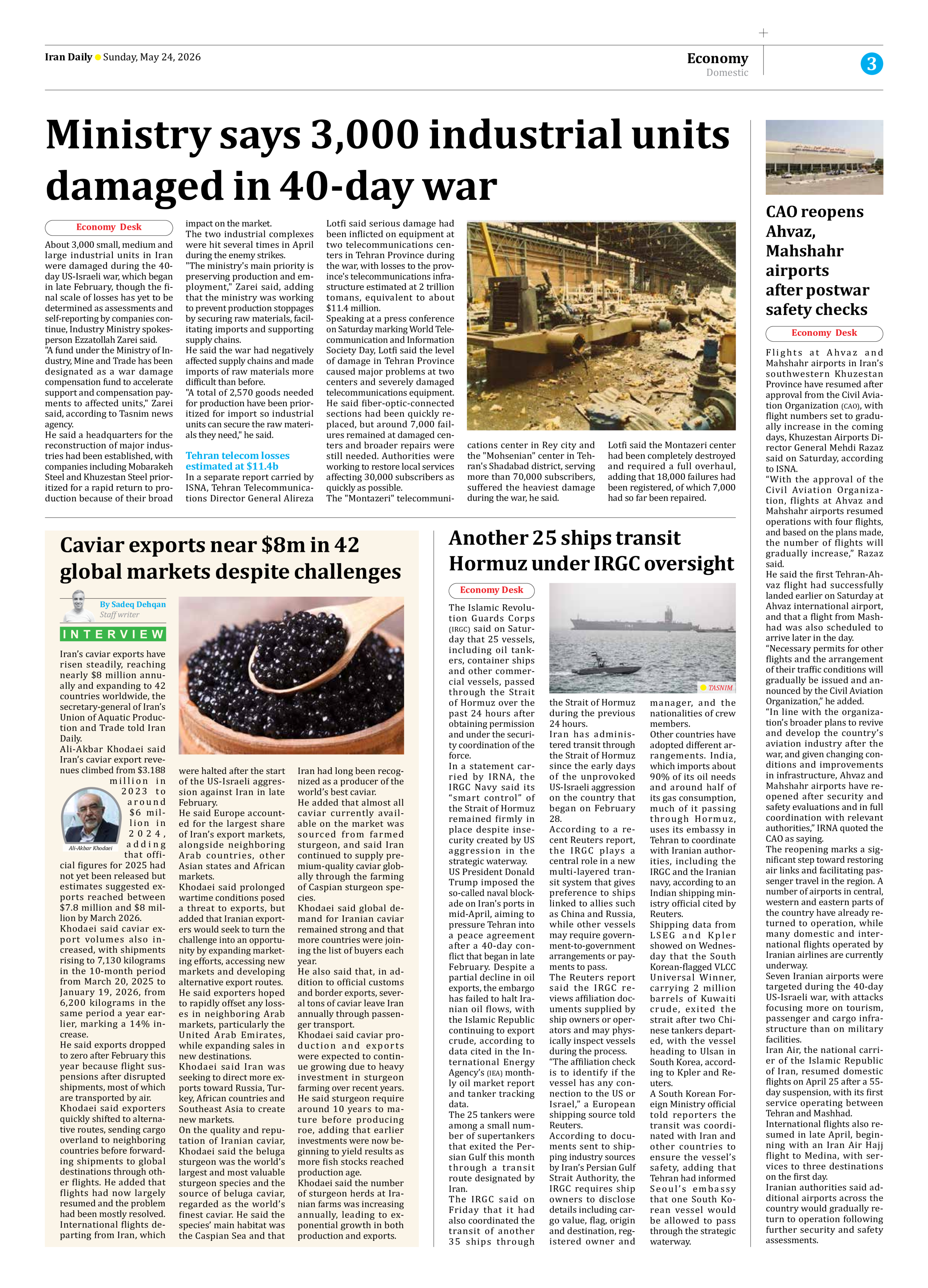


Another 25 ships transit Hormuz under IRGC oversight
The Islamic Revolution Guards Corps (IRGC) said on Saturday that 25 vessels, including oil tankers, container ships and other commercial vessels, passed through the Strait of Hormuz over the past 24 hours after obtaining permission and under the security coordination of the force.
In a statement carried by IRNA, the IRGC Navy said its “smart control” of the Strait of Hormuz remained firmly in place despite insecurity created by US aggression in the strategic waterway.
US President Donald Trump imposed the so-called naval blockade on Iran's ports in mid-April, aiming to pressure Tehran into a peace agreement after a 40-day conflict that began in late February. Despite a partial decline in oil exports, the embargo has failed to halt Iranian oil flows, with the Islamic Republic continuing to export crude, according to data cited in the International Energy Agency’s (IEA) monthly oil market report and tanker tracking data.
The 25 tankers were among a small number of supertankers that exited the Persian Gulf this month through a transit route designated by Iran.
The IRGC said on Friday that it had also coordinated the transit of another 35 ships through the Strait of Hormuz during the previous 24 hours.
Iran has administered transit through the Strait of Hormuz since the early days of the unprovoked US-Israeli aggression on the country that began on February 28.
According to a recent Reuters report, the IRGC plays a central role in a new multi-layered transit system that gives preference to ships linked to allies such as China and Russia, while other vessels may require government-to-government arrangements or payments to pass.
The Reuters report said the IRGC reviews affiliation documents supplied by ship owners or operators and may physically inspect vessels during the process.
“The affiliation check is to identify if the vessel has any connection to the US or Israel,” a European shipping source told Reuters.
According to documents sent to shipping industry sources by Iran’s Persian Gulf Strait Authority, the IRGC requires ship owners to disclose details including cargo value, flag, origin and destination, registered owner and manager, and the nationalities of crew members.
Other countries have adopted different arrangements. India, which imports about 90% of its oil needs and around half of its gas consumption, much of it passing through Hormuz, uses its embassy in Tehran to coordinate with Iranian authorities, including the IRGC and the Iranian navy, according to an Indian shipping ministry official cited by Reuters.
Shipping data from LSEG and Kpler showed on Wednesday that the South Korean-flagged VLCC Universal Winner, carrying 2 million barrels of Kuwaiti crude, exited the strait after two Chinese tankers departed, with the vessel heading to Ulsan in South Korea, according to Kpler and Reuters.
A South Korean Foreign Ministry official told reporters the transit was coordinated with Iran and other countries to ensure the vessel’s safety, adding that Tehran had informed Seoul’s embassy that one South Korean vessel would be allowed to pass through the strategic waterway.