





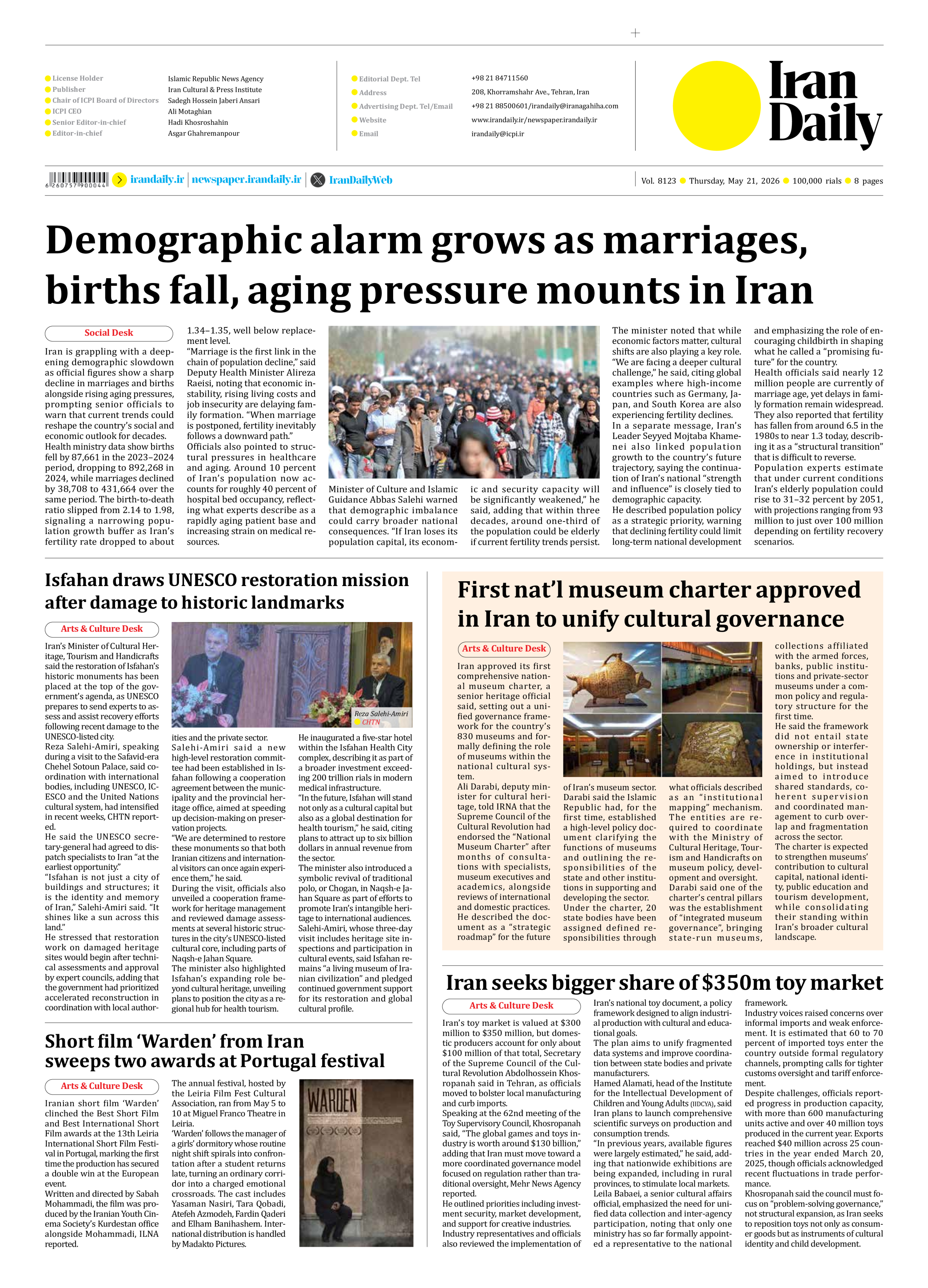


Demographic alarm grows as marriages, births fall, aging pressure mounts in Iran
Iran is grappling with a deepening demographic slowdown as official figures show a sharp decline in marriages and births alongside rising aging pressures, prompting senior officials to warn that current trends could reshape the country’s social and economic outlook for decades.
Health ministry data show births fell by 87,661 in the 2023–2024 period, dropping to 892,268 in 2024, while marriages declined by 38,708 to 431,664 over the same period. The birth-to-death ratio slipped from 2.14 to 1.98, signaling a narrowing population growth buffer as Iran’s fertility rate dropped to about 1.34–1.35, well below replacement level.
“Marriage is the first link in the chain of population decline,” said Deputy Health Minister Alireza Raeisi, noting that economic instability, rising living costs and job insecurity are delaying family formation. “When marriage is postponed, fertility inevitably follows a downward path.”
Officials also pointed to structural pressures in healthcare and aging. Around 10 percent of Iran’s population now accounts for roughly 40 percent of hospital bed occupancy, reflecting what experts describe as a rapidly aging patient base and increasing strain on medical resources.
Minister of Culture and Islamic Guidance Abbas Salehi warned that demographic imbalance could carry broader national consequences. “If Iran loses its population capital, its economic and security capacity will be significantly weakened,” he said, adding that within three decades, around one-third of the population could be elderly if current fertility trends persist.
The minister noted that while economic factors matter, cultural shifts are also playing a key role. “We are facing a deeper cultural challenge,” he said, citing global examples where high-income countries such as Germany, Japan, and South Korea are also experiencing fertility declines.
In a separate message, Iran’s Leader Seyyed Mojtaba Khamenei also linked population growth to the country’s future trajectory, saying the continuation of Iran’s national “strength and influence” is closely tied to demographic capacity.
He described population policy as a strategic priority, warning that declining fertility could limit long-term national development and emphasizing the role of encouraging childbirth in shaping what he called a “promising future” for the country.
Health officials said nearly 12 million people are currently of marriage age, yet delays in family formation remain widespread. They also reported that fertility has fallen from around 6.5 in the 1980s to near 1.3 today, describing it as a “structural transition” that is difficult to reverse.
Population experts estimate that under current conditions Iran’s elderly population could rise to 31–32 percent by 2051, with projections ranging from 93 million to just over 100 million depending on fertility recovery scenarios.