





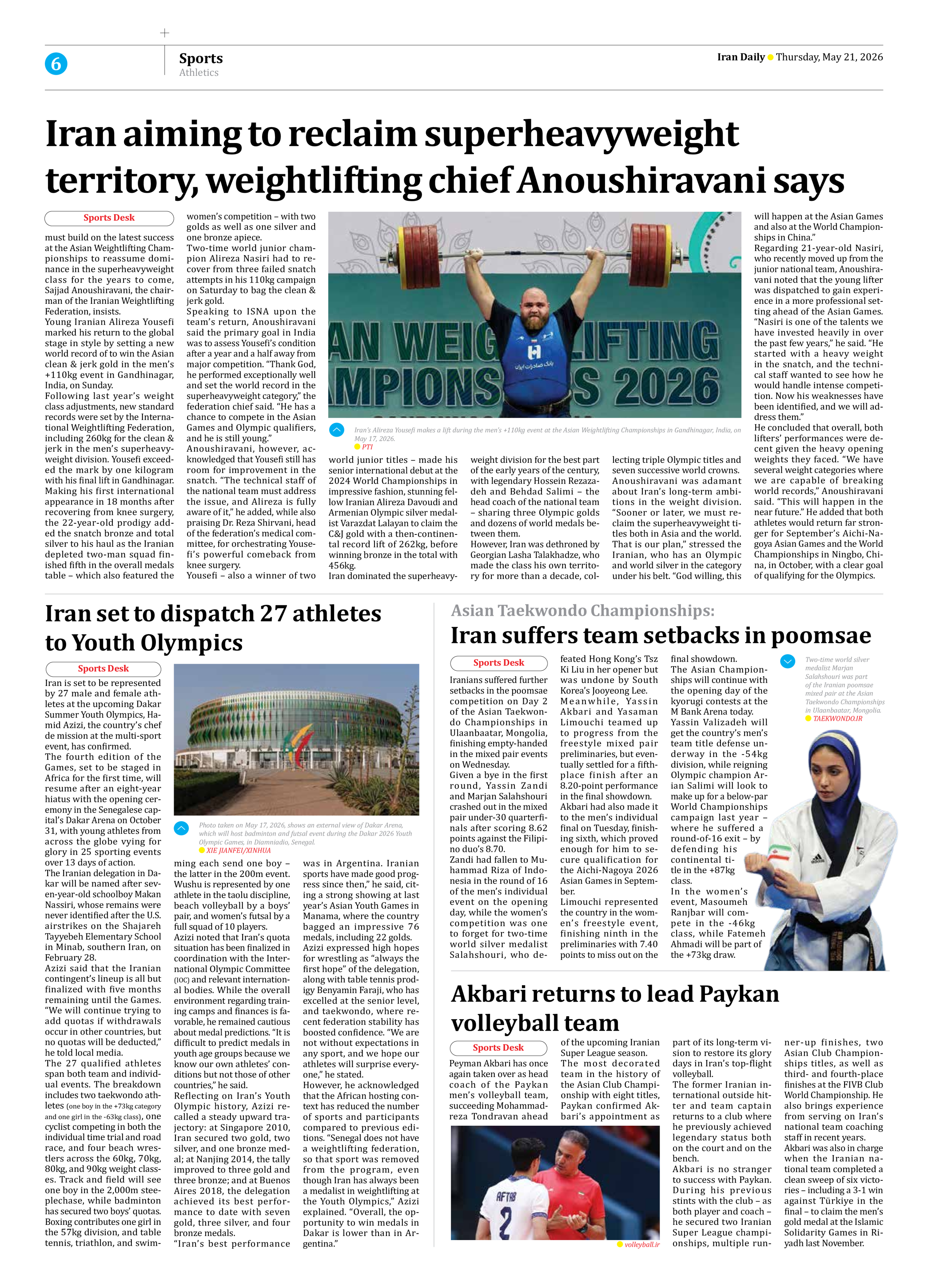


Iran set to dispatch 27 athletes to Youth Olympics
Iran is set to be represented by 27 male and female athletes at the upcoming Dakar Summer Youth Olympics, Hamid Azizi, the country’s chef de mission at the multi-sport event, has confirmed.
The fourth edition of the Games, set to be staged in Africa for the first time, will resume after an eight-year hiatus with the opening ceremony in the Senegalese capital’s Dakar Arena on October 31, with young athletes from across the globe vying for glory in 25 sporting events over 13 days of action.
The Iranian delegation in Dakar will be named after seven-year-old schoolboy Makan Nassiri, whose remains were never identified after the U.S. airstrikes on the Shajareh Tayyebeh Elementary School in Minab, southern Iran, on February 28.
Azizi said that the Iranian contingent’s lineup is all but finalized with five months remaining until the Games. “We will continue trying to add quotas if withdrawals occur in other countries, but no quotas will be deducted,” he told local media.
The 27 qualified athletes span both team and individual events. The breakdown includes two taekwondo athletes (one boy in the +73kg category and one girl in the -63kg class), one cyclist competing in both the individual time trial and road race, and four beach wrestlers across the 60kg, 70kg, 80kg, and 90kg weight classes. Track and field will see one boy in the 2,000m steeplechase, while badminton has secured two boys’ quotas. Boxing contributes one girl in the 57kg division, and table tennis, triathlon, and swimming each send one boy – the latter in the 200m event. Wushu is represented by one athlete in the taolu discipline, beach volleyball by a boys’ pair, and women’s futsal by a full squad of 10 players.
Azizi noted that Iran’s quota situation has been finalized in coordination with the International Olympic Committee (IOC) and relevant international bodies. While the overall environment regarding training camps and finances is favorable, he remained cautious about medal predictions. “It is difficult to predict medals in youth age groups because we know our own athletes’ conditions but not those of other countries,” he said.
Reflecting on Iran’s Youth Olympic history, Azizi recalled a steady upward trajectory: at Singapore 2010, Iran secured two gold, two silver, and one bronze medal; at Nanjing 2014, the tally improved to three gold and three bronze; and at Buenos Aires 2018, the delegation achieved its best performance to date with seven gold, three silver, and four bronze medals.
“Iran’s best performance was in Argentina. Iranian sports have made good progress since then,” he said, citing a strong showing at last year’s Asian Youth Games in Manama, where the country bagged an impressive 76 medals, including 22 golds.
Azizi expressed high hopes for wrestling as “always the first hope” of the delegation, along with table tennis prodigy Benyamin Faraji, who has excelled at the senior level, and taekwondo, where recent federation stability has boosted confidence. “We are not without expectations in any sport, and we hope our athletes will surprise everyone,” he stated.
However, he acknowledged that the African hosting context has reduced the number of sports and participants compared to previous editions. “Senegal does not have a weightlifting federation, so that sport was removed from the program, even though Iran has always been a medalist in weightlifting at the Youth Olympics,” Azizi explained. “Overall, the opportunity to win medals in Dakar is lower than in Argentina.”