







Minister unveils post-war plans to expedite goods clearance via north
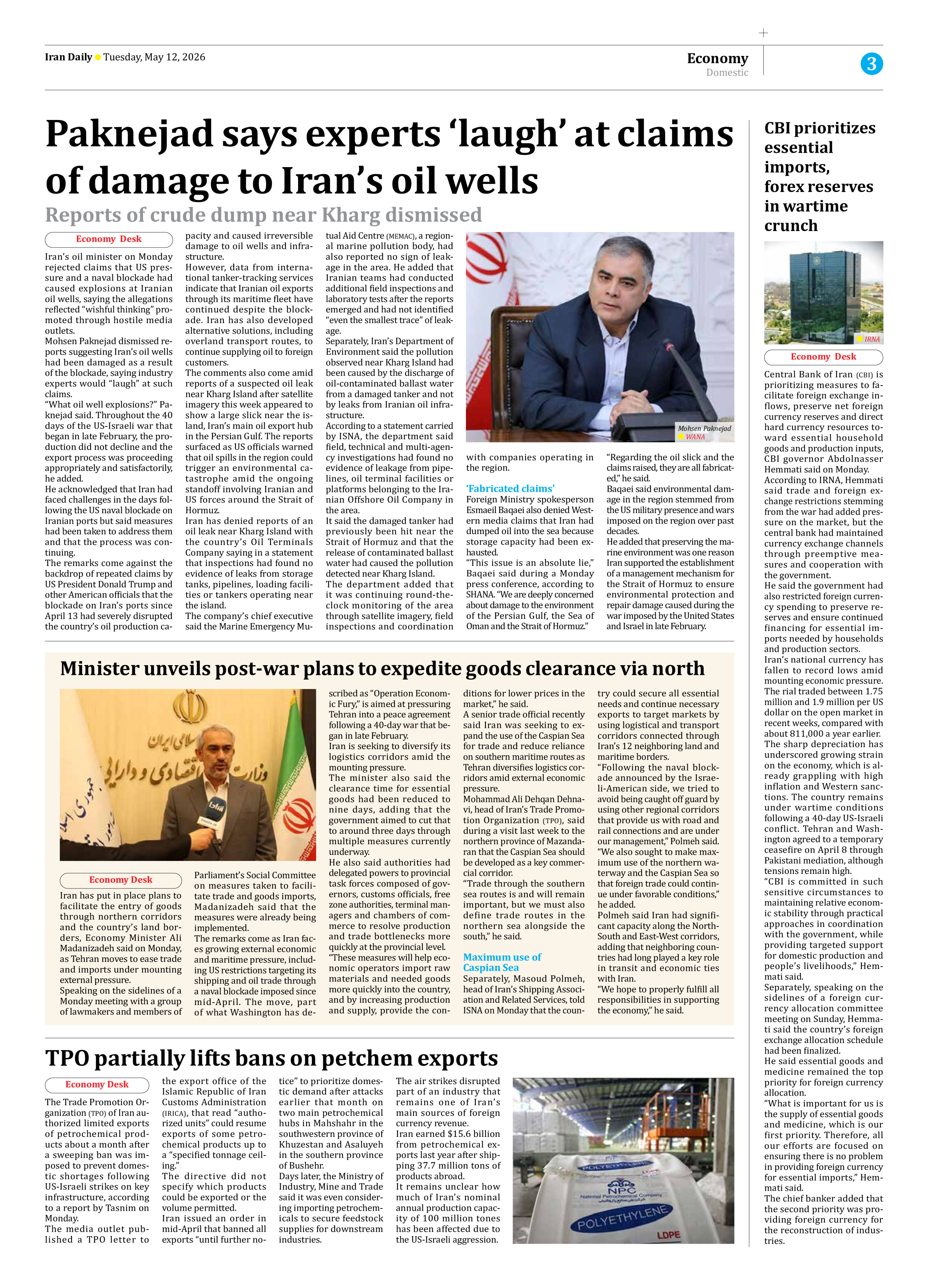
Iran has put in place plans to facilitate the entry of goods through northern corridors and the country’s land borders, Economy Minister Ali Madanizadeh said on Monday, as Tehran moves to ease trade and imports under mounting external pressure.
Speaking on the sidelines of a Monday meeting with a group of lawmakers and members of Parliament’s Social Committee on measures taken to facilitate trade and goods imports, Madanizadeh said that the measures were already being implemented.
The remarks come as Iran faces growing external economic and maritime pressure, including US restrictions targeting its shipping and oil trade through a naval blockade imposed since mid-April. The move, part of what Washington has described as “Operation Economic Fury,” is aimed at pressuring Tehran into a peace agreement following a 40-day war that began in late February.
Iran is seeking to diversify its logistics corridors amid the mounting pressure.
The minister also said the clearance time for essential goods had been reduced to nine days, adding that the government aimed to cut that to around three days through multiple measures currently underway.
He also said authorities had delegated powers to provincial task forces composed of governors, customs officials, free zone authorities, terminal managers and chambers of commerce to resolve production and trade bottlenecks more quickly at the provincial level.
“These measures will help economic operators import raw materials and needed goods more quickly into the country, and by increasing production and supply, provide the conditions for lower prices in the market,” he said.
A senior trade official recently said Iran was seeking to expand the use of the Caspian Sea for trade and reduce reliance on southern maritime routes as Tehran diversifies logistics corridors amid external economic pressure.
Mohammad Ali Dehqan Dehnavi, head of Iran’s Trade Promotion Organization (TPO), said during a visit last week to the northern province of Mazandaran that the Caspian Sea should be developed as a key commercial corridor.
“Trade through the southern sea routes is and will remain important, but we must also define trade routes in the northern sea alongside the south,” he said.
Maximum use of
Caspian Sea
Separately, Masoud Polmeh, head of Iran’s Shipping Association and Related Services, told ISNA on Monday that the country could secure all essential needs and continue necessary exports to target markets by using logistical and transport corridors connected through Iran’s 12 neighboring land and maritime borders.
“Following the naval blockade announced by the Israeli-American side, we tried to avoid being caught off guard by using other regional corridors that provide us with road and rail connections and are under our management,” Polmeh said.
“We also sought to make maximum use of the northern waterway and the Caspian Sea so that foreign trade could continue under favorable conditions,” he added.
Polmeh said Iran had significant capacity along the North-South and East-West corridors, adding that neighboring countries had long played a key role in transit and economic ties with Iran.
“We hope to properly fulfill all responsibilities in supporting the economy,” he said.