







Paknejad says experts ‘laugh’ at claims of damage to Iran’s oil wells
Reports of crude dump near Kharg dismissed
Iran’s oil minister on Monday rejected claims that US pressure and a naval blockade had caused explosions at Iranian oil wells, saying the allegations reflected “wishful thinking” promoted through hostile media outlets.
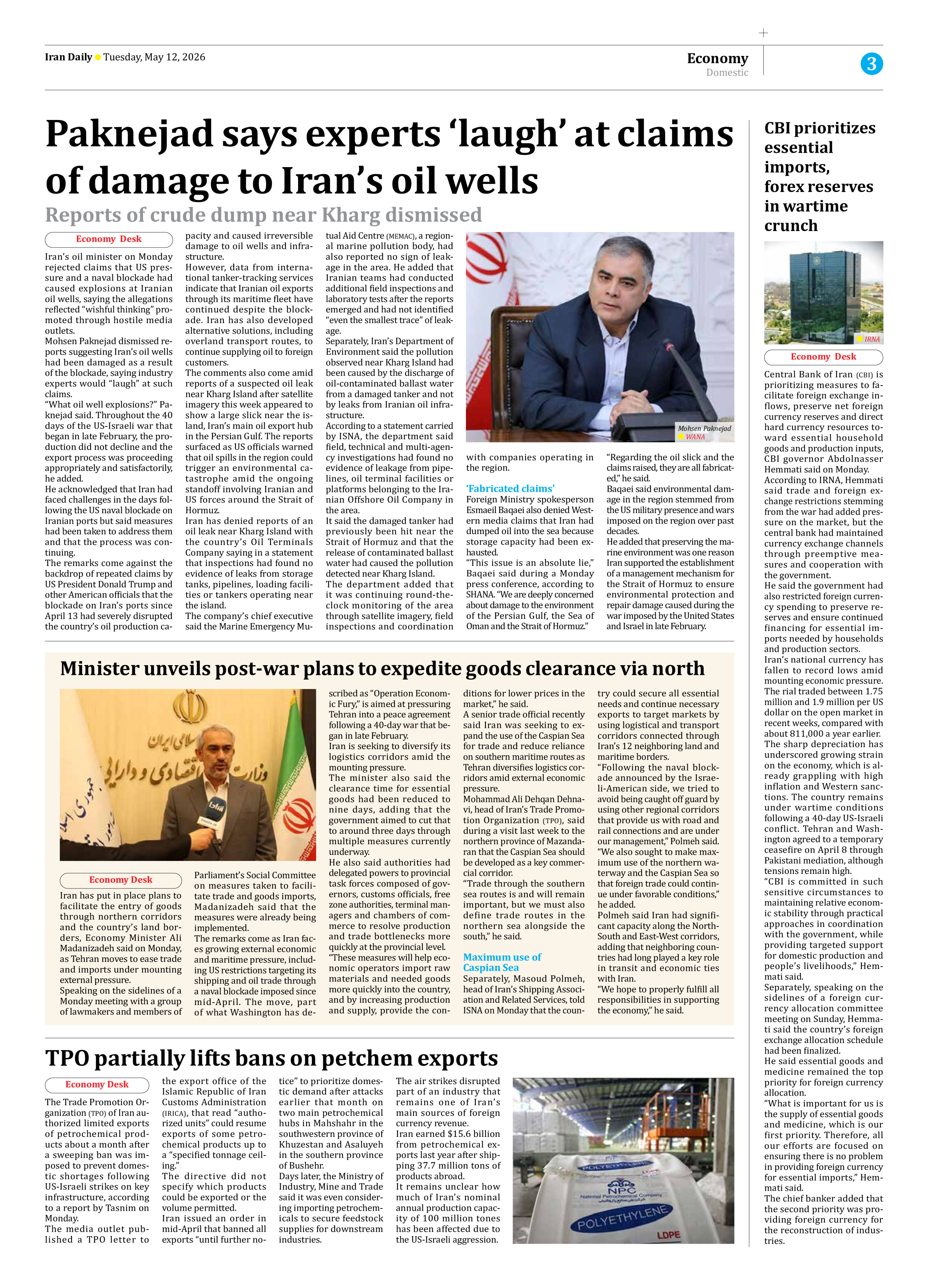
Mohsen Paknejad dismissed reports suggesting Iran’s oil wells had been damaged as a result of the blockade, saying industry experts would “laugh” at such claims.
“What oil well explosions?” Paknejad said. Throughout the 40 days of the US-Israeli war that began in late February, the production did not decline and the export process was proceeding appropriately and satisfactorily, he added.
He acknowledged that Iran had faced challenges in the days following the US naval blockade on Iranian ports but said measures had been taken to address them and that the process was continuing.
The remarks come against the backdrop of repeated claims by US President Donald Trump and other American officials that the blockade on Iran’s ports since April 13 had severely disrupted the country’s oil production capacity and caused irreversible damage to oil wells and infrastructure.
However, data from international tanker-tracking services indicate that Iranian oil exports through its maritime fleet have continued despite the blockade. Iran has also developed alternative solutions, including overland transport routes, to continue supplying oil to foreign customers.
The comments also come amid reports of a suspected oil leak near Kharg Island after satellite imagery this week appeared to show a large slick near the island, Iran’s main oil export hub in the Persian Gulf. The reports surfaced as US officials warned that oil spills in the region could trigger an environmental catastrophe amid the ongoing standoff involving Iranian and US forces around the Strait of Hormuz.
Iran has denied reports of an oil leak near Kharg Island with the country’s Oil Terminals Company saying in a statement that inspections had found no evidence of leaks from storage tanks, pipelines, loading facilities or tankers operating near the island.
The company’s chief executive said the Marine Emergency Mutual Aid Centre (MEMAC), a regional marine pollution body, had also reported no sign of leakage in the area. He added that Iranian teams had conducted additional field inspections and laboratory tests after the reports emerged and had not identified “even the smallest trace” of leakage.
Separately, Iran’s Department of Environment said the pollution observed near Kharg Island had been caused by the discharge of oil-contaminated ballast water from a damaged tanker and not by leaks from Iranian oil infrastructure.
According to a statement carried by ISNA, the department said field, technical and multi-agency investigations had found no evidence of leakage from pipelines, oil terminal facilities or platforms belonging to the Iranian Offshore Oil Company in the area.
It said the damaged tanker had previously been hit near the Strait of Hormuz and that the release of contaminated ballast water had caused the pollution detected near Kharg Island.
The department added that it was continuing round-the-clock monitoring of the area through satellite imagery, field inspections and coordination with companies operating in the region.
‘Fabricated claims’
Foreign Ministry spokesperson Esmaeil Baqaei also denied Western media claims that Iran had dumped oil into the sea because storage capacity had been exhausted.
“This issue is an absolute lie,” Baqaei said during a Monday press conference, according to SHANA. “We are deeply concerned about damage to the environment of the Persian Gulf, the Sea of Oman and the Strait of Hormuz.”
“Regarding the oil slick and the claims raised, they are all fabricated,” he said.
Baqaei said environmental damage in the region stemmed from the US military presence and wars imposed on the region over past decades.
He added that preserving the marine environment was one reason Iran supported the establishment of a management mechanism for the Strait of Hormuz to ensure environmental protection and repair damage caused during the war imposed by the United States and Israel in late February.