







Russian publisher brings martyred Leader’s memoir to broad new readership
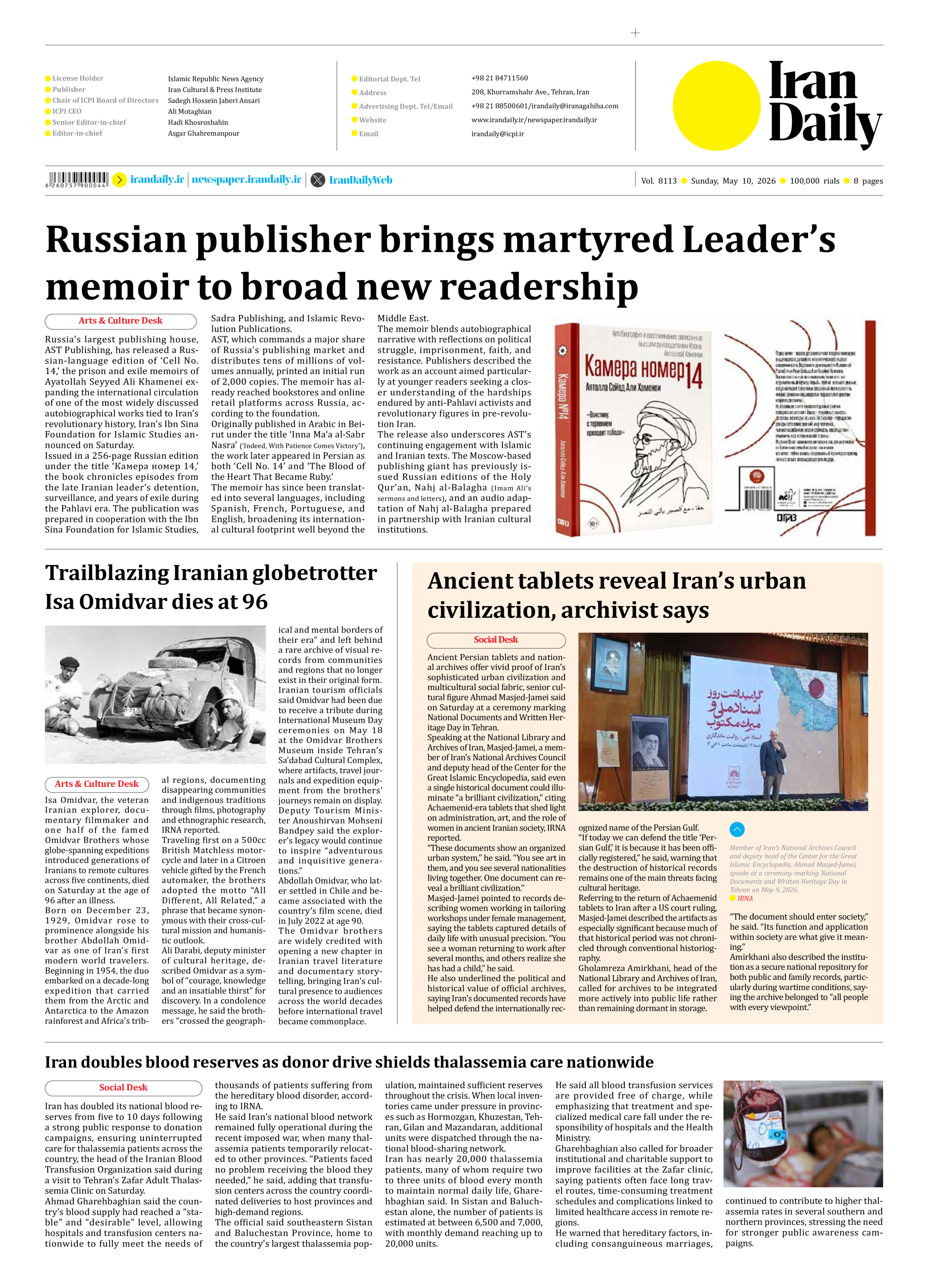
Russia’s largest publishing house, AST Publishing, has released a Russian-language edition of ‘Cell No. 14,’ the prison and exile memoirs of Ayatollah Seyyed Ali Khamenei expanding the international circulation of one of the most widely discussed autobiographical works tied to Iran’s revolutionary history, Iran’s Ibn Sina Foundation for Islamic Studies announced on Saturday.
Issued in a 256-page Russian edition under the title ‘Камера номер 14,’ the book chronicles episodes from the late Iranian leader’s detention, surveillance, and years of exile during the Pahlavi era. The publication was prepared in cooperation with the Ibn Sina Foundation for Islamic Studies, Sadra Publishing, and Islamic Revolution Publications.
AST, which commands a major share of Russia’s publishing market and distributes tens of millions of volumes annually, printed an initial run of 2,000 copies. The memoir has already reached bookstores and online retail platforms across Russia, according to the foundation.
Originally published in Arabic in Beirut under the title ‘Inna Ma‘a al-Sabr Nasra’ (‘Indeed, With Patience Comes Victory’), the work later appeared in Persian as both ‘Cell No. 14’ and ‘The Blood of the Heart That Became Ruby.’
The memoir has since been translated into several languages, including Spanish, French, Portuguese, and English, broadening its international cultural footprint well beyond the Middle East.
The memoir blends autobiographical narrative with reflections on political struggle, imprisonment, faith, and resistance. Publishers described the work as an account aimed particularly at younger readers seeking a closer understanding of the hardships endured by anti-Pahlavi activists and revolutionary figures in pre-revolution Iran.
The release also underscores AST’s continuing engagement with Islamic and Iranian texts. The Moscow-based publishing giant has previously issued Russian editions of the Holy Qur’an, Nahj al-Balagha (Imam Ali's sermons and letters), and an audio adaptation of Nahj al-Balagha prepared in partnership with Iranian cultural institutions.