





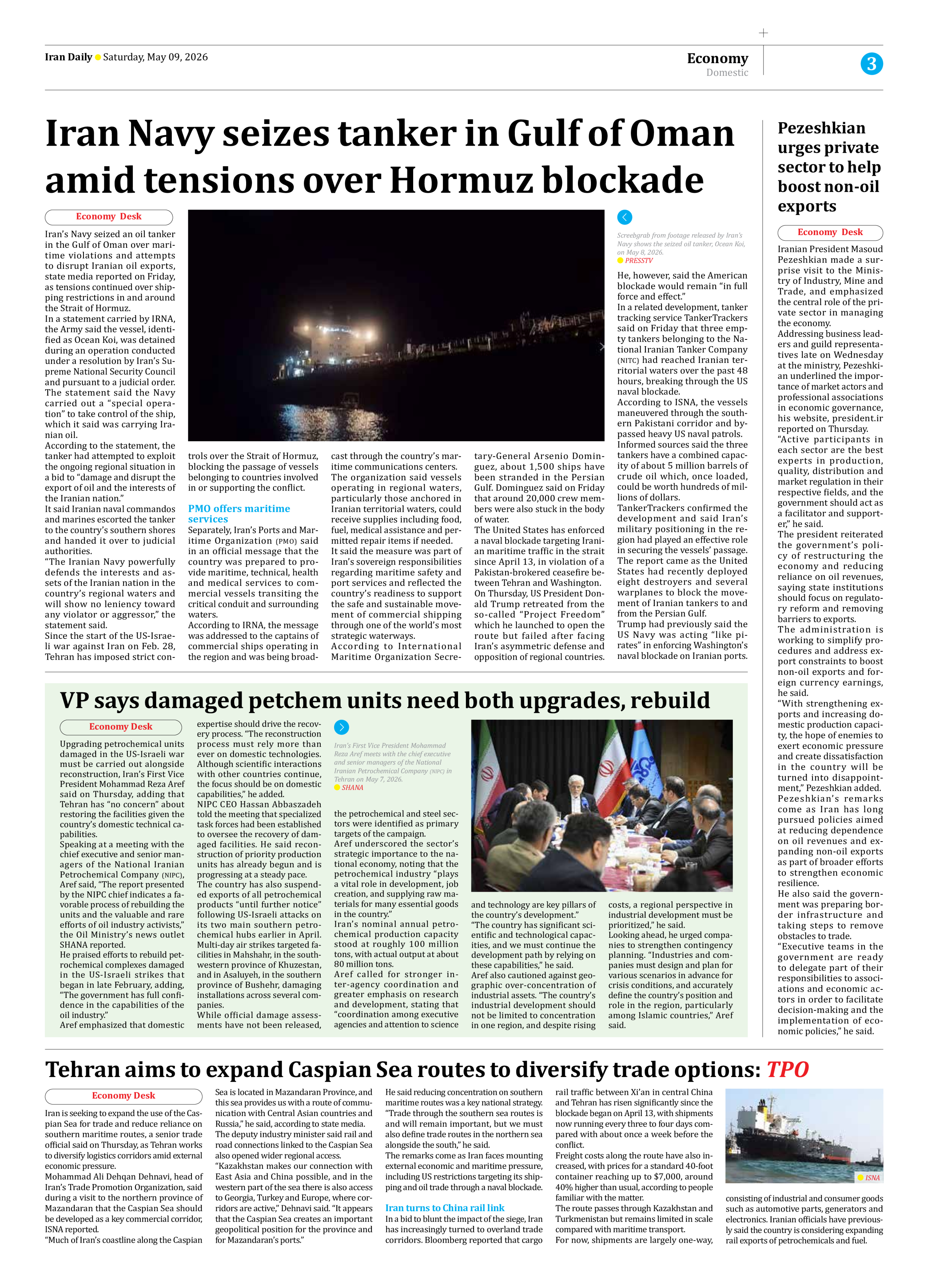


Tehran aims to expand Caspian Sea routes to diversify trade options: TPO
Iran is seeking to expand the use of the Caspian Sea for trade and reduce reliance on southern maritime routes, a senior trade official said on Thursday, as Tehran works to diversify logistics corridors amid external economic pressure.
Mohammad Ali Dehqan Dehnavi, head of Iran’s Trade Promotion Organization, said during a visit to the northern province of Mazandaran that the Caspian Sea should be developed as a key commercial corridor, ISNA reported.
“Much of Iran’s coastline along the Caspian Sea is located in Mazandaran Province, and this sea provides us with a route of communication with Central Asian countries and Russia,” he said, according to state media.
The deputy industry minister said rail and road connections linked to the Caspian Sea also opened wider regional access.
“Kazakhstan makes our connection with East Asia and China possible, and in the western part of the sea there is also access to Georgia, Turkey and Europe, where corridors are active,” Dehnavi said. “It appears that the Caspian Sea creates an important geopolitical position for the province and for Mazandaran’s ports.”
He said reducing concentration on southern maritime routes was a key national strategy.
“Trade through the southern sea routes is and will remain important, but we must also define trade routes in the northern sea alongside the south,” he said.
The remarks come as Iran faces mounting external economic and maritime pressure, including US restrictions targeting its shipping and oil trade through a naval blockade.
Iran turns to China rail link
In a bid to blunt the impact of the siege, Iran has increasingly turned to overland trade corridors. Bloomberg reported that cargo rail traffic between Xi’an in central China and Tehran has risen significantly since the blockade began on April 13, with shipments now running every three to four days compared with about once a week before the conflict.
Freight costs along the route have also increased, with prices for a standard 40-foot container reaching up to $7,000, around 40% higher than usual, according to people familiar with the matter.
The route passes through Kazakhstan and Turkmenistan but remains limited in scale compared with maritime transport.
For now, shipments are largely one-way, consisting of industrial and consumer goods such as automotive parts, generators and electronics. Iranian officials have previously said the country is considering expanding rail exports of petrochemicals and fuel.