







VP says damaged petchem units need both upgrades, rebuild
Upgrading petrochemical units damaged in the US-Israeli war must be carried out alongside reconstruction, Iran’s First Vice President Mohammad Reza Aref said on Thursday, adding that Tehran has “no concern” about restoring the facilities given the country’s domestic technical capabilities.
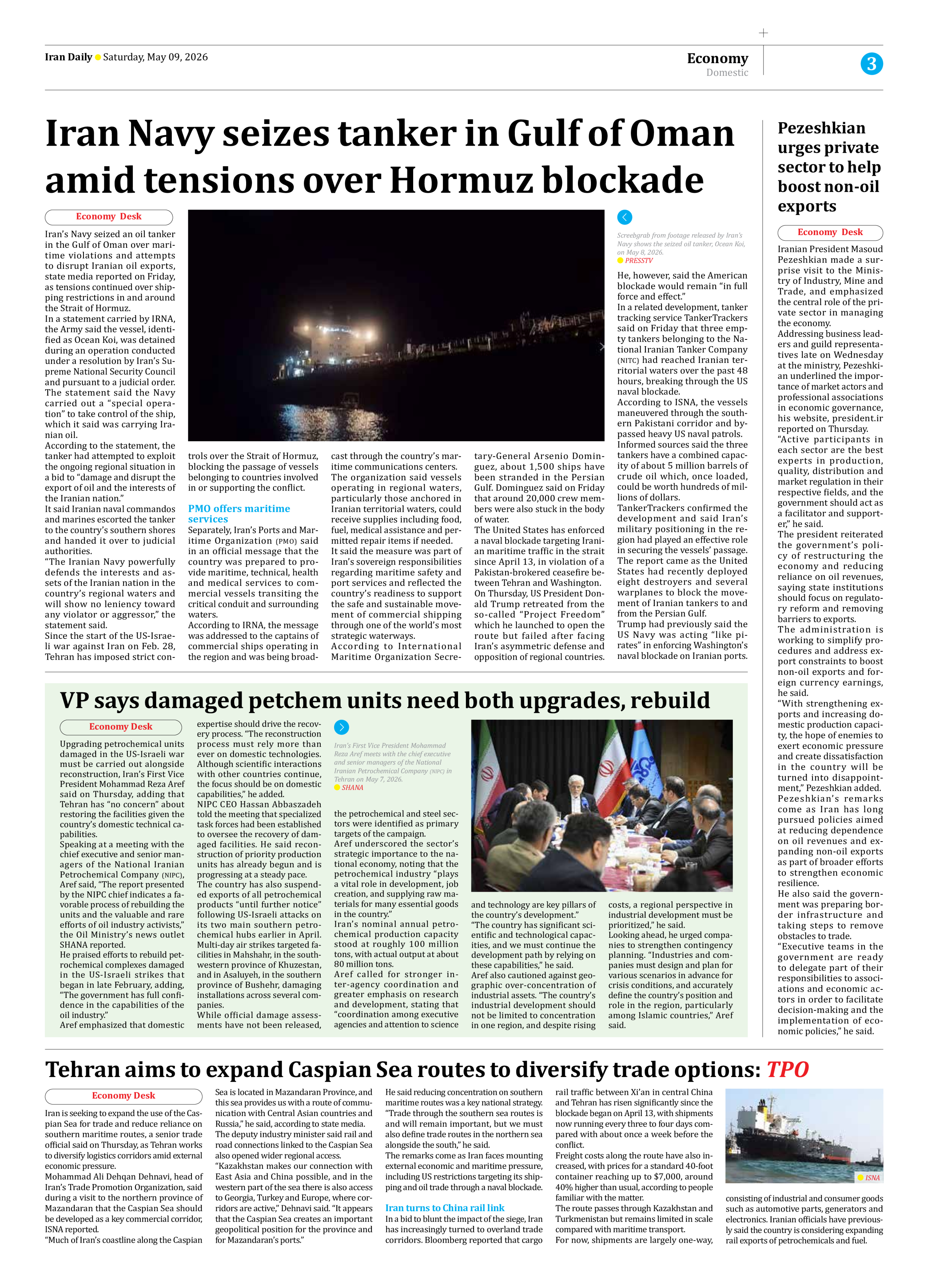
Speaking at a meeting with the chief executive and senior managers of the National Iranian Petrochemical Company (NIPC), Aref said, “The report presented by the NIPC chief indicates a favorable process of rebuilding the units and the valuable and rare efforts of oil industry activists,” the Oil Ministry’s news outlet SHANA reported.
He praised efforts to rebuild petrochemical complexes damaged in the US-Israeli strikes that began in late February, adding, “The government has full confidence in the capabilities of the oil industry.”
Aref emphasized that domestic expertise should drive the recovery process. “The reconstruction process must rely more than ever on domestic technologies. Although scientific interactions with other countries continue, the focus should be on domestic capabilities,” he added.
NIPC CEO Hassan Abbaszadeh told the meeting that specialized task forces had been established to oversee the recovery of damaged facilities. He said reconstruction of priority production units has already begun and is progressing at a steady pace.
The country has also suspended exports of all petrochemical products “until further notice” following US-Israeli attacks on its two main southern petrochemical hubs earlier in April. Multi-day air strikes targeted facilities in Mahshahr, in the southwestern province of Khuzestan, and in Asaluyeh, in the southern province of Bushehr, damaging installations across several companies.
While official damage assessments have not been released, the petrochemical and steel sectors were identified as primary targets of the campaign.
Aref underscored the sector’s strategic importance to the national economy, noting that the petrochemical industry “plays a vital role in development, job creation, and supplying raw materials for many essential goods in the country.”
Iran’s nominal annual petrochemical production capacity stood at roughly 100 million tons, with actual output at about 80 million tons.
Aref called for stronger inter-agency coordination and greater emphasis on research and development, stating that “coordination among executive agencies and attention to science and technology are key pillars of the country’s development.”
“The country has significant scientific and technological capacities, and we must continue the development path by relying on these capabilities,” he said.
Aref also cautioned against geographic over-concentration of industrial assets. “The country’s industrial development should not be limited to concentration in one region, and despite rising costs, a regional perspective in industrial development must be prioritized,” he said.
Looking ahead, he urged companies to strengthen contingency planning. “Industries and companies must design and plan for various scenarios in advance for crisis conditions, and accurately define the country’s position and role in the region, particularly among Islamic countries,” Aref said.