





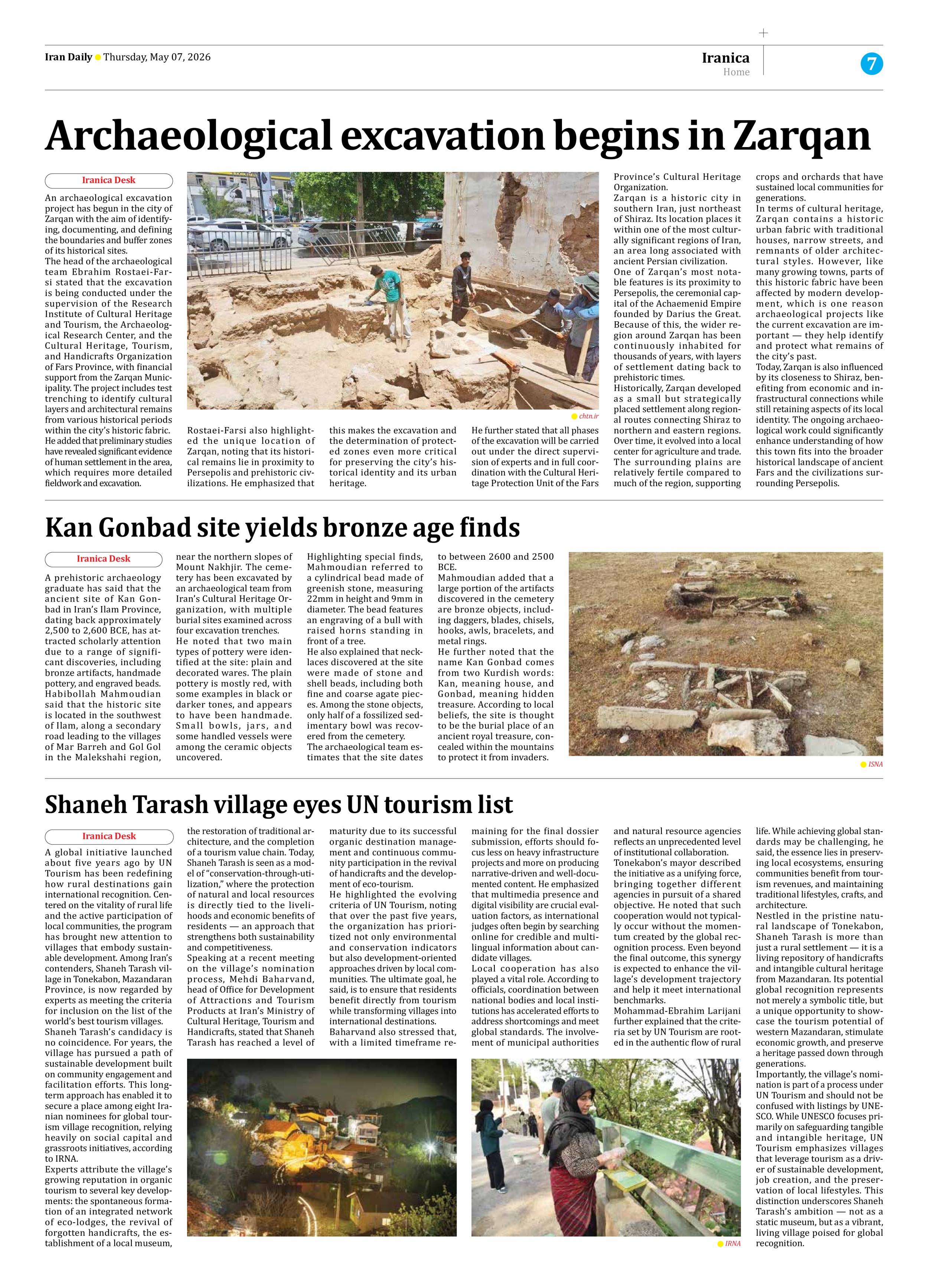


Shaneh Tarash village eyes UN tourism list
A global initiative launched about five years ago by UN Tourism has been redefining how rural destinations gain international recognition. Centered on the vitality of rural life and the active participation of local communities, the program has brought new attention to villages that embody sustainable development. Among Iran’s contenders, Shaneh Tarash village in Tonekabon, Mazandaran Province, is now regarded by experts as meeting the criteria for inclusion on the list of the world’s best tourism villages.
Shaneh Tarash’s candidacy is no coincidence. For years, the village has pursued a path of sustainable development built on community engagement and facilitation efforts. This long-term approach has enabled it to secure a place among eight Iranian nominees for global tourism village recognition, relying heavily on social capital and grassroots initiatives, according to IRNA.
Experts attribute the village’s growing reputation in organic tourism to several key developments: the spontaneous formation of an integrated network of eco-lodges, the revival of forgotten handicrafts, the establishment of a local museum, the restoration of traditional architecture, and the completion of a tourism value chain. Today, Shaneh Tarash is seen as a model of “conservation-through-utilization,” where the protection of natural and local resources is directly tied to the livelihoods and economic benefits of residents — an approach that strengthens both sustainability and competitiveness.
Speaking at a recent meeting on the village’s nomination process, Mehdi Baharvand, head of Office for Development of Attractions and Tourism Products at Iran’s Ministry of Cultural Heritage, Tourism and Handicrafts, stated that Shaneh Tarash has reached a level of maturity due to its successful organic destination management and continuous community participation in the revival of handicrafts and the development of eco-tourism.
He highlighted the evolving criteria of UN Tourism, noting that over the past five years, the organization has prioritized not only environmental and conservation indicators but also development-oriented approaches driven by local communities. The ultimate goal, he said, is to ensure that residents benefit directly from tourism while transforming villages into international destinations.
Baharvand also stressed that, with a limited timeframe remaining for the final dossier submission, efforts should focus less on heavy infrastructure projects and more on producing narrative-driven and well-documented content. He emphasized that multimedia presence and digital visibility are crucial evaluation factors, as international judges often begin by searching online for credible and multilingual information about candidate villages.
Local cooperation has also played a vital role. According to officials, coordination between national bodies and local institutions has accelerated efforts to address shortcomings and meet global standards. The involvement of municipal authorities and natural resource agencies reflects an unprecedented level of institutional collaboration.
Tonekabon’s mayor described the initiative as a unifying force, bringing together different agencies in pursuit of a shared objective. He noted that such cooperation would not typically occur without the momentum created by the global recognition process. Even beyond the final outcome, this synergy is expected to enhance the village’s development trajectory and help it meet international benchmarks.
Mohammad-Ebrahim Larijani further explained that the criteria set by UN Tourism are rooted in the authentic flow of rural life. While achieving global standards may be challenging, he said, the essence lies in preserving local ecosystems, ensuring communities benefit from tourism revenues, and maintaining traditional lifestyles, crafts, and architecture.
Nestled in the pristine natural landscape of Tonekabon, Shaneh Tarash is more than just a rural settlement — it is a living repository of handicrafts and intangible cultural heritage from Mazandaran. Its potential global recognition represents not merely a symbolic title, but a unique opportunity to showcase the tourism potential of western Mazandaran, stimulate economic growth, and preserve a heritage passed down through generations.
Importantly, the village’s nomination is part of a process under UN Tourism and should not be confused with listings by UNESCO. While UNESCO focuses primarily on safeguarding tangible and intangible heritage, UN Tourism emphasizes villages that leverage tourism as a driver of sustainable development, job creation, and the preservation of local lifestyles. This distinction underscores Shaneh Tarash’s ambition — not as a static museum, but as a vibrant, living village poised for global recognition.