





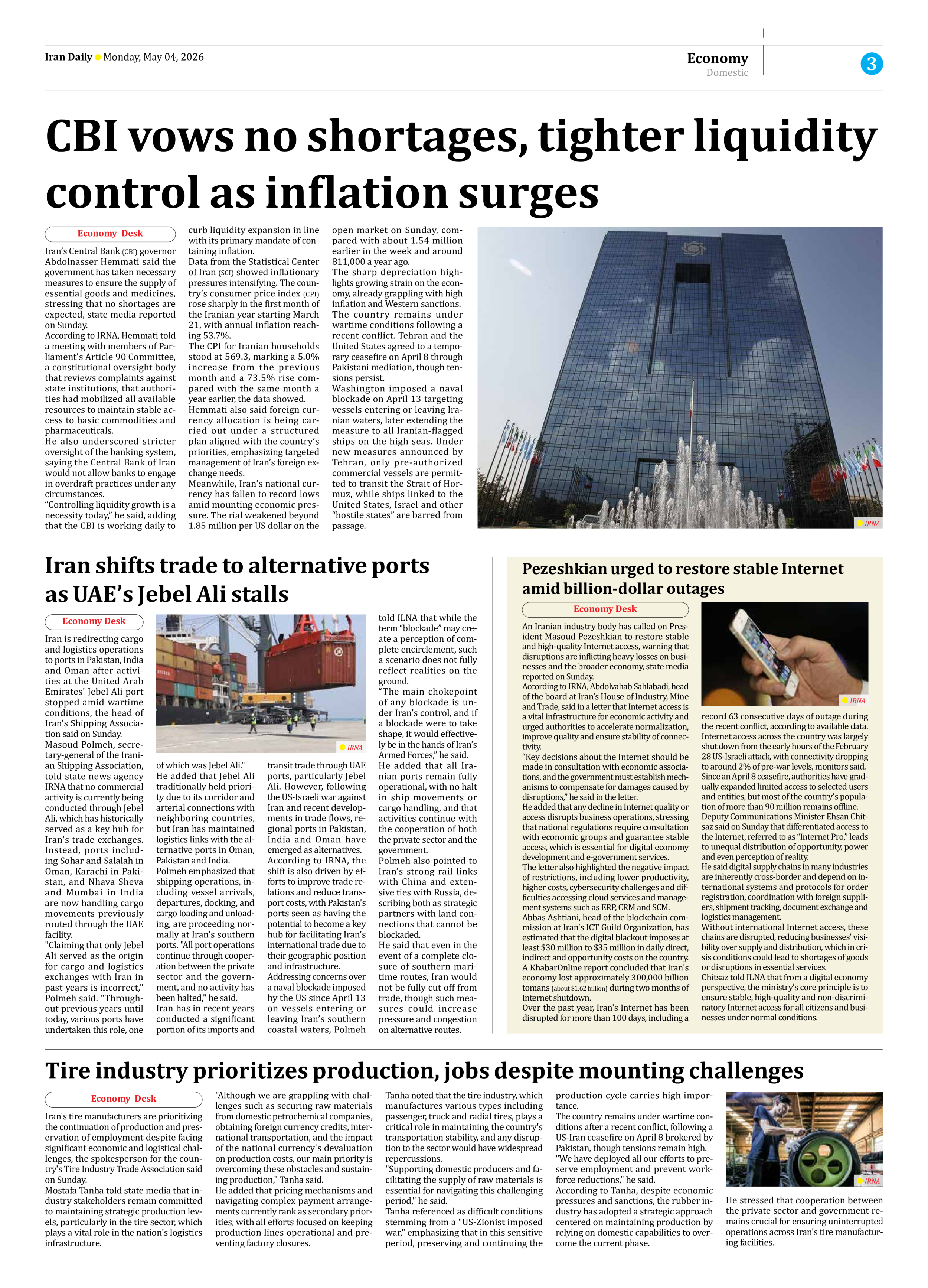


Iran shifts trade to alternative ports as UAE’s Jebel Ali stalls
Iran is redirecting cargo and logistics operations to ports in Pakistan, India and Oman after activities at the United Arab Emirates' Jebel Ali port stopped amid wartime conditions, the head of Iran's Shipping Association said on Sunday.
Masoud Polmeh, secretary-general of the Iranian Shipping Association, told state news agency IRNA that no commercial activity is currently being conducted through Jebel Ali, which has historically served as a key hub for Iran's trade exchanges. Instead, ports including Sohar and Salalah in Oman, Karachi in Pakistan, and Nhava Sheva and Mumbai in India are now handling cargo movements previously routed through the UAE facility.
"Claiming that only Jebel Ali served as the origin for cargo and logistics exchanges with Iran in past years is incorrect," Polmeh said. "Throughout previous years until today, various ports have undertaken this role, one of which was Jebel Ali."
He added that Jebel Ali traditionally held priority due to its corridor and arterial connections with neighboring countries, but Iran has maintained logistics links with the alternative ports in Oman, Pakistan and India.
Polmeh emphasized that shipping operations, including vessel arrivals, departures, docking, and cargo loading and unloading, are proceeding normally at Iran's southern ports. "All port operations continue through cooperation between the private sector and the government, and no activity has been halted," he said.
Iran has in recent years conducted a significant portion of its imports and transit trade through UAE ports, particularly Jebel Ali. However, following the US-Israeli war against Iran and recent developments in trade flows, regional ports in Pakistan, India and Oman have emerged as alternatives.
According to IRNA, the shift is also driven by efforts to improve trade relations and reduce transport costs, with Pakistan’s ports seen as having the potential to become a key hub for facilitating Iran’s international trade due to their geographic position and infrastructure.
Addressing concerns over a naval blockade imposed by the US since April 13 on vessels entering or leaving Iran’s southern coastal waters, Polmeh told ILNA that while the term “blockade” may create a perception of complete encirclement, such a scenario does not fully reflect realities on the ground.
“The main chokepoint of any blockade is under Iran’s control, and if a blockade were to take shape, it would effectively be in the hands of Iran’s Armed Forces,” he said.
He added that all Iranian ports remain fully operational, with no halt in ship movements or cargo handling, and that activities continue with the cooperation of both the private sector and the government.
Polmeh also pointed to Iran’s strong rail links with China and extensive ties with Russia, describing both as strategic partners with land connections that cannot be blockaded.
He said that even in the event of a complete closure of southern maritime routes, Iran would not be fully cut off from trade, though such measures could increase pressure and congestion on alternative routes.