





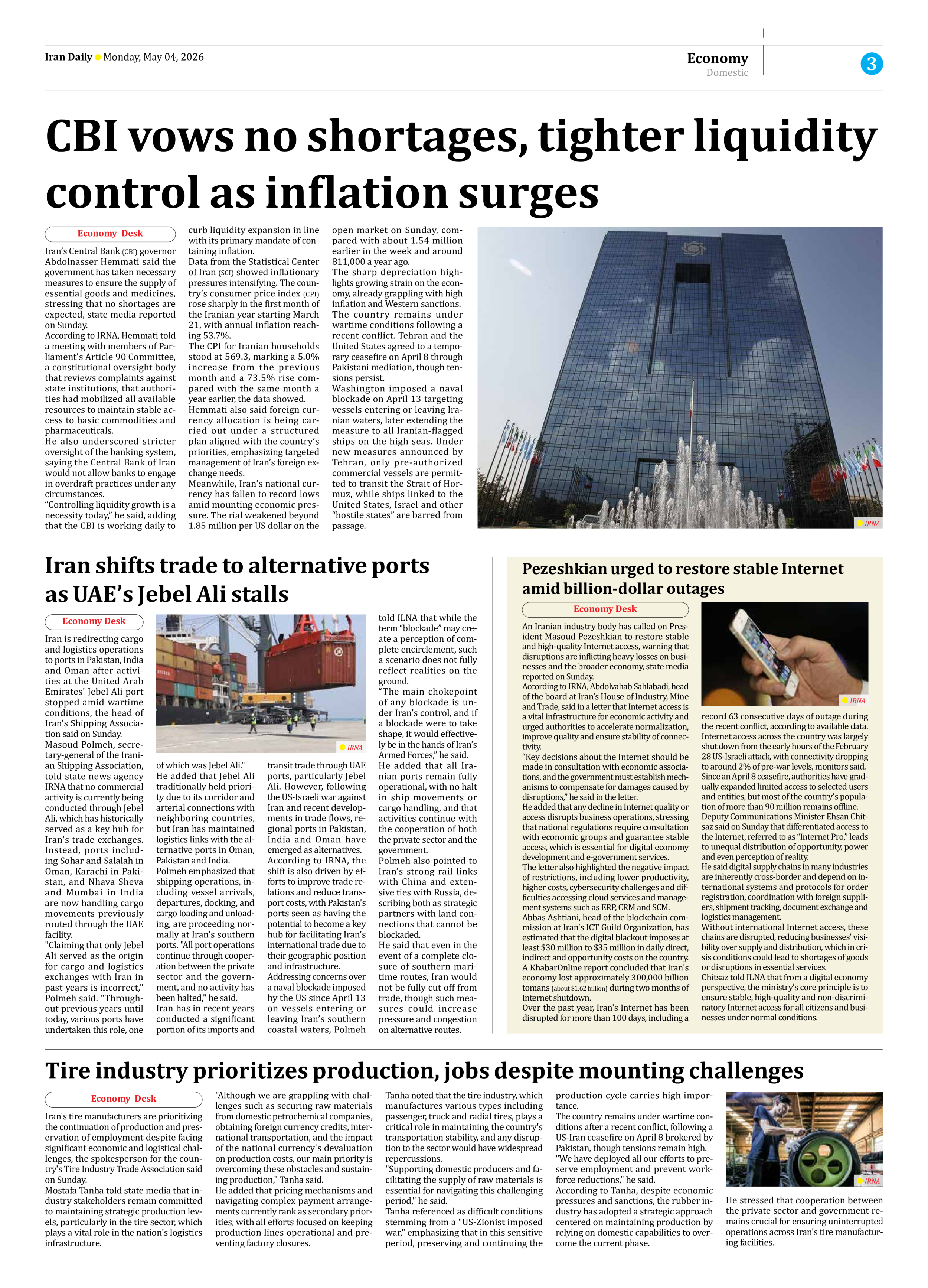


CBI vows no shortages, tighter liquidity control as inflation surges
Iran’s Central Bank (CBI) governor Abdolnasser Hemmati said the government has taken necessary measures to ensure the supply of essential goods and medicines, stressing that no shortages are expected, state media reported on Sunday.
According to IRNA, Hemmati told a meeting with members of Parliament’s Article 90 Committee, a constitutional oversight body that reviews complaints against state institutions, that authorities had mobilized all available resources to maintain stable access to basic commodities and pharmaceuticals.
He also underscored stricter oversight of the banking system, saying the Central Bank of Iran would not allow banks to engage in overdraft practices under any circumstances.
“Controlling liquidity growth is a necessity today,” he said, adding that the CBI is working daily to curb liquidity expansion in line with its primary mandate of containing inflation.
Data from the Statistical Center of Iran (SCI) showed inflationary pressures intensifying. The country’s consumer price index (CPI) rose sharply in the first month of the Iranian year starting March 21, with annual inflation reaching 53.7%.
The CPI for Iranian households stood at 569.3, marking a 5.0% increase from the previous month and a 73.5% rise compared with the same month a year earlier, the data showed.
Hemmati also said foreign currency allocation is being carried out under a structured plan aligned with the country’s priorities, emphasizing targeted management of Iran’s foreign exchange needs.
Meanwhile, Iran’s national currency has fallen to record lows amid mounting economic pressure. The rial weakened beyond 1.85 million per US dollar on the open market on Sunday, compared with about 1.54 million earlier in the week and around 811,000 a year ago.
The sharp depreciation highlights growing strain on the economy, already grappling with high inflation and Western sanctions.
The country remains under wartime conditions following a recent conflict. Tehran and the United States agreed to a temporary ceasefire on April 8 through Pakistani mediation, though tensions persist.
Washington imposed a naval blockade on April 13 targeting vessels entering or leaving Iranian waters, later extending the measure to all Iranian-flagged ships on the high seas. Under new measures announced by Tehran, only pre-authorized commercial vessels are permitted to transit the Strait of Hormuz, while ships linked to the United States, Israel and other “hostile states” are barred from passage.