







Behdeh village emerges as key cultural tourism destination
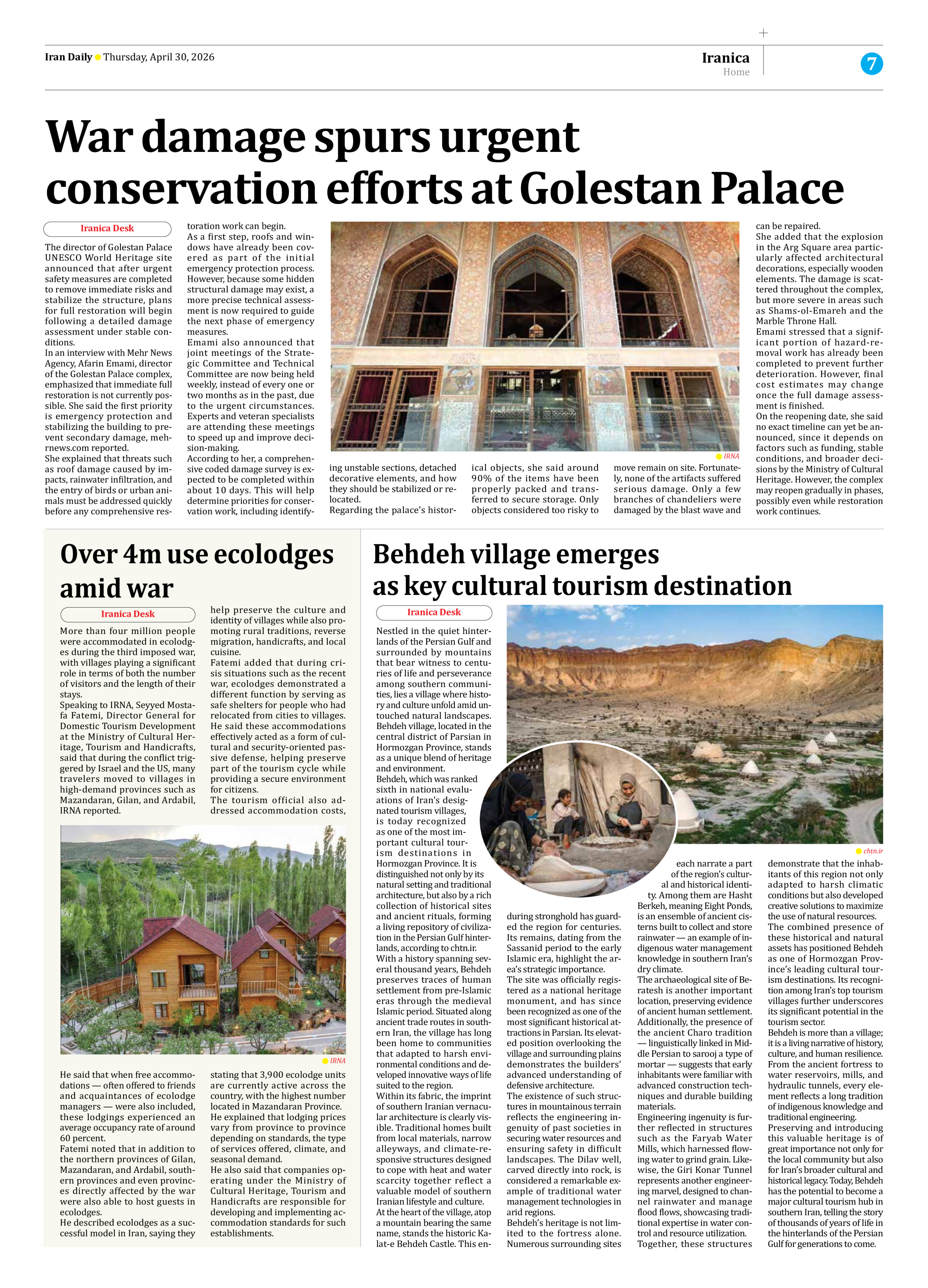
Nestled in the quiet hinterlands of the Persian Gulf and surrounded by mountains that bear witness to centuries of life and perseverance among southern communities, lies a village where history and culture unfold amid untouched natural landscapes. Behdeh village, located in the central district of Parsian in Hormozgan Province, stands as a unique blend of heritage and environment.
Behdeh, which was ranked sixth in national evaluations of Iran’s designated tourism villages, is today recognized as one of the most important cultural tourism destinations in Hormozgan Province. It is distinguished not only by its natural setting and traditional architecture, but also by a rich collection of historical sites and ancient rituals, forming a living repository of civilization in the Persian Gulf hinterlands, according to chtn.ir.
With a history spanning several thousand years, Behdeh preserves traces of human settlement from pre-Islamic eras through the medieval Islamic period. Situated along ancient trade routes in southern Iran, the village has long been home to communities that adapted to harsh environmental conditions and developed innovative ways of life suited to the region.
Within its fabric, the imprint of southern Iranian vernacular architecture is clearly visible. Traditional homes built from local materials, narrow alleyways, and climate-responsive structures designed to cope with heat and water scarcity together reflect a valuable model of southern Iranian lifestyle and culture.
At the heart of the village, atop a mountain bearing the same name, stands the historic Kalat-e Behdeh Castle. This enduring stronghold has guarded the region for centuries. Its remains, dating from the Sassanid period to the early Islamic era, highlight the area’s strategic importance.
The site was officially registered as a national heritage monument, and has since been recognized as one of the most significant historical attractions in Parsian. Its elevated position overlooking the village and surrounding plains demonstrates the builders’ advanced understanding of defensive architecture.
The existence of such structures in mountainous terrain reflects the engineering ingenuity of past societies in securing water resources and ensuring safety in difficult landscapes. The Dilav well, carved directly into rock, is considered a remarkable example of traditional water management technologies in arid regions.
Behdeh’s heritage is not limited to the fortress alone. Numerous surrounding sites each narrate a part of the region’s cultural and historical identity. Among them are Hasht Berkeh, meaning Eight Ponds, is an ensemble of ancient cisterns built to collect and store rainwater — an example of indigenous water management knowledge in southern Iran’s dry climate.
The archaeological site of Beratesh is another important location, preserving evidence of ancient human settlement. Additionally, the presence of the ancient Charo tradition — linguistically linked in Middle Persian to sarooj a type of mortar — suggests that early inhabitants were familiar with advanced construction techniques and durable building materials.
Engineering ingenuity is further reflected in structures such as the Faryab Water Mills, which harnessed flowing water to grind grain. Likewise, the Giri Konar Tunnel represents another engineering marvel, designed to channel rainwater and manage flood flows, showcasing traditional expertise in water control and resource utilization.
Together, these structures demonstrate that the inhabitants of this region not only adapted to harsh climatic conditions but also developed creative solutions to maximize the use of natural resources.
The combined presence of these historical and natural assets has positioned Behdeh as one of Hormozgan Province’s leading cultural tourism destinations. Its recognition among Iran’s top tourism villages further underscores its significant potential in the tourism sector.
Behdeh is more than a village; it is a living narrative of history, culture, and human resilience. From the ancient fortress to water reservoirs, mills, and hydraulic tunnels, every element reflects a long tradition of indigenous knowledge and traditional engineering.
Preserving and introducing this valuable heritage is of great importance not only for the local community but also for Iran’s broader cultural and historical legacy. Today, Behdeh has the potential to become a major cultural tourism hub in southern Iran, telling the story of thousands of years of life in the hinterlands of the Persian Gulf for generations to come.